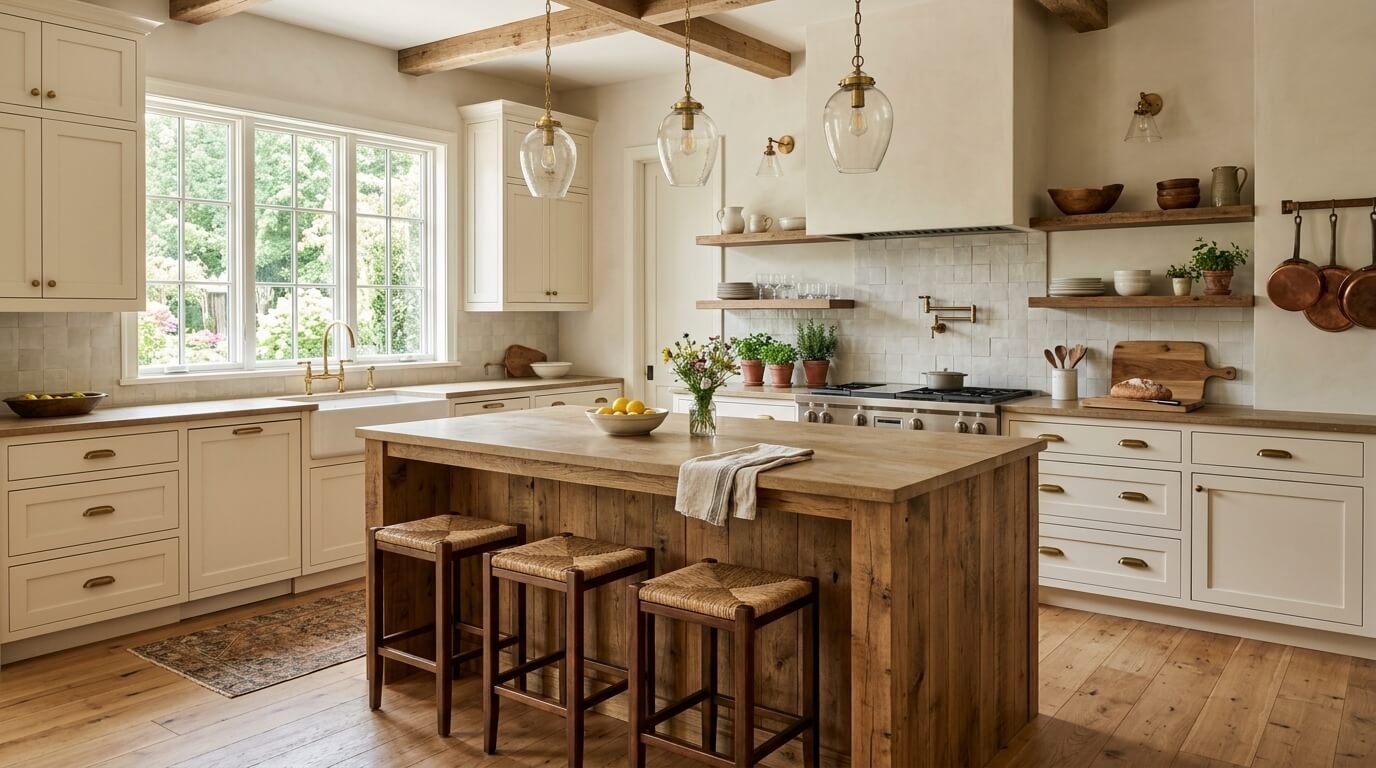

Low ceilings can make kitchen lighting feel like a design puzzle. A large pendant may hang too low, while a single ceiling fixture can leave countertops and work areas in shadow.
The good news is that you don’t need a tall ceiling to create a bright, comfortable kitchen. The best kitchen lighting for low ceilings combines slim fixtures with well-placed task lighting, so you get useful illumination without making the room feel crowded.
From flush-mount ceiling lights and recessed LEDs to under-cabinet lighting and carefully positioned pendants, these seven ideas can help you choose lighting that works with your kitchen’s height and layout.
Key Takeaways
- Flush-mount lights are a practical choice when ceiling height is limited.
- Under-cabinet lighting helps illuminate countertops without taking up ceiling space.
- Recessed and wafer-style LEDs provide a streamlined look where the ceiling construction allows them.
- Track lighting can direct light toward specific kitchen zones.
- A low-profile pendant can still work above an island when there is adequate clearance.
- The most effective plan usually combines ambient, task, and accent lighting rather than relying on one fixture.
What Makes a Good Light for a Low-Ceiling Kitchen?
The right fixture isn’t simply the one with the smallest profile. It should provide enough useful light, fit the room’s proportions, and avoid creating unnecessary visual or physical obstruction.
Before choosing a fixture, consider four things:
Height: How far does the fixture extend below the ceiling?
Coverage: Does it spread light across the room or concentrate it in one spot?
Function: Does the area need general illumination, task lighting, or softer accent light?
Appearance: Does the fixture complement the kitchen without making the ceiling feel visually heavy?
A low-ceiling kitchen often works best when lighting is planned by zone rather than by fixture.
| Kitchen Area | Useful Lighting Choice | Main Benefit |
|---|---|---|
| General kitchen area | Flush-mount or recessed light | Overall illumination |
| Countertops | Under-cabinet LEDs | Reduces work-surface shadows |
| Sink | Recessed or directional light | Focused task lighting |
| Kitchen island | Low-profile pendant or recessed lights | Task and decorative lighting |
| Dark corners | Track or directional lighting | Flexible coverage |
| Open shelving | Small accent lighting | Adds depth and atmosphere |
7 Best Kitchen Lighting Ideas for Low Ceilings
1. Install a Slim Flush-Mount Ceiling Light

A flush-mount fixture is one of the simplest solutions when you want useful ceiling lighting without sacrificing headroom.
Because the fixture sits close to the ceiling, it works especially well in kitchens with low walkways or limited vertical space. A broad diffuser can also distribute light more evenly than a very small directional fixture.
When shopping, look beyond the fixture’s diameter. Check its overall depth, light output, beam or distribution pattern, and compatibility with your electrical setup.
A simple white fixture can visually blend into the ceiling, while a black, brass, or wood-accented design can add a subtle focal point.
Best for: General kitchen illumination, galley kitchens, and low-ceiling areas where hanging fixtures could obstruct movement.
2. Add Under-Cabinet Lighting to Brighten Countertops

Ceiling lights aren’t always the best source for countertop illumination. Wall cabinets can block light from reaching the work surface, creating shadows exactly where you prepare food.
Under-cabinet lighting solves this by placing the light closer to the countertop.
LED light bars and diffused LED strips are popular choices because they can provide relatively even illumination while taking up very little space.
For the cleanest result, position the light toward the front working portion of the cabinet rather than hiding it so far toward the backsplash that most of the illumination falls behind the work area.
Under-cabinet lighting is particularly useful above:
- Food-preparation counters
- Sinks
- Coffee stations
- Small-appliance areas
- Dark sections of countertop
Best for: Task lighting where ceiling fixtures leave countertop shadows.
3. Consider Recessed or Wafer-Style LED Lights
If you want the ceiling to look clean and uncluttered, recessed lighting can be a strong option.
Traditional recessed fixtures require suitable ceiling space, while slim wafer-style LED fixtures can offer a lower-profile alternative for some installations. However, the correct fixture depends on the ceiling construction, insulation, electrical requirements, and manufacturer’s installation instructions.
Placement matters as much as the fixture itself.
Instead of putting every light directly in the middle of the kitchen, think about the areas that need illumination:
- Countertops
- Sink
- Cooking area
- Main walkway
- Island
- Dark corners
Poorly positioned recessed lights can still create shadows, particularly when cabinets or people block the light.
Best for: Homeowners who want a streamlined ceiling and evenly distributed general lighting.
4. Use Track Lighting When You Need Directional Flexibility
Track lighting can be useful when one part of the kitchen needs more light than another.
Adjustable heads allow you to aim light toward a countertop, sink, shelving, artwork, or another area that a fixed ceiling light might miss.
This can be especially helpful in kitchens with:
- Unusual layouts
- Long worktops
- Dark corners
- Limited options for recessed installation
- Multiple work zones
Choose a slim track and relatively compact heads if the kitchen already has a lot of visual detail. The purpose is to improve light distribution, not make the ceiling look busy.
Best for: Kitchens where lighting needs to be directed toward several different areas.
5. Try a Low-Profile Pendant Above the Kitchen Island
A low ceiling doesn’t automatically rule out pendant lighting.
The key is location and clearance.
A pendant over a fixed island can be easier to accommodate than one hanging above a busy walkway because the island provides a defined area underneath it. However, you still need to check the available height and the manufacturer’s installation guidance before deciding on the fixture.
Look for a pendant with:
- A compact or shallow shade
- Appropriate hanging height
- A visually lightweight design
- Suitable light distribution
- Adjustable hardware where useful
If the ceiling is particularly low, a semi-flush fixture or recessed lighting above the island may be more practical.
Best for: Islands and breakfast bars where a decorative focal point is desirable and adequate clearance is available.
6. Add Wall Lighting to Take Pressure Off the Ceiling
Your ceiling doesn’t have to provide every layer of kitchen lighting.
Wall-mounted fixtures can provide useful illumination around suitable areas such as open shelving, dining zones, or selected walls.
A compact wall sconce can also add visual interest without taking up ceiling space.
However, kitchen wall lighting needs to be chosen with its location in mind. Fixtures installed near sinks or other wet areas must meet applicable requirements and manufacturer specifications.
Best for: Adding another lighting layer or highlighting suitable vertical surfaces.
7. Layer Ambient and Task Lighting With Dimmers

If there’s one idea that can make the biggest difference, it’s this: don’t expect one fixture to do every job.
A well-lit kitchen typically benefits from several lighting layers.
Ambient lighting provides general illumination throughout the room.
Task lighting focuses on areas where you chop, cook, wash dishes, or perform other detailed work.
Accent lighting can highlight shelves, cabinetry, architectural details, or decorative areas.
For example, a low-ceiling kitchen might combine:
- A slim flush-mount fixture for ambient lighting
- Under-cabinet LEDs for countertop tasks
- Recessed or directional lighting over an island
- A small accent light for shelving
- Dimmers for adjusting the atmosphere
This approach is often more effective than installing one extremely bright ceiling fixture.
How to Choose the Best Kitchen Lighting for Low Ceilings
Once you know which lighting types can work, narrow your options using the specifications that actually affect performance.
Measure the Ceiling and Fixture Depth
Start with the actual ceiling height.
Then check the fixture’s dimensions, especially its depth or overall drop. A fixture that looks compact in a photograph may project farther into the room than expected.
For areas where people walk underneath the fixture, clearance should take priority over decorative appeal.
Look at Lumens Instead of Wattage Alone
When comparing LED fixtures, don’t judge brightness by wattage alone.
Lumens describe the amount of visible light produced, while wattage describes electrical power consumption. Two LED fixtures with similar wattage can produce different amounts of light.
The right amount of illumination depends on factors such as kitchen size, natural daylight, surface colors, fixture distribution, and the type of work performed in the space.
Instead of choosing the brightest fixture you can find, aim for well-distributed light.
Choose a Suitable Color Temperature
Color temperature affects how warm or cool the kitchen looks.
Warm white lighting around 2700K–3000K can create a comfortable, cozy appearance. Around 3500K produces a more neutral feel.
There isn’t one perfect color temperature for every kitchen. Cabinet color, countertop material, flooring, natural daylight, and personal preference all matter.
The important thing is to avoid an obvious mismatch between different lighting layers. A warm ceiling fixture paired with very cool under-cabinet lighting can make the room look inconsistent.
Check the CRI
CRI stands for Color Rendering Index and describes how accurately a light source renders colors compared with a reference light source.
This can matter in a kitchen because food, cabinetry, paint, countertops, and finishes should look natural under the lighting.
When comparing LED products, check the manufacturer’s stated CRI rather than assuming every LED produces the same color quality.
Consider Glare and Shadows
A fixture can be bright without being comfortable.
Exposed bulbs or poorly diffused LEDs can create glare, while badly positioned ceiling lights can leave strong shadows across countertops.
Look for diffusers or fixtures designed to distribute light comfortably, and use task lighting to illuminate work surfaces from a more useful angle.
Choose Dimmable Fixtures Where Practical
Dimming can make a kitchen more flexible.
You may want stronger illumination while cooking and softer light during breakfast, entertaining, or evening use.
Make sure the fixture, LED lamp or integrated LED system, and dimmer are compatible. Not every LED product works properly with every dimmer.
How to Layer Lighting in a Low-Ceiling Kitchen
A simple way to plan your lighting is to work from general to specific.
Step 1: Establish General Illumination
Start with the main areas of the kitchen that need comfortable overall visibility.
Depending on the ceiling and layout, this could be a flush mount, semi-flush fixture, recessed lights, wafer LEDs, or track lighting.
Step 2: Light the Work Surfaces
Next, identify areas where detailed tasks take place.
Countertops underneath cabinets are often the priority. Under-cabinet lighting can add illumination without making the ceiling more crowded.
Step 3: Address Dark Areas
Look for corners, shelving, or sections of the kitchen that remain dim after the main lighting is installed.
Directional track heads, carefully placed recessed fixtures, or suitable accent lighting can help.
Step 4: Add Decorative Lighting Carefully
If you want a pendant, wall light, or other decorative fixture, choose it after the functional lighting is planned.
This prevents appearance from taking priority over usability.
Step 5: Add Dimming Where It Makes Sense
Dimming lets you adjust the overall atmosphere without changing fixtures.
It is particularly useful when the kitchen also serves as a dining or social space.
Common Low-Ceiling Kitchen Lighting Mistakes

Relying on One Central Ceiling Light
A single fixture can leave countertops and corners darker than expected.
Better approach: Combine general lighting with task lighting.
Choosing a Fixture Only Because It Is Small
A tiny fixture isn’t automatically a good fixture.
Better approach: Check light output, distribution, dimensions, and the area it is expected to illuminate.
Ignoring Countertop Shadows
Upper cabinets can prevent overhead light from reaching the work surface effectively.
Better approach: Add appropriately positioned under-cabinet lighting.
Hanging a Pendant Over a Walkway
A beautiful pendant can become a nuisance if people regularly walk underneath it.
Better approach: Reserve hanging fixtures for locations where the available clearance and layout make sense.
Mixing Very Different Light Colors
Noticeably different color temperatures can make the kitchen feel visually disjointed.
Better approach: Compare the CCT of your ceiling, under-cabinet, and accent lighting before buying.
Making Everything Extremely Bright
More light isn’t automatically better. Excessive brightness or glare can make a kitchen uncomfortable.
Better approach: Focus on useful light distribution and use dimming where appropriate.
Installing Lights Without Considering the Ceiling Structure
Recessed and hardwired lighting isn’t simply a matter of cutting a hole and connecting a fixture.
Better approach: Follow the manufacturer’s installation requirements and applicable local electrical requirements. Use a qualified electrician when professional installation is needed.
FAQs About Kitchen Lighting for Low Ceilings
What is the best kitchen lighting for low ceilings?
A combination of low-profile ambient lighting and task lighting is usually the most practical solution. Flush-mount or suitable recessed fixtures can provide general illumination, while under-cabinet lights can brighten countertops.
Are pendant lights good for low ceilings?
They can be, particularly above a kitchen island where the fixture’s position and clearance can be controlled. For very low ceilings or busy walkways, a flush, semi-flush, or recessed option may be more practical.
Are recessed lights suitable for low ceilings?
Yes, recessed lighting can provide a clean appearance because the fixture does not hang into the room. However, suitability depends on the ceiling construction and the specific fixture’s installation requirements.
What color temperature is best for kitchen lighting?
Warm white around 2700K–3000K creates a warmer atmosphere, while around 3500K has a more neutral appearance. Choose according to your kitchen’s finishes and desired mood, while keeping different lighting layers reasonably consistent.
How can I make a low-ceiling kitchen look brighter?
Use several appropriately placed light sources instead of depending on one central fixture. Under-cabinet lighting, well-distributed ceiling lights, and strategically directed fixtures can help reduce dark areas and countertop shadows.
Should a low-ceiling kitchen have a chandelier?
A large chandelier can be difficult to use comfortably in a low-ceiling kitchen because of its depth and visual weight. If you want a decorative focal point, consider a shallow semi-flush fixture or a carefully scaled island light instead.
Final Thoughts
The best kitchen lighting for low ceilings isn’t necessarily the smallest fixture or the brightest bulb. It is a lighting plan that provides useful illumination while respecting the room’s limited vertical space.
Start with the kitchen’s layout and ceiling height. Use a flush-mount, recessed, wafer, or track fixture for general lighting where appropriate, then add task lighting where countertops need more visibility. If you have an island, a carefully scaled pendant can provide a decorative focal point when clearance allows.
Most importantly, think in layers and zones. When every light has a purpose, a low ceiling becomes much less of a limitation—and your kitchen can feel brighter, more comfortable, and better designed.
Related resource: Kitchen Cabinet Refinishing: 9 Proven Tips for Success