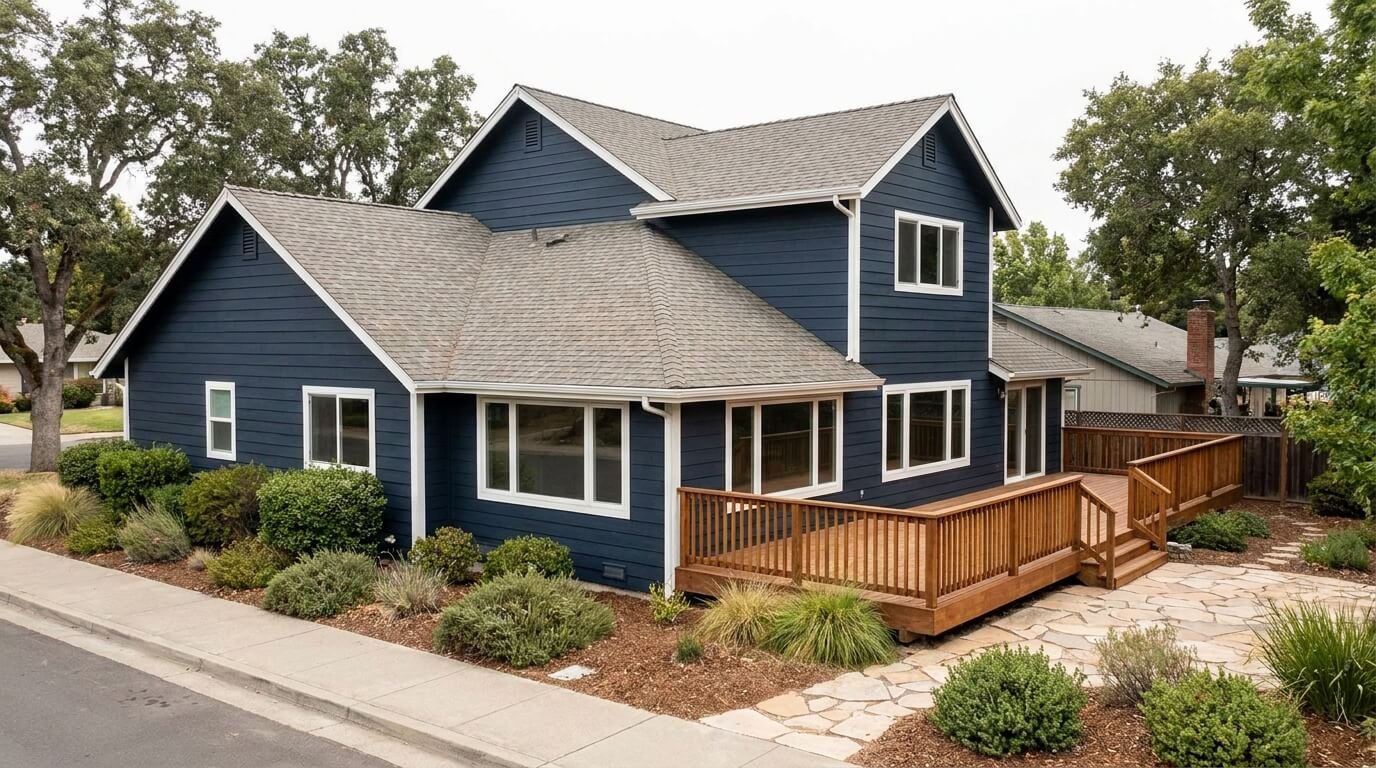
A dark blue house with deck looks especially good when the deck provides contrast instead of trying to match the siding. Natural wood, warm brown, or a restrained gray deck can all work; the right choice depends on your trim, roof, railing, and the style of the house.
The combination is attractive, but there’s a practical side to it too. If you’re painting existing vinyl siding dark blue, the coating needs to be suitable for that material because darker paint can increase heat absorption and contribute to warping or buckling.
So before choosing a navy paint color from a photo, look at the whole exterior palette.
Start With the Blue, Not the Deck
“Dark blue” covers a surprisingly wide range.
Some navy colors are almost black. Others have gray undertones. Some lean slightly green, while others look cooler and more muted.
That difference matters because your deck will sit directly beside the siding.
For example, Sherwin-Williams describes Naval SW 6244 as a deep blue with a cool gray-green undertone, while Benjamin Moore’s Hale Navy HC-154 has an LRV of 8.36. Sherwin-Williams lists Naval at an LRV of 4.458, making it substantially darker.
You don’t need to become an LRV expert to choose a blue. Just understand the basic idea: a lower LRV means the color reflects less light and appears darker.
Before buying gallons of paint, test a physical sample on the house or on a large movable board. Sherwin-Williams and Benjamin Moore both caution that screen representations aren’t a substitute for seeing the actual color.
Look at the fixed colors first
Your roof, brick, stone, windows, and existing masonry aren’t going anywhere just because you found a navy you like.
If the house has warm red brick or a cedar feature, a blue with some warmth can sit more comfortably beside it. If the exterior already has gray stone, black windows, or cool-toned materials, a gray-blue may be easier to coordinate.
This is where many exterior makeovers go wrong. The blue looks great by itself. Then it gets placed next to a roof or stone color that was never considered.
1. Dark Blue House With a Natural Wood Deck
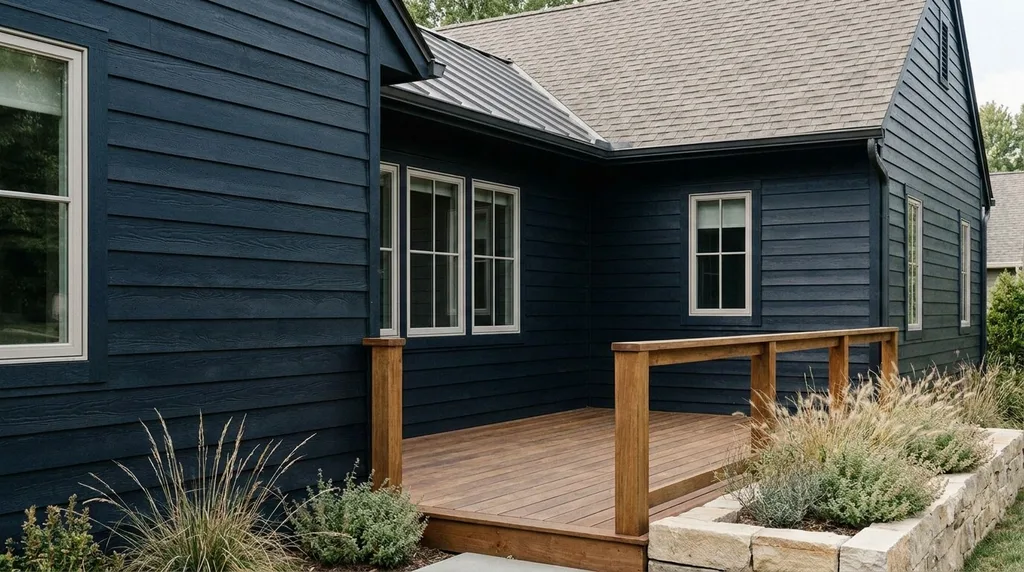
This is the combination I’d put at the top of the list.
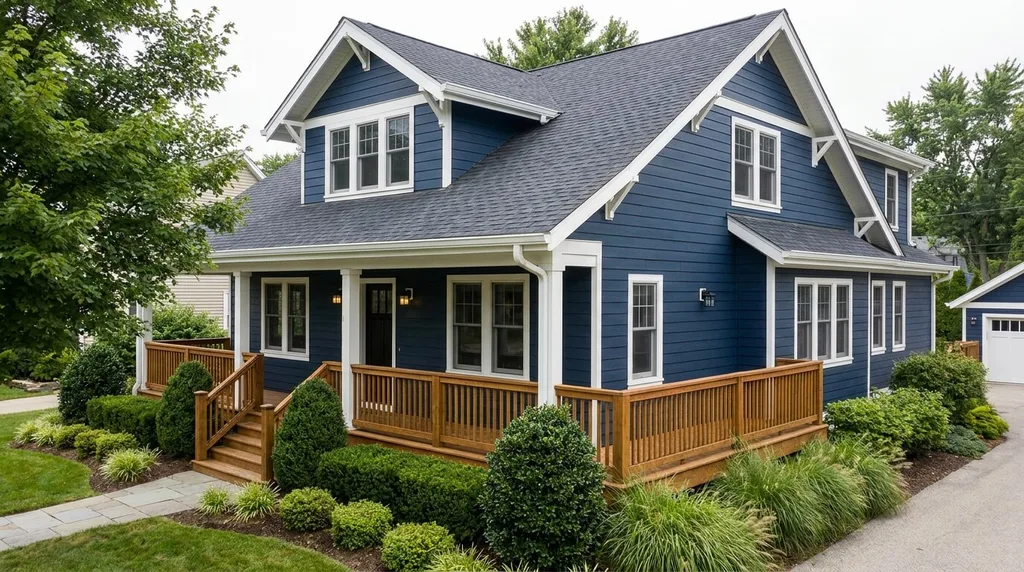
A dark blue house with natural wood deck boards gets contrast from the siding and warmth from the wood. You don’t need another dramatic exterior color to make it interesting.
Cedar-colored, medium-brown, or other natural-looking wood tones can work particularly well with deep blue siding.
The deck also gives you a place to repeat the warm tone. A wood front door, outdoor furniture, planters, or a porch ceiling can connect the two sides of the house without making everything match.
That’s the key: repeat the warmth, don’t duplicate every finish.
2. Navy Blue House With White Trim
If you’re after a classic navy house exterior, white trim is the easiest place to start.
White around windows, doors, fascia, and other architectural details creates strong contrast against the siding. It also helps traditional homes, Craftsman-style houses, cottages, and similar designs retain their architectural definition.
Add a natural wood deck and the palette becomes:
navy + white + natural wood.
That’s a very forgiving combination.
If bright white feels too stark against your particular shade of blue, test a softer white or warm off-white instead. Judge the right trim beside the siding, not from a separate paint card.
3. Dark Blue House With Black Trim
Black trim takes the same dark blue exterior in a more modern direction.
It works particularly well when the house already has simple architectural lines, black-framed windows, modern exterior lights, or a contemporary railing.
But there’s a limit.
If the house has elaborate trim, decorative brackets, or lots of small architectural details, black can visually swallow those elements instead of highlighting them.
That’s why I wouldn’t choose dark blue house black trim simply because the combination is popular in photos. Look at the architecture first.
A natural wood deck is a strong partner here because it introduces warmth between the blue and black.
4. Dark Blue Siding With a Gray Deck
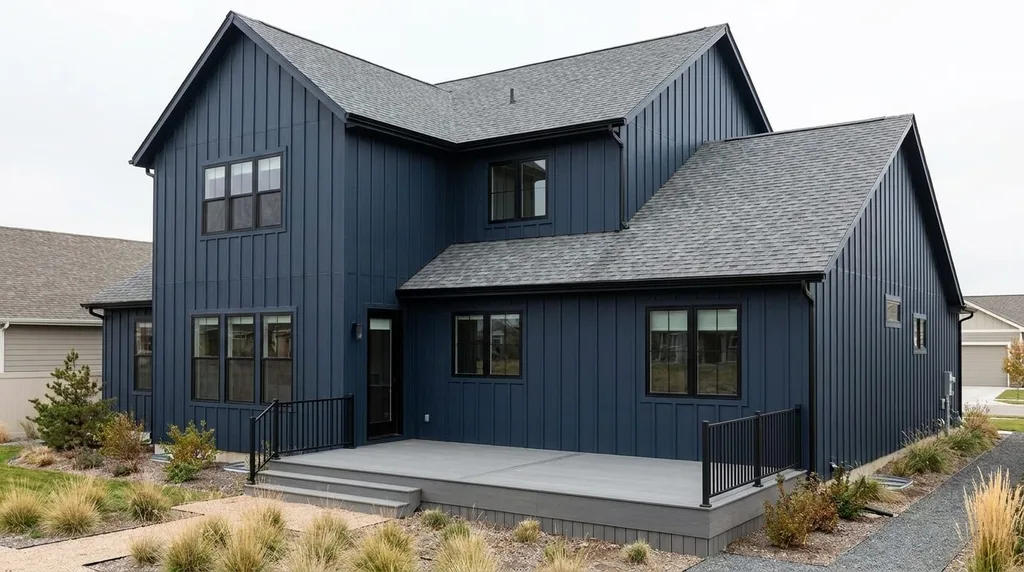
Want something more contemporary than natural wood?
Try gray.
A medium or darker gray deck can work with dark blue siding when the house already contains other cool neutrals. Think gray roof, concrete, stone, black windows, or simple modern landscaping.
The important part is contrast.
If the siding and deck are nearly identical in darkness, the two surfaces can visually merge. A slightly lighter or warmer gray can separate the deck from the house without introducing another strong color.
For a modern dark blue exterior house, this is one of the cleaner combinations.
5. Dark Blue House With a Warm Brown Deck
A warm brown deck works well when you want the look of wood without pushing the palette toward a very orange or rustic feel.
Mocha, medium brown, and muted brown stains can all work with navy siding.
I’d keep the railing simple. Black railing gives the combination a sharper contemporary appearance, while white railing connects more naturally with white house trim.
The deck doesn’t need to be the most noticeable feature of the backyard. It needs to look like it belongs there.
6. Dark Blue House With White Railing
If your deck is natural wood and your house has white trim, a white railing can tie everything together.
The siding stays dark blue.
The deck supplies warmth.
The white railing repeats the trim.
That gives the eye a consistent connection between the house and outdoor living area.
For a more contemporary version, switch the railing to black while keeping the deck boards natural. You get the same basic palette with a stronger contrast.
7. Dark Blue House With a Wood Door
The deck doesn’t have to carry all the warmth.
A natural wood front door can give a dark blue house exterior another warm focal point. If you already have a wood deck at the back, repeating a related wood tone at the front can make the exterior feel more coordinated.
Don’t worry about making every wood surface identical.
Outdoor wood changes with age and exposure, and different species have different natural colors. The goal is visual harmony, not a perfect match.
White Trim or Black Trim?
Still stuck?
Use the architecture as your shortcut.
Choose white trim when:
- You want a traditional appearance.
- The house has substantial window or door trim.
- You want the architecture to stand out.
- You already have a light-colored roof or other light exterior elements.
Choose black trim when:
- The house has simple, clean lines.
- You want a more contemporary appearance.
- You already have black windows or exterior lighting.
- You plan to keep the rest of the palette restrained.
There is a third option that deserves more attention: wood accents.
Natural wood around a porch, door, or gable can bridge dark blue siding and a wood deck without adding another painted color.
What Deck Material Makes Sense?
Color is only half the deck decision. The material determines how much maintenance you’re signing up for.
Pressure-treated wood
Pressure-treated lumber remains a common choice for wood decks and is typically treated to improve resistance to decay and insects. Lowe’s recommends allowing new treated lumber to dry before applying an exterior stain-and-sealer product and recommends ongoing cleaning and refinishing according to the product’s requirements.
Its biggest advantage is straightforward: you get the familiar look and feel of a wood deck without moving into premium decking materials.
The trade-off is maintenance.
Cedar and redwood
Cedar and redwood offer natural wood color and natural resistance to decay and insects. They still need cleaning and appropriate maintenance if you want to preserve their appearance.
For a dark blue house with a wood deck, this is the look I’d choose when the natural character of real wood is part of the appeal.
Letting the wood weather is also an option if you like a silver-gray appearance.
Composite decking
Composite is the better fit if your priority is reducing routine deck maintenance.
Trex, for example, says its current high-performance composite decking does not need painting or staining and requires substantially less maintenance than wood; routine cleaning is still required.
That doesn’t mean composite is maintenance-free. It means the maintenance is different and generally less intensive than refinishing a wood deck.
Don’t Ignore the Siding Material
This is the practical checkpoint that should come before you choose the darkest blue in the paint store.
If the house has vinyl siding, check the siding manufacturer’s instructions and the paint manufacturer’s approved colors.
Sherwin-Williams explains that darker paint on vinyl can absorb more solar heat and cause the siding to expand enough to warp or buckle. Its VinylSafe system includes a selection of darker colors formulated for use on sound, stable vinyl siding.
Benjamin Moore’s technical guidance similarly says not to paint vinyl siding darker than its original color or below its stated LRV threshold unless the color is from its approved vinyl palette and the siding manufacturer’s guidelines are followed.
So if you’re turning a light vinyl exterior into a dark blue house with deck, don’t treat the paint color as a purely decorative decision.
Check the substrate first.
Does Dark Blue Fade Faster?
Dark exterior colors deserve more attention to sun exposure and product selection, but I’d avoid promising homeowners a specific repaint schedule.
The finish, coating, substrate, climate, exposure, and maintenance all matter.
What is clear is that dark paint creates a particular concern on vinyl siding because of heat absorption. That’s why approved coatings and manufacturer guidance matter when changing an existing vinyl exterior to a much darker color.
For any exterior, inspect the walls that receive the strongest sun rather than assuming every side of the house will age at the same rate.
And don’t use fading as the only reason to reject a color you love.
How to Make the Deck and House Look Like One Design
Here’s the simple method I’d use before making the final purchase.
First, choose the blue.
Test it outdoors against the actual house materials.
Second, place your deck sample beside it.
Don’t compare a paint chip with a deck photo. Get an actual decking sample if possible.
Third, choose the trim.
White creates contrast. Black creates a stronger modern look. Wood adds warmth.
Fourth, decide on the railing.
Use the railing to repeat an existing exterior finish rather than introducing a completely unrelated color.
Finally, step back.
Look at the roof, windows, door, siding, deck, railing, stone, and landscaping together.
If you see too many competing colors, remove one.
Mistakes to Avoid
Matching the deck exactly to the blue siding
The house and deck don’t need to match. In fact, contrast is usually more useful here.
A natural wood or warm brown deck gives dark siding some visual warmth.
Choosing trim before checking the architecture
Black trim isn’t automatically modern-looking, and white trim isn’t automatically traditional. The home’s shape, windows, roof, and existing materials all affect the result.
Picking the blue from a screen
Manufacturers themselves warn that on-screen color representations can differ from actual paint. Use a physical sample before making a large purchase.
Forgetting the railing
A deck isn’t just its boards. The railing occupies a large visual area and can either connect the deck to the house or make the two look unrelated.
Ignoring maintenance
A beautiful natural wood deck requires a different maintenance commitment from composite decking. Choose the material based on how you actually want to spend your time maintaining the outdoor space.
FAQ
What color deck goes best with a dark blue house?
Natural wood, warm brown, and medium wood-look tones are strong choices because they contrast with dark blue siding. Gray or charcoal decking can work particularly well on modern homes.
Is a dark blue house with white trim a good combination?
Yes. White trim provides strong contrast and clearly defines windows, doors, and other architectural details. It is one of the easiest combinations to work with if you want a classic exterior.
Does black trim work with dark blue siding?
Yes, especially on homes with simple architectural lines and other black details such as windows or exterior lighting. On heavily ornamented homes, black trim can make small details disappear visually.
What wood looks good with a navy house exterior?
Cedar, redwood, and other warm natural wood tones can complement navy siding. A medium-brown stain is another practical option if you want more control over the final color.
Can I paint vinyl siding dark blue?
You can use dark colors on vinyl siding only when the coating and color are appropriate for the siding. Sherwin-Williams offers VinylSafe colors specifically formulated for darker applications on sound, stable vinyl siding, while Benjamin Moore also provides specific guidance for approved vinyl colors. Always follow the siding and coating manufacturer’s instructions.
The Best Starting Point
If you want the safest design direction, start with dark blue siding, natural or warm-brown decking, and white trim.
For a modern house, test the same blue with black trim and a natural wood or gray deck.
Then make the decision from physical samples, not a Pinterest photo and not a tiny paint chip.
The combination that looks best on your house will be the one that works with its actual roof, windows, siding material, deck exposure, and existing colors.
Related resources: How to Get Rid of Mold in Bathroom Spaces (And Keep It From Coming Back) ·