A home bar cabinet is any freestanding or built-in piece that stores bottles, glassware, and mixing tools in one spot from a narrow armoire to a wide credenza with a wine fridge built in. Pick one based on your space, whether you want appliances inside, and how much you plan to entertain. Here’s how to choose, and where most guides leave out the parts that actually matter.
Most “home bar cabinet ideas” articles are photo dumps. Scroll through the usual suspects and you’ll get seventy gorgeous Houzz shots, a Pinterest board, and a “top 10” listicle that tells you to “add lighting” and “choose a theme.” Nobody tells you that a freestanding wine cooler shoved into a closed cabinet will overheat and die early, or that the wrong depth means your cabinet doors won’t clear a nearby wall. That’s the gap. This article covers style, sure but it also covers the measurements and appliance rules that keep your bar cabinet from becoming an expensive mistake.
1. A Freestanding Cabinet if You Rent or Might Move
Start here if you’re not ready to commit to a built-in. A freestanding home bar cabinet armoire-style, credenza-style, whatever finish you like — needs zero construction and comes with you when you move.
Footprint is the trade-off. Before you buy a freestanding bar cabinet online, measure your available space and check the cabinet’s actual depth. Measure the entire way into the room before making a purchase, not just the location where the cabinet will sit. Doorways, narrow corridors, stair turns, and nearby furniture can make a cabinet that looks ideal online surprisingly difficult to get into place.
Renters especially like this route because it solves the “I want a home bar but I can’t touch the walls” problem. Buy it, style it, take it with you when the lease ends.
2. Wall-Mounted or Floating Cabinets for Small Spaces
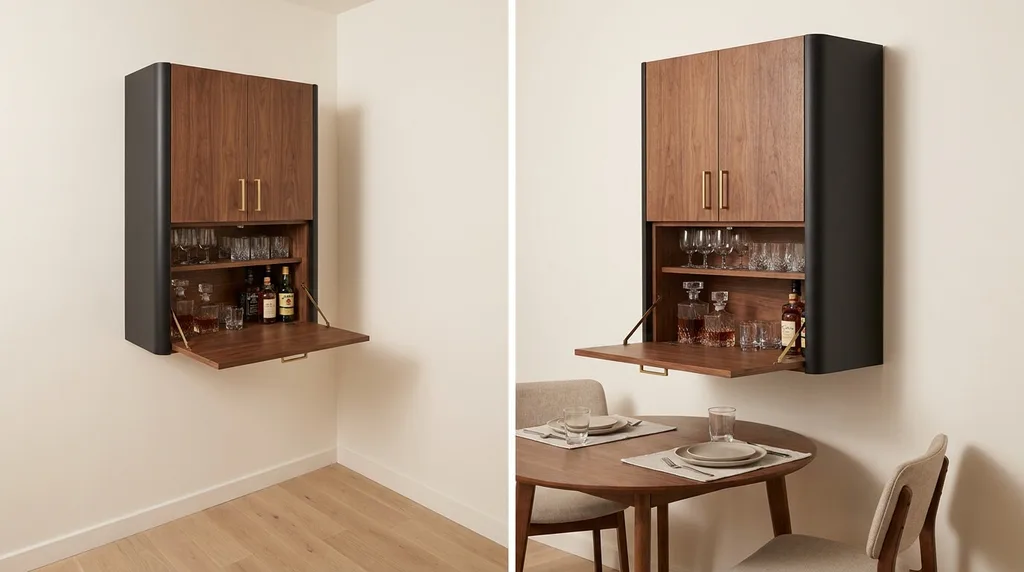
If floor space is the enemy, get the cabinet off the floor. A wall-mounted home bar cabinet for small spaces keeps the room feeling open and works especially well in apartments, dining nooks, or that awkward gap between a doorway and a window.
Look for a unit with a fold-down or pull-out shelf that acts as a mini countertop when you’re mixing a drink, then folds flat the rest of the time. Depth matters here more than anywhere else. The deeper the cabinet, the more it projects into the room, so compare its actual depth with the walkway and furniture around it before mounting it.
One thing people skip: check your wall material before mounting. Plaster and older drywall don’t always hold a loaded cabinet on standard anchors. Find the studs, or use toggle bolts rated for the combined weight of the cabinet plus bottles and glassware — that adds up faster than people expect. A dozen bottles alone can run 30-plus pounds.
3. A Glass-Front Cabinet That Shows Off the Collection
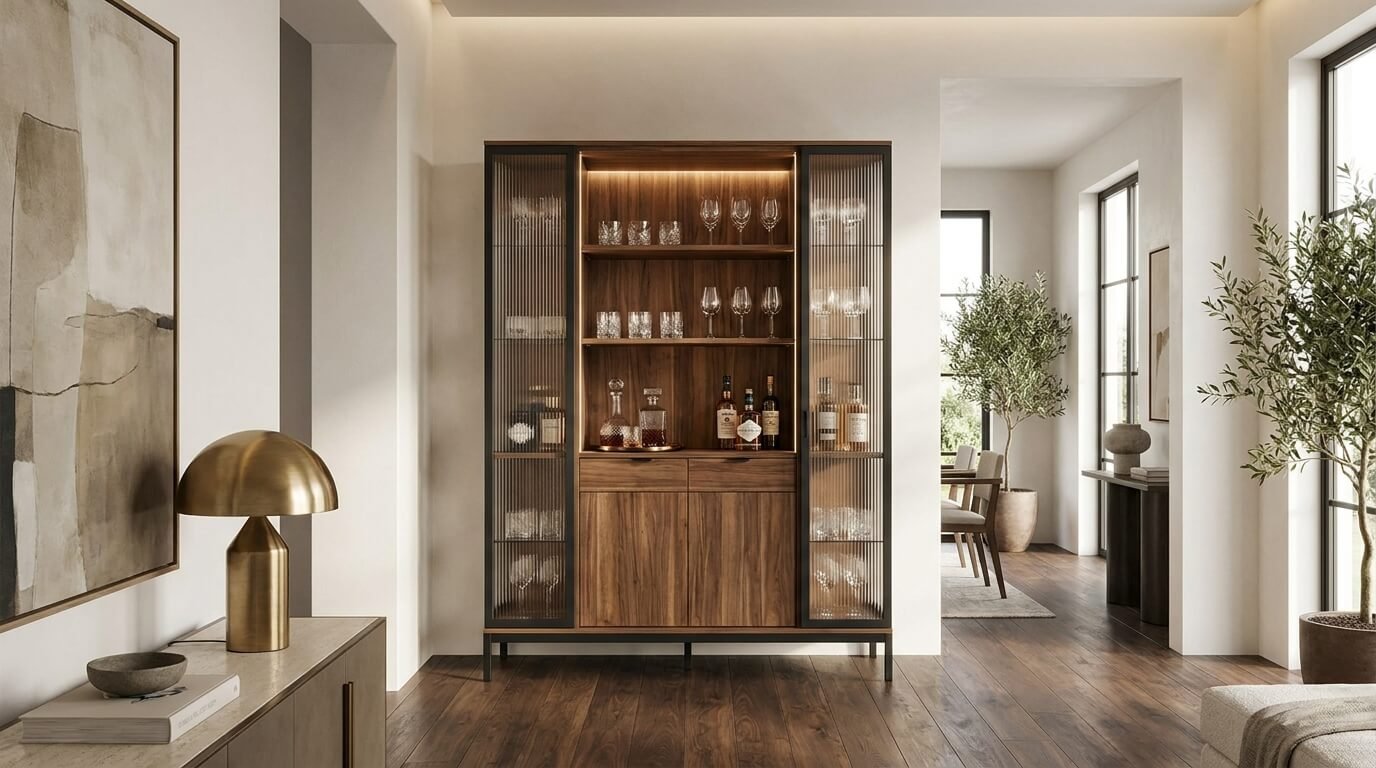
Glass doors turn a bar cabinet into a display case, and that’s the whole appeal — you’re not hiding the bottles, you’re framing them. A home bar cabinet with glass doors works especially well for anyone with a decent spirits or wine collection they actually want to look at, not just store.
Interior lighting is what separates a good glass-front cabinet from a great one. LED strip lighting along the interior top edge, on the cheaper end, or puck lights for a more finished look. Either way, put it on a separate switch or a simple plug-in dimmer so you can turn the bar into ambient lighting at parties without lighting the whole room.
Fingerprints and glare are the two real complaints owners have with glass-front cabinets. Frosted or reeded glass hides both and still reads as glass-front from across the room — worth considering if you’ve got kids, or if direct sunlight hits the cabinet in the afternoon.
4. A Cabinet With a Wine Fridge — Read This Before You Buy
Here’s the section every other list gets wrong, or skips entirely.
A home bar cabinet with fridge sounds simple: buy a cabinet, buy a wine fridge, put the fridge in the cabinet. Except wine coolers come in two types that aren’t interchangeable, and these types are designed for different installation conditions; treating them as interchangeable can create ventilation problems.
Freestanding wine coolers vent from the sides or back and need open air around them. Freestanding wine coolers require ventilation around the unit, but the exact clearance varies by model. Check the manufacturer’s installation instructions before designing the cabinet around one. Seal one of these into a closed cabinet, and the compressor can’t dump heat, so it runs constantly, struggles to hold temperature, and can fail well before it should.
Built-in wine coolers are the ones designed for cabinetry. They vent from the front, through a grille near the bottom of the unit, which is why they can sit flush inside enclosed cabinetry without a ventilation gap on the sides. If you want a wine fridge sealed into a cabinet, this is the only type built for the job — and even then, check the spec sheet, because some built-in units still want a small clearance behind or above the unit.
The fix is simple once you know it: if your cabinet doesn’t have an open back or a vented toe-kick, buy a unit explicitly labeled “built-in” or “under-counter,” not “freestanding.” It’s a quick check on the product page that can prevent you from installing the wrong type of cooler in an enclosed cabinet.
Beyond the fridge itself, a home bar cabinet with wine storage should account for bottle weight. A wine rack holding a full collection puts substantial weight on the shelf or rack, so check its load rating rather than assuming that a rack that fits the bottles will safely support them. Make sure the shelf or rack is rated for it, not just sized for it.
5. A Cabinet With Drawers for the Stuff That Isn’t Bottles
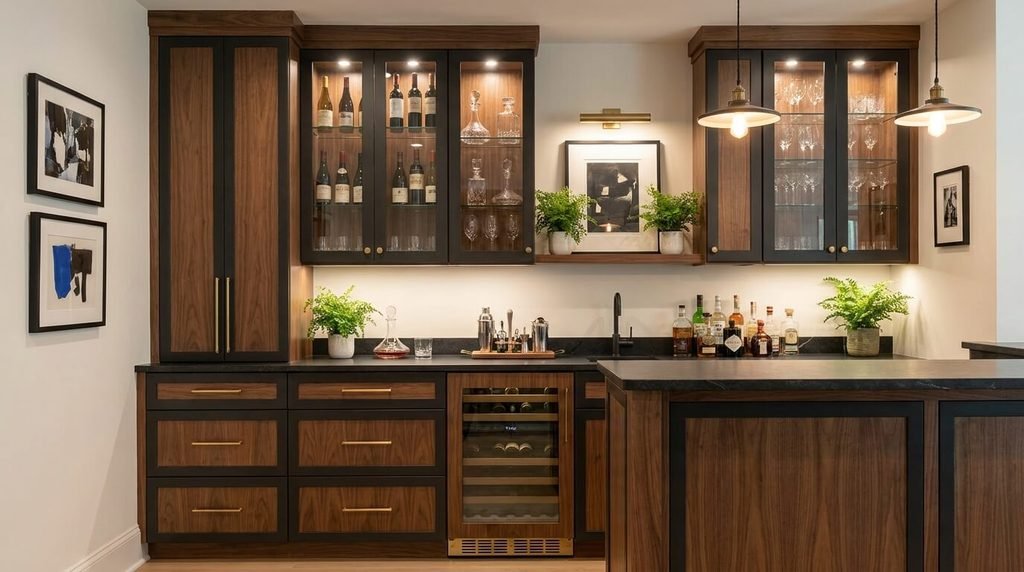
Open shelving looks great in photos and is useless for the actual clutter of running a bar — bottle openers, cocktail napkins, spare corks, that one jigger you can never find. A home bar storage cabinet with drawers solves this in a way glass shelving never will.
Two drawers is usually enough: one shallow, lined, for tools and small items; one deeper for linens or backup mixers. If you’re buying rather than building, look specifically for felt-lined or divided drawer inserts — a lot of cabinets ship with a bare drawer box and nothing to keep bar spoons from sliding around every time you open it.
This is also where a lot of the “modern home bar cabinet” designs earn their keep. Push-to-open drawer mechanisms skip the hardware entirely, which keeps the front clean and avoids snagging on sleeves during a party.
6. A Corner Cabinet for the Space Nobody Else Wants
Every house has one — a dead corner too small for furniture and too awkward to decorate. That’s exactly where a corner home bar cabinet earns its keep.
Corner units run narrower up front and deeper along the wall, which means less usable countertop but a real footprint reduction compared to a standard rectangular cabinet. They work best for smaller collections: a dozen bottles, a handful of glasses, maybe a small fridge if the model has room. Don’t expect to fit a full entertaining setup in one — that’s not what they’re for.
If you’re building rather than buying, a corner cabinet is also one of the more forgiving DIY projects, since the angled front hides minor measurement errors better than a straight run would.
7. A Statement Piece as the Room’s Focal Point
Sometimes the goal isn’t storage efficiency — it’s the piece itself. A bold freestanding home bar cabinet in a saturated color, mixed metals, or an unusual silhouette can anchor an entire room the way a piece of furniture rarely gets to.
This is where you can afford to prioritize looks over specs a little. Mirrored backs, brass hardware, a marble or stone top — these read as intentional, not fussy, when the cabinet is doing double duty as decor.
The one rule that still applies: measure the doors. A dramatic cabinet with wide double doors needs clearance to swing fully open, and in a tight room that’s the detail people forget until moving day.
Choosing Between Them
If you’re renting: freestanding, full stop. Suppose your square footage is the problem: wall-mounted or corner. If you’re building a real collection: glass-front with proper interior lighting, and a built-in-rated wine cooler if you want refrigeration — not a freestanding unit crammed into a cabinet that wasn’t designed to vent it. If organization is your actual pain point: drawers over open shelving, every time.
Whatever you land on, take five minutes with a tape measure before you buy anything. Door swing, wall depth, and appliance ventilation are the three things that turn a good-looking cabinet into a daily annoyance — and they’re also the three things that never make it into the photo.
A statement cabinet works best when the rest of the room gives it some breathing room. If the cabinet already has bold hardware, a strong finish, or a dramatic shape, keep nearby decor quieter so the piece feels intentional rather than crowded.
Read More About Home Decor