How to Get Rid of Mold in Bathroom
You noticed a dark smudge creeping along the grout near your showerhead a few weeks ago. You wiped it down, felt good about it, and moved on. Now it’s back, bigger and darker, and this time it’s spreading toward the caulk line around the tub. Sound familiar?
Bathroom mold is one of those problems that feels like it should have a simple fix, but most people end up scrubbing the same spot over and over without ever solving it. That’s usually because they’re treating the symptom (the visible spot) instead of the cause (the moisture feeding it). This guide covers exactly how to get rid of mold in bathroom surfaces for good — how to confirm what you’re actually dealing with, how to remove it properly by surface, and how to stop it from showing back up in three weeks.
Is That Actually Mold? (Quick Self-Diagnosis)
Before you reach for the bleach, it’s worth a 30-second gut check, because a lot of what people call “mold” isn’t mold at all.
Hard water stains and efflorescence show up as white, chalky, or gray crusty patches usually around faucets, drains, or grout lines where water evaporates and leaves mineral deposits behind. They’re flat, dry to the touch, and don’t smell like anything.
Old soap scum tends to look filmy and slightly yellow or gray, and it wipes away pretty easily with regular soap and water, no special cleaner needed.
Actual mold is usually fuzzy or slightly raised in texture, and comes with a musty, damp smell even when you can’t see it clearly that’s the giveaway most people skip. It shows up in a range of colors: green, brown, orange, and, most commonly reported, black. Black mold in bathroom environments tends to get the most attention because it’s often linked to Stachybotrys chartarum, a species people worry about specifically, though color alone doesn’t confirm the species testing does. If your bathroom smells like a basement after you shower, there’s a good chance mold is growing somewhere you haven’t spotted yet, like behind the toilet or under the sink cabinet.
There’s also a pink or orange slimy film that shows up in tubs, toilet bowls, and shower corners that people often mistake for mold. That’s usually Serratia marcescens, a bacteria that feeds on soap residue and moisture rather than organic material. It’s not dangerous in the way mold can be, and it responds well to regular cleaning you don’t need to treat it like a mold infestation.
If you’re still not sure, there’s a simple test: dab a small amount of diluted bleach on the spot. If it lightens significantly within a couple of minutes, it’s mold. If the color barely changes, you’re probably looking at dirt or a stain, and a mold-specific approach is overkill.
What Causes Mold in the Bathroom
Mold needs exactly two things to grow: moisture and something organic to feed on. Your bathroom hands it both daily, which is why this room is the most common place in the house to find it.
Humidity from showering is the biggest driver. Hot water creates steam, and if that moisture isn’t cleared out fast, it condenses on cooler surfaces tile, mirrors, ceilings and just sits there. Mold species start finding that environment hospitable once indoor humidity climbs above roughly 60%, and a five-minute hot shower with the door closed and no fan running can push a small bathroom well past that.
Exhaust fans that don’t actually vent outside are a sneaky, common culprit. A lot of homes have a fan that pulls air up into the attic instead of pushing it outdoors through a proper vent. It feels like it’s working because you hear the fan and the mirror clears, but all that moisture is just relocating to your attic space and sometimes it comes right back down as mold in bathroom ceiling patches months later, with no obvious cause unless you know to check the ductwork.
Leaks are the other major source, and the sneaky ones are worse than the obvious ones. A burst supply line is bad, but you’ll notice it and dry it out fast. A slow drip under the sink or around the toilet base can go undetected for weeks, quietly feeding mold growth the entire time.
Cracked grout and aging caulk create gaps where water gets trapped against a surface instead of draining or evaporating. Mold can establish itself in as little as 24 to 48 hours once moisture and an organic surface (grout, drywall, wood) are in contact for that long.
Rounding things out: wet towels and bath mats left in a pile, windows that aren’t sealed properly, and just not cleaning often enough, soap scum and skin cells on a showerhead or faucet are organic material mold is happy to feed on.
How Serious Is It? A Real Decision Framework

Most articles on this topic throw out a size cutoff. “Anything under half a square meter, handle it yourself” without explaining where that number comes from or what actually matters. Size is part of the picture, but it’s not the whole story.
What actually determines whether you can handle it yourself is where the mold is growing and what’s underneath it.
If it’s on a non-porous surface tile, glass, a sealed countertop, the caulk bead around your tub it’s almost always safe to clean yourself, regardless of exact square footage, as long as it hasn’t been there for months. These surfaces don’t let mold sink roots below the surface, so a good scrub actually gets rid of it.
The real warning sign is recurrence. If you clean a spot and it comes back within a few days, that tells you the mold has already established itself below the surface inside drywall, behind tile, in the wood substrate under your bathtub. At that point you’re not cleaning mold, you’re just wiping the visible tip of it, and it’ll keep returning until the underlying material is treated or replaced.
Mold in bathroom ceiling spots deserves extra caution even if they look minor, because ceiling mold is very often a symptom of a ventilation problem (that fan venting into your attic) or a roof/plumbing leak above the bathroom not just surface condensation. Cleaning the visible spot without addressing what’s feeding it is a short-term fix at best.
And regardless of how much mold you’re looking at: if anyone in the house has asthma, allergies, or is dealing with respiratory symptoms that seem to flare up in or near the bathroom, it’s worth being more cautious about DIY removal and considering professional testing, even for a small area.
Once you’ve assessed severity, the next step is actually how to get rid of mold in bathroom surfaces without just masking the problem which is where surface type matters more than most guides let on.
Quick self-check before you grab a cleaner:
- Is it on a hard, sealed surface? → DIY is fine
- Has it reappeared after previous cleaning? → Likely rooted deeper — treat with caution or call a pro
- Is it on the ceiling or spreading along a wall? → Investigate the source before just cleaning
- Is anyone in the house having respiratory symptoms? → Lean toward professional testing
How to Get Rid of Mold in Bathroom Surfaces (Step by Step)
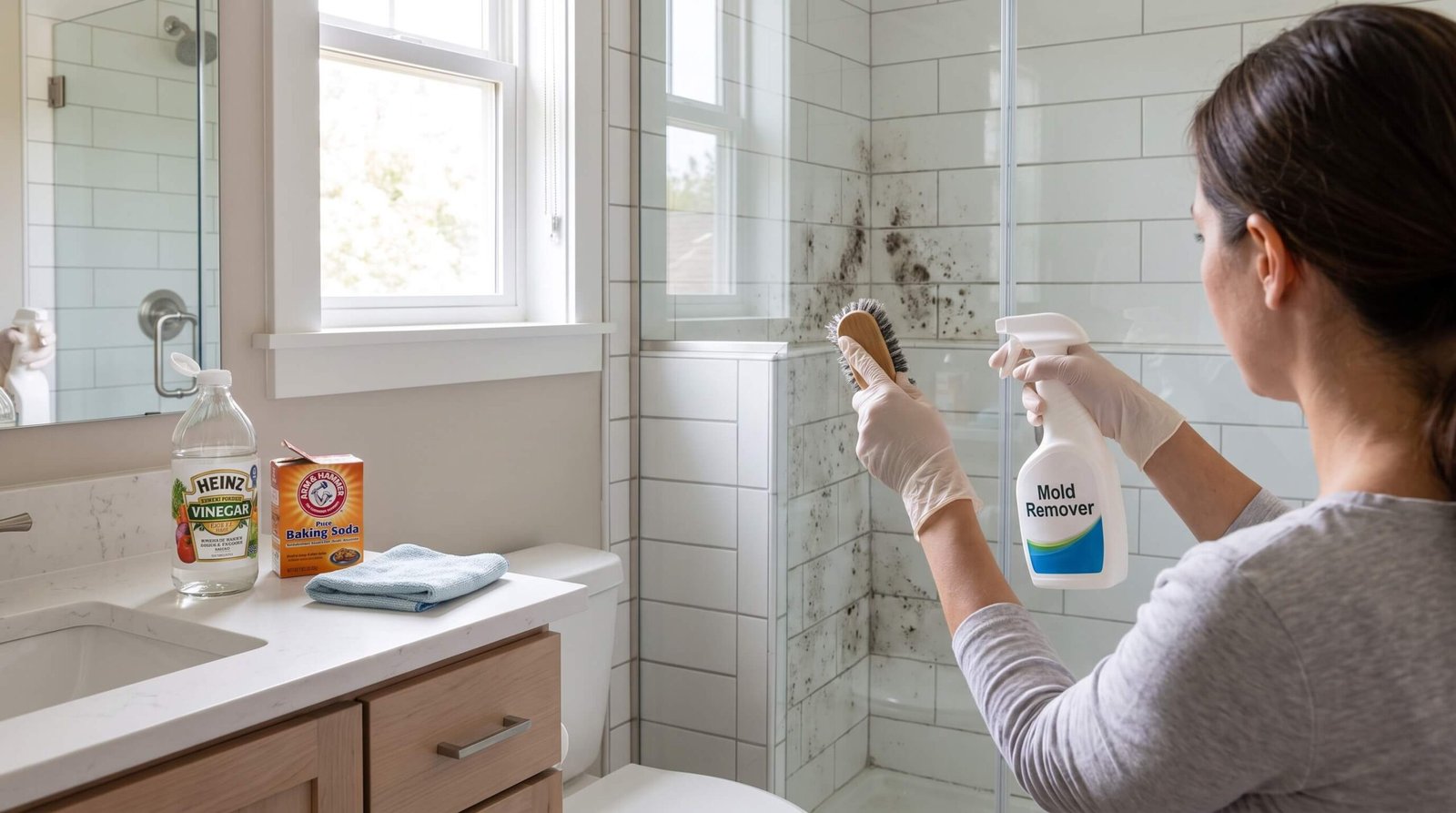
Before you start: open a window or run the exhaust fan, put on gloves and eye protection, and if you’re using a chemical cleaner, wear a basic respirator mask. Mold spores become airborne once disturbed, and you don’t want to be breathing them in for the next twenty minutes while you scrub.
Non-porous surfaces (tile, glass, sealed countertops, shower doors): These are the easiest wins. Spray your cleaner of choice directly on the mold, let it sit for a few minutes so it actually has time to work rather than just sitting on the surface for ten seconds, then scrub with a stiff brush or old toothbrush for grout lines. Rinse thoroughly with water and dry the area completely. Leaving it damp just invites the mold to start over.
Semi-porous surfaces (grout, painted drywall): This is where a lot of people get frustrated because the mold seems to keep partially coming back. That’s because grout and painted drywall have tiny pores mold can grow into just below the surface. Hydrogen peroxide (around 3%) works well here soak a paper towel in it, lay it over the affected grout or wall section, and leave it for 30 minutes before scrubbing. This gives it time to penetrate rather than just sitting on top. For stubborn spots, a second round is often needed. If mold keeps returning to the same patch of grout after repeated treatment, the grout itself may need to be removed and replaced rather than cleaned.
Porous surfaces (silicone caulk, fabric shower curtains, bath mats): Here’s the truth competitors tend to gloss over: once mold gets into caulk or fabric, cleaning it is mostly cosmetic. The roots grow into the material itself, and you can’t scrub that out. If your silicone caulk has visible mold, the most reliable fix is stripping it out and re-caulking rather than trying to clean it repeatedly. Same goes for a moldy shower curtain liner replace it. It’s a $10–15 fix versus an ongoing battle you won’t actually win.
Comparison at a glance:
| Method | Best for | How it works | Watch out for |
|---|---|---|---|
| Rubbing alcohol (70%) | Tile, glass, painted surfaces | Kills mold on contact; low odor | Doesn’t remove staining, only kills growth |
| White vinegar | Grout, non-porous surfaces | Mildly acidic; effective on many common mold species | Slower-acting than bleach; strong smell |
| Hydrogen peroxide (3%) | Grout, semi-porous surfaces | Penetrates slightly below surface with soak time | Can lighten colored grout or fabric |
| Baking soda paste | Grout, general scrubbing | Mild abrasive, safe on most surfaces | Not effective alone on heavy growth |
| Chlorine bleach cleaners | Non-porous, heavy staining | Kills mold and bleaches stains simultaneously | Never mix with ammonia or other cleaners; ventilate well |
Never mix cleaning products, especially bleach, with anything containing ammonia that combination produces toxic fumes. Stick to one product per cleaning session.
Why Mold Keeps Coming Back
If you’ve cleaned the same spot more than twice, the mold itself isn’t really the problem anymore the moisture source is. Cleaning without fixing the source is like mowing a weed instead of pulling the root; it looks fine for a week, then it’s back.
A few things worth actually checking rather than guessing at:
Your exhaust fan might not be venting outside. Look up at the fan cover if you can, check where the ductwork actually leads. If it dead-ends in the attic instead of exiting through the roof or a wall vent, that’s very likely your recurring mold source, and it’s a fixable problem with a licensed contractor or, in some cases, a DIY duct reroute.
Grout may have been sealed over active mold. If someone (maybe a past homeowner) applied grout sealer without fully cleaning out existing mold first, the sealer trapped moisture and spores underneath it. In that case, cleaning the surface does nothing the grout needs to be stripped and redone.
There could be a hidden leak. If mold keeps appearing in the same spot on a wall, especially near a shower valve, sink supply lines, or toilet base, and you’ve ruled out ventilation, it’s worth checking for a slow leak behind that wall. A moisture meter (inexpensive, available at any hardware store) can help confirm this without opening up drywall.
Your humidity might just be too high, and you don’t know it. A basic hygrometer costs about $10–15 and gives you an actual number instead of a guess. If your bathroom regularly sits above 60% humidity for long stretches after a shower, that’s your answer you need better ventilation, not more cleaning.
How to Prevent Mold From Returning
Prevention here isn’t complicated, but it does need to be consistent mold doesn’t care that you did it right last week.
- Run the exhaust fan during your shower and for 15–20 minutes after. If you don’t have a fan, crack a window or prop the door open to get airflow moving.
- Keep a squeegee in the shower and use it on tile and glass right after you’re done it takes 30 seconds and removes most of the standing moisture mold needs.
- Hang towels and bath mats so they dry fully instead of leaving them balled up on the floor or on a hook.
- Wipe down the showerhead, faucet, and any grout lines during your regular cleaning routine, not just when you notice a problem.
- Reinspect caulk and grout once a year. If caulk looks discolored, cracked, or is pulling away from the tub, redo it before mold has a chance to move in.
- If your bathroom doesn’t have a window and struggles with humidity even with the fan running, a small dehumidifier sized for the room can make a real difference.
Mold in a Rental Bathroom: What You Can (and Can’t) Do
If you’re renting, your options look a little different, and it’s worth knowing where you stand before you start ripping out caulk.
Start by documenting everything dated photos of the mold, notes on when you first noticed it, and any smell or health symptoms you’ve experienced. This matters if you need to formally notify your landlord, since mold can be considered a habitability issue in many states, meaning landlords are often legally required to address it.
For temporary relief while you wait on a landlord response, a portable dehumidifier and a strong focus on ventilation (running the fan, cracking a window) can help slow things down without making any permanent changes to the unit. A removable, washable shower curtain liner is also a low-commitment swap if the fabric one has mold — no caulk gun required.
What you generally shouldn’t do without permission is re-caulk, replace grout, or make structural changes, since those are typically the landlord’s responsibility and doing it yourself could complicate a security deposit or liability down the line. Tenant protection laws vary significantly by state, so if you’re dealing with a landlord who isn’t responsive, it’s worth looking up your specific state’s habitability requirements or contacting a local tenant rights organization.
When to Call a Mold Removal Professional
DIY works for a lot of bathroom mold, including most black mold in bathroom cases found on non-porous surfaces like tile and glass, but there’s a point where it makes more sense to bring someone in.
Call a professional if: the mold keeps coming back despite proper cleaning and addressing ventilation, it’s spreading across a large area (the EPA generally suggests anything over about 10 square feet warrants professional attention), it’s on the ceiling or you suspect it’s behind a wall, or anyone in the household is having ongoing respiratory symptoms that seem tied to the bathroom.
Cost-wise, a professional mold inspection typically runs somewhere in the $200–$600 range depending on your area and how thorough the testing is, while actual remediation costs vary widely based on square footage and severity small, contained jobs might run a few hundred dollars, while larger remediation involving wall or subfloor replacement can run into the thousands. Getting an inspection first, even if you end up doing some of the cleanup yourself, is often worth the cost just to know what you’re actually dealing with.
A typical professional visit involves an initial inspection (sometimes with air or surface sampling), containment of the affected area to prevent spores from spreading during removal, the actual remediation work, and a final clearance test to confirm the mold is gone before they consider the job done.
FAQs
Is mold in the bathroom dangerous?
Is black mold in bathroom spaces more dangerous than other colors?
What causes mold in bathroom ceiling areas specifically?
Can I mix bleach and vinegar to clean mold faster?
How fast does mold grow in a bathroom?
Does painting over mold work?
What actually kills mold permanently?
Related resources: How to Paint a Room Like a Pro: 7 Professional Steps
Related resources: Dark Blue House With Deck: 7 Color Combinations That Work