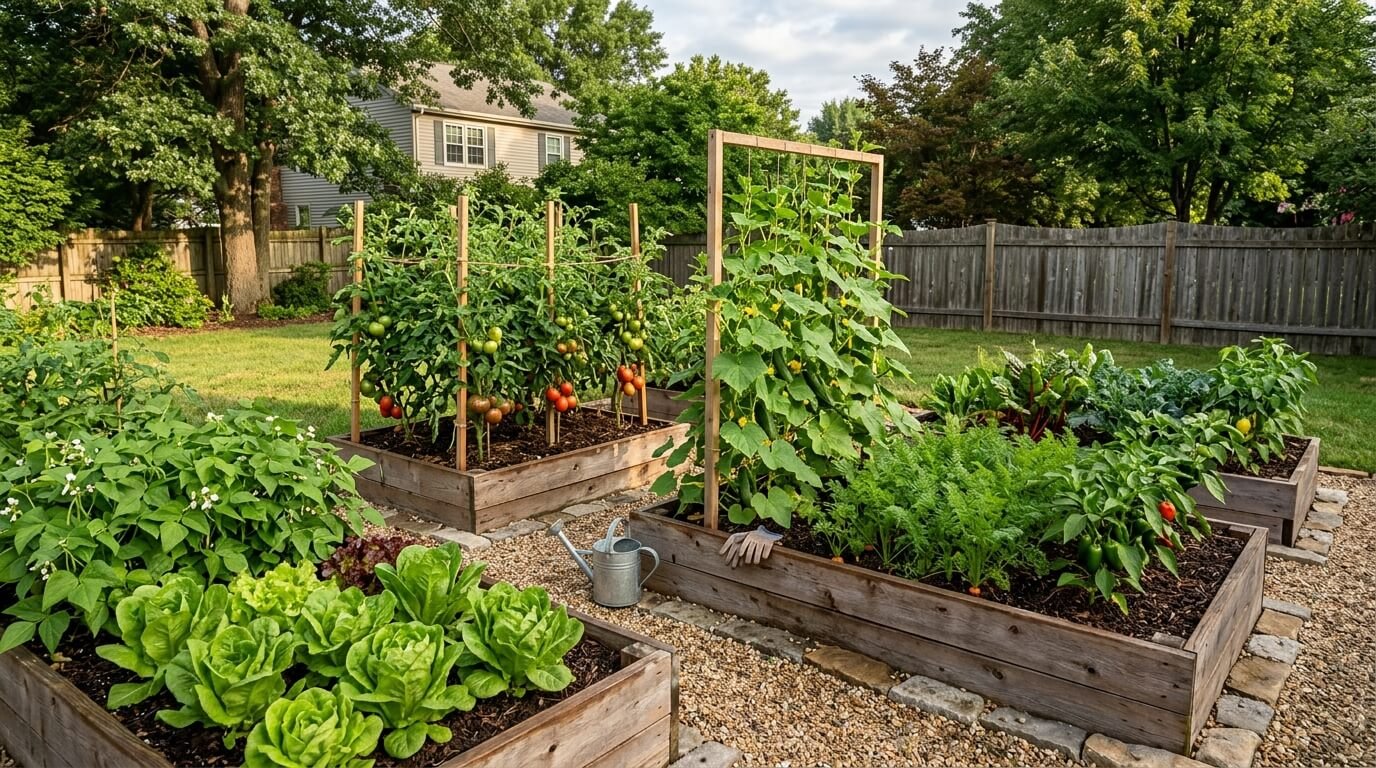
Raised beds make vegetable gardening easier to plan because you can control the soil, organize planting space, and create growing conditions suited to the crops you want to grow. They can also make gardening more accessible by bringing the planting area above ground level.
But not every vegetable is equally convenient for a raised bed.
The best choices are usually crops that make good use of the available space, suit the soil depth, and match your local growing season. Some vegetables, such as lettuce and radishes, need relatively little room. Others, such as tomatoes and cucumbers, can be excellent choices but need more space or support.
If you’re deciding what to plant, this guide covers 15 of the best vegetables for raised beds and explains where each one fits best.
Key Takeaways
- Lettuce, radishes, carrots, and leafy greens are excellent choices for smaller raised beds.
- Tomatoes, peppers, and cucumbers can produce well but need more room and careful planning.
- Root crops benefit from loose, well-prepared soil with enough depth for their roots.
- Vertical supports can make space-hungry crops more practical in a raised bed.
- Choose vegetables according to your sunlight, soil depth, available space, and growing season.
- A productive raised bed usually works better with a mix of quick crops and longer-season vegetables.
What Makes a Vegetable Good for a Raised Bed?
A good raised-bed vegetable does not simply need to be capable of growing above ground level.
The better question is whether the crop makes efficient use of the space and fits the conditions you can provide.
Raised beds give gardeners more control over the growing medium, drainage, and planting arrangement. University of Maryland Extension notes that raised beds can be built above existing ground and can also be used on hard surfaces, giving gardeners flexibility in how they create growing areas.
Before choosing vegetables, consider five factors:
Soil Depth
Shallow-rooted crops such as lettuce and some salad greens can work well in shallower beds.
Root crops and larger plants may require more depth.
Available Space
A raised bed has a fixed footprint. Crops that spread aggressively can quickly take over space needed by other plants.
Sunlight
Many fruiting vegetables, including tomatoes and peppers, need plenty of direct sunlight for good production.
Growing Season
Cool-season crops and warm-season crops have different temperature preferences. Your local frost dates and climate should influence what you plant and when.
Maintenance
Some vegetables need staking, trellising, regular harvesting, or closer monitoring than others.
The best raised-bed garden is not necessarily the one containing the largest number of vegetables. It is the one where the chosen crops fit the space and growing conditions.
15 Best Vegetables for Raised Beds
1. Tomatoes
Tomatoes are one of the most popular vegetables for raised beds because gardeners can create loose, fertile soil and give the plants plenty of sunlight.
They are especially useful when you want a high-value crop from a limited garden because a few plants can provide a substantial harvest.
However, tomatoes need space.
Determinate varieties generally stay more compact, while indeterminate varieties continue growing and usually require stronger support.
Best for:
- Sunny raised beds
- Experienced or beginner gardeners
- Summer gardens
- Vertical support systems
Watch out for:
Tomatoes can become large and shade nearby plants. Place them where their mature size will not block sunlight from smaller crops.
2. Lettuce
Lettuce is one of the easiest vegetables to fit into a raised bed.
Its relatively compact growth makes it useful for small spaces, and you can grow multiple varieties without dedicating an entire bed to one crop.
Loose-leaf varieties are particularly useful when you want repeated harvests rather than one large harvest at once.
Best for:
- Small raised beds
- Beginners
- Cool seasons
- Quick harvests
- Succession planting
Practical tip:
Plant smaller amounts at intervals instead of sowing the entire bed at once. This can help spread your harvest over a longer period.
3. Carrots
Carrots can be an excellent raised-bed crop because gardeners can create the loose, relatively stone-free soil that helps roots develop properly.
A raised bed is particularly useful if the native soil is heavy or difficult to work.
Shorter carrot varieties can be a practical choice for shallower beds.
Best for:
- Loose soil
- Small spaces
- Beginner gardeners
- Deep or medium-depth beds
Watch out for:
Avoid compacted soil and large stones. Poor soil conditions can cause roots to develop poorly.
4. Radishes
If you want a fast and space-efficient crop, radishes are hard to overlook.
They occupy relatively little space and mature faster than many larger vegetables. That makes them useful for filling gaps between longer-season crops.
Best for:
- Beginners
- Small raised beds
- Quick harvests
- Succession planting
Radishes can also help you make productive use of areas that would otherwise remain empty while slower crops are developing.
5. Bush Beans
Bush beans are a practical choice when you want productive plants without building a tall trellis.
Unlike pole beans, bush varieties generally remain more compact.
That makes them particularly useful when the raised bed is designed around easy access and simple maintenance.
Best for:
- Beginners
- Medium-sized beds
- Warm-season gardens
- Compact planting
Practical tip:
Harvest beans regularly once they are ready. Frequent picking can encourage continued production.
6. Peppers
Peppers can thrive in raised beds when they receive sufficient warmth, sunlight, and consistent moisture.
They are relatively compact compared with sprawling crops, making them useful when you want a warm-season vegetable without giving an entire section of the garden to one plant.
You can grow sweet peppers or hot peppers depending on your preferences.
Best for:
- Sunny raised beds
- Warm climates
- Compact gardens
- Containers and raised beds
Watch out for:
Do not crowd pepper plants. Good spacing allows air movement and gives each plant enough room to develop.
7. Cucumbers
Cucumbers can be excellent raised-bed vegetables, especially when grown vertically.
Instead of allowing vines to spread across the soil and occupy a large portion of the bed, a trellis can encourage upward growth.
Best for:
- Vertical gardening
- Sunny raised beds
- Warm-season gardens
- Gardeners who want to maximize space
Practical tip:
Install the support structure before the vines become large. Adding a trellis later can disturb established plants.
8. Spinach
Spinach is a useful cool-season crop for raised beds.
Its compact growth makes it easy to fit between larger crops, and it can be harvested for young leaves or allowed to develop further.
Best for:
- Cool seasons
- Small gardens
- Beginners
- Succession planting
Spinach generally performs better when temperatures are suitable for cool-season growth. In warm conditions, gardeners may find that it becomes more difficult to maintain quality.
9. Kale
Kale earns a place in many raised beds because it can provide a long harvest period and works well as a cool-season crop.
Its relatively upright growth also makes efficient use of vertical space compared with sprawling vegetables.
Best for:
- Fall and cool-season gardens
- Long harvests
- Beginner gardeners
- Medium-sized raised beds
Practical tip:
Harvest outer leaves while allowing the central growing point to continue developing.
10. Beets
Beets are another strong choice for raised beds because the edible root develops below the soil while the leafy tops remain above it.
Loose soil is especially useful for root development.
Best for:
- Medium-depth beds
- Small gardens
- Cool-season planting
- Beginner gardeners
You can also harvest beet greens, giving the plant more than one useful purpose in the garden.
11. Swiss Chard
Swiss chard is useful when you want a leafy vegetable that can continue producing over an extended period.
It can also bring visual interest to a vegetable bed because some varieties have brightly colored stems.
Best for:
- Long harvest periods
- Partial shade compared with many fruiting vegetables
- Small-to-medium gardens
- Gardeners who want leafy greens
Give mature plants enough room because they can become substantially larger than young seedlings suggest.
12. Zucchini
Zucchini can grow successfully in raised beds, but space is the main consideration.
A single plant can become much larger than expected, so it should not be placed where it will crowd lettuce, carrots, or other compact crops.
Best for:
- Large raised beds
- Gardeners wanting high-output summer crops
- Sunny locations
Watch out for:
Do not underestimate its mature size.
If your raised bed is small, a compact variety or another vegetable may make better use of the available area.
13. Onions
Onions can make good use of raised-bed space because they grow relatively upright and do not require the sprawling footprint of crops such as zucchini.
They can also be useful as part of a mixed vegetable planting plan.
Best for:
- Small-to-medium beds
- Space-efficient planting
- Gardeners who want storage crops
Choose varieties appropriate for your region and planting season because onion development is influenced by day length and local growing conditions.
14. Peas
Peas are particularly useful when you can take advantage of vertical growing.
A trellis or other appropriate support allows climbing varieties to grow upward rather than spreading across valuable soil space.
Best for:
- Vertical gardens
- Cool-season planting
- Small raised beds
- Gardeners wanting space efficiency
Practical tip:
Put the support in place before the plants become heavily established.
15. Broccoli
Broccoli can be a productive raised-bed vegetable when the garden has enough room for its mature size.
It benefits from well-prepared soil and consistent care, but it takes more space than compact crops such as radishes or lettuce.
Best for:
- Medium-to-large beds
- Cool-season gardens
- Gardeners who want substantial vegetable heads
Broccoli is best treated as a planned crop rather than something to squeeze into an already crowded bed.
Best Vegetables for Small Raised Beds
If you have a small raised bed, space efficiency should be one of your biggest priorities.
The strongest choices are generally compact crops that can be harvested repeatedly or planted closely enough to make good use of the available area.
Good options include:
- Lettuce
- Radishes
- Carrots
- Beets
- Spinach
- Swiss chard
- Bush beans
- Onions
- Peas with vertical support
You can also combine crops with different growth habits.
For example, a trellised crop can grow upward while low-growing greens occupy nearby space.
The goal is not simply to fit as many plants as possible. Overcrowding can make watering, harvesting, and pest management more difficult.
Best Vegetables for Beginners
If this is your first raised-bed garden, start with crops that are relatively straightforward to manage.
Good beginner choices include:
Lettuce
Compact, useful, and easy to fit into a small space.
Radishes
Fast-growing and useful for gardeners who want early results.
Bush Beans
They do not require the same type of tall support as pole beans.
Carrots
A good choice when the raised bed has loose, suitable soil.
Swiss Chard
Useful for gardeners who want a leafy crop that can provide repeated harvests.
Kale
A practical cool-season option with a long harvest window.
Starting with five or six vegetables is often more manageable than filling your first raised bed with 15 different crops.
Which Vegetables Need More Space?
Some vegetables can be excellent raised-bed crops but become difficult to manage in a small bed.
Zucchini is a good example.
Cucumbers can also consume considerable space if allowed to trail along the soil, although trellising can dramatically improve their use of vertical space.
Large tomato plants can also dominate a bed if they are not properly spaced or supported.
Before planting a large crop, ask:
How much space will this plant occupy when fully grown—not when I first transplant it?
That question can prevent many raised-bed gardening problems.
How to Choose Vegetables for Your Raised Bed
Instead of choosing vegetables only because they appear on a “best vegetables” list, match them to your actual garden.
1. Check How Much Sun You Have
Observe the bed throughout the day.
If the location receives strong direct sunlight, warm-season crops such as tomatoes and peppers may be suitable.
If the location has less direct sun, leafy vegetables may be more practical, although the exact light requirements vary by crop and local conditions.
2. Measure the Bed
Know the length and width before deciding how many vegetables to plant.
A simple garden map can prevent accidental overcrowding.
3. Check Soil Depth
Different vegetables have different root systems.
Shallow-rooted crops can fit into less soil, while root crops and larger vegetables may benefit from deeper beds.
Do not assume that every vegetable requires the same planting depth.
4. Consider Your Growing Season
A vegetable that performs well in one season may struggle in another.
Cool-season crops and warm-season crops should be planted according to local conditions rather than a universal calendar.
For U.S. gardeners, local frost dates and regional growing guidance are more useful than copying planting dates from a gardener in another state.
5. Plan Vertical Space
Trellising can change how much ground space a crop requires.
Cucumbers and peas are good examples of crops that can benefit from vertical support.
But make sure the support is sturdy enough for the mature plant.
6. Grow What You Actually Eat
This sounds obvious, but it is one of the most useful rules for a home vegetable garden.
If your household rarely eats radishes but uses tomatoes and peppers every week, dedicate more space to the vegetables you will actually harvest and use.
A productive garden is more valuable when its harvest fits your lifestyle.
A Simple Raised-Bed Planting Strategy
If you have one medium-sized raised bed, avoid planting only one slow-growing crop.
Instead, combine vegetables with different growth patterns.
For example:
Back of the bed:
Trellised peas or cucumbers
Middle:
Peppers or bush beans
Front:
Lettuce, radishes, or spinach
This arrangement can help you use vertical and horizontal space together.
However, the exact arrangement should depend on the bed’s sunlight and the mature size of each plant.
Common Raised-Bed Vegetable Gardening Mistakes
Choosing Plants Without Considering Mature Size
Small seedlings can be misleading.
A plant that looks tiny at planting time may become one of the largest plants in the bed.
Overcrowding
More plants do not automatically mean more vegetables.
Crowding can make maintenance harder and can reduce airflow around plants.
Follow the spacing guidance for the specific variety you grow.
Ignoring Soil Depth
A raised bed does not automatically provide enough depth for every crop.
Consider the mature root system before planting.
Growing Too Many Large Crops
Several zucchini plants, large tomatoes, or sprawling cucumbers can quickly consume a small bed.
Choose large crops carefully and use vertical supports where appropriate.
Forgetting the Growing Season
Planting a warm-season vegetable too early can create problems, while planting a cool-season crop during unsuitable heat can also lead to poor results.
Use local growing information rather than relying on one national planting calendar.
Focusing Only on the Fastest Crops
Quick harvests are satisfying, but a productive garden can also include crops that take longer to mature.
Mixing quick crops with longer-season vegetables can make better use of the bed throughout the season.
Frequently Asked Questions
What are the best vegetables for raised beds?
Some of the best vegetables for raised beds include tomatoes, lettuce, carrots, radishes, bush beans, peppers, cucumbers, spinach, kale, beets, Swiss chard, zucchini, onions, peas, and broccoli. The best choices depend on the bed’s size, soil depth, sunlight, and local growing season.
What vegetables grow best in a small raised bed?
Lettuce, radishes, carrots, spinach, beets, onions, bush beans, and Swiss chard are useful choices for small raised beds because they can make efficient use of limited space. Peas and cucumbers can also work when grown vertically.
What is the easiest vegetable to grow in a raised bed?
Lettuce, radishes, bush beans, and leafy greens are generally good starting points for beginner gardeners because they are relatively straightforward to plant and manage. The easiest crop for you will still depend on your climate and growing season.
How deep should a raised bed be for vegetables?
The appropriate depth depends on the vegetables you plan to grow. Shallow-rooted crops can use less soil, while root crops and larger plants may benefit from greater depth. Do not choose bed depth without considering the crops you want to grow.
Can tomatoes grow in raised beds?
Yes. Tomatoes can be excellent raised-bed vegetables when they receive adequate sunlight, suitable soil, sufficient space, and appropriate support. Their mature size should be considered before planting them near smaller crops.
Can cucumbers grow in raised beds?
Yes. Cucumbers can be particularly useful in raised beds when grown vertically on a suitable trellis. Vertical growth can reduce the amount of ground space the vines occupy.
What vegetables should I not grow in a raised bed?
There is no universal list of vegetables that cannot grow in raised beds. However, very sprawling crops can use a disproportionate amount of space. Large zucchini plants, sprawling vines, and poorly planned large crops may be inefficient in a small bed.
Are raised beds good for root vegetables?
Yes. Raised beds can be useful for root vegetables because gardeners can create loose, well-prepared soil. Carrots and beets are examples of root crops that can work well when the soil conditions and depth are appropriate.
How many vegetables should I plant in one raised bed?
The answer depends on the bed’s dimensions, the mature size of each crop, and the spacing recommendations for the varieties you choose. Avoid planting according to the number of seedlings that fit visually when young; plan according to their mature size.
Final Thoughts
The best vegetables for raised beds are not necessarily the vegetables that produce the biggest harvest.
They are the vegetables that make good use of your available space, suit your soil depth, match your sunlight and growing season, and provide food you actually want to eat.
For beginners, lettuce, radishes, carrots, bush beans, kale, and Swiss chard can provide a manageable starting point. Tomatoes, peppers, cucumbers, and other larger crops can also be excellent choices when you plan their space and support requirements properly.
If you have a small raised bed, prioritize compact crops and use vertical supports where appropriate. If you have more room, combine different crop sizes and growing seasons to keep the bed productive.
The most successful raised-bed garden starts with the bed you actually have—not an idealized garden from a photograph.
Related resources: Different Types of Sage Plants: 25 Beautiful Varieties for Your Garde
nnRelated resources: Decoradhouse Garden Tips for a Beautiful and Functional Home Garden