An abstract rug can do much more than cover an empty floor. With flowing shapes, layered colors, irregular lines, or painterly patterns, it can become the visual anchor that brings furniture and decor together.
But bold rugs can also be surprisingly easy to get wrong. Choose the wrong size and the furniture may look disconnected. Choose too many competing colors or patterns and the room can feel busy rather than intentional.
The key is to treat an abstract rug as part of the room’s overall composition not as an isolated decoration.
This guide explains what an abstract rug is, how to choose one, where to place it, and how to style it so the pattern adds personality without overwhelming your space.
Key Takeaways
- Choose the rug size based on the furniture arrangement before worrying about the pattern.
- Use the rug’s colors to connect existing furniture and accessories rather than matching everything exactly.
- Let a strongly patterned abstract rug be the main visual statement when possible.
- Consider low-pile or easy-care materials for busy areas.
- In small rooms, larger-scale and restrained patterns can sometimes work better than tightly repeated designs.
- The best abstract rug is one that supports the room’s layout, colors, and everyday use.
What Is an Abstract Rug?
An abstract rug is an area rug featuring non-representational designs rather than traditional recognizable motifs such as floral arrangements, medallions, or clearly defined geometric repeats.
Abstract designs may use:
- Fluid shapes
- Irregular lines
- Brushstroke-like patterns
- Color blocks
- Blended tones
- Organic forms
- Distressed effects
- Watercolor-inspired transitions
- Layered geometric shapes
The design does not necessarily represent a specific object. Instead, it uses color, shape, line, and texture to create visual movement.
That makes an abstract rug particularly useful when you want your flooring to contribute to the room’s personality.
Why Choose an Abstract Rug for Your Home?
The biggest advantage of an abstract rug is flexibility.
Because the pattern does not have to follow a recognizable motif, it can work across several decorating styles. A muted abstract design may complement a minimalist or transitional room, while a colorful design can become a focal point in a more expressive interior.
An abstract rug can also help connect colors that already exist in a room.
For example, imagine a living room with a cream sofa, walnut furniture, and blue artwork. A rug containing cream, muted blue, and warm brown can visually connect those elements without requiring every accessory to match.
Statement rugs can also help anchor furniture arrangements and introduce personality into otherwise restrained rooms.
The important distinction is this:
An abstract rug should support the room’s design rather than compete with everything else in it.
How to Choose the Right Abstract Rug
Choosing an abstract rug becomes easier when you decide in the right order.
Start with the room and furniture arrangement. Then consider size, color, pattern, and material.
1. Start With the Rug Size
Size is often more important than pattern.
A beautiful abstract rug can still look wrong if it is too small for the furniture arrangement.
In a living room, the rug should clearly define the seating area. Depending on the layout, the front legs of the sofa and chairs can rest on the rug, or a larger rug can accommodate the major furniture pieces more fully.
For a bedroom, the rug should have enough visible area around the bed to look intentional rather than like a small mat placed underneath it.
For dining rooms, allow enough rug beyond the table so chairs remain on the rug when they are pulled away from the table.
The exact size depends on your furniture dimensions and room layout, so measure before buying.
As a general design principle, large-scale patterns tend to work well in open spaces, while smaller rooms often benefit from more controlled visual complexity.
A simple sizing process
- Measure the furniture arrangement.
- Mark the approximate rug footprint with painter’s tape.
- Check walking paths.
- Make sure doors can open without catching the rug.
- Only then choose the pattern and color.
This prevents a common mistake: falling in love with a design before checking whether it actually fits the room.
2. Choose a Color Relationship
You do not need to find an abstract rug that exactly matches your sofa, curtains, or walls.
Instead, look for a relationship between colors.
One useful approach is to choose a rug that contains:
- One dominant color
- One or two supporting colors
- A neutral or grounding tone
For example, a rug with navy, cream, and muted terracotta could work with a neutral sofa while giving you accent colors for cushions, artwork, or accessories.
Think of this as echoing color rather than matching color.
If your room already contains several strong colors, a neutral abstract rug may create better balance.
If the room is mostly beige, cream, gray, or white, a more colorful abstract rug can provide a focal point.
3. Consider Pattern Scale
Not every abstract pattern has the same visual impact.
Large flowing shapes can feel bold and artistic, while smaller repeated marks can create a busier appearance.
Consider the scale of the surrounding furniture.
A large sectional and spacious room can usually accommodate a stronger, larger-scale design.
A compact room with small furniture may benefit from an abstract pattern with fewer competing details.
Also consider what is already happening visually.
If the room has patterned curtains, decorative wallpaper, colorful artwork, and patterned upholstery, a highly complex rug may be too much.
4. Think About Pile and Material
The rug’s construction affects both its appearance and practicality.
Low-pile and flatweave rugs tend to show graphic patterns clearly and can be easier to maintain in areas with frequent foot traffic.
Higher-pile rugs can feel softer and more substantial, but their texture may make a detailed abstract pattern less visually crisp.
Think about the room before choosing the material.
For busy living areas
Look for a material and construction that can handle everyday foot traffic and routine cleaning.
For bedrooms
Comfort underfoot may matter more, making a softer construction appealing.
For dining rooms
Prioritize practical cleaning and enough room for chairs to move easily.
For entryways
Durability and ease of cleaning should be high on the list.
The prettiest rug is not necessarily the best rug if it is difficult to maintain in the room where you plan to use it.
5. Match the Rug to the Room’s Function
A rug should work with the way the room is used.
A living room may need to withstand frequent walking and furniture movement.
A bedroom may prioritize softness and calm.
A home office may benefit from a visually interesting rug that defines the workspace without distracting from it.
A dining room needs enough surface area for chairs and should be practical enough for the occasional spill.
Think about everyday life—not just how the rug looks in a photograph.
9 Abstract Rug Ideas for Different Rooms
1. Use a Large Abstract Rug in the Living Room
The living room is one of the easiest places to make an abstract rug the focal point.
If the furniture is mostly neutral, a colorful abstract design can introduce energy without requiring major changes elsewhere.
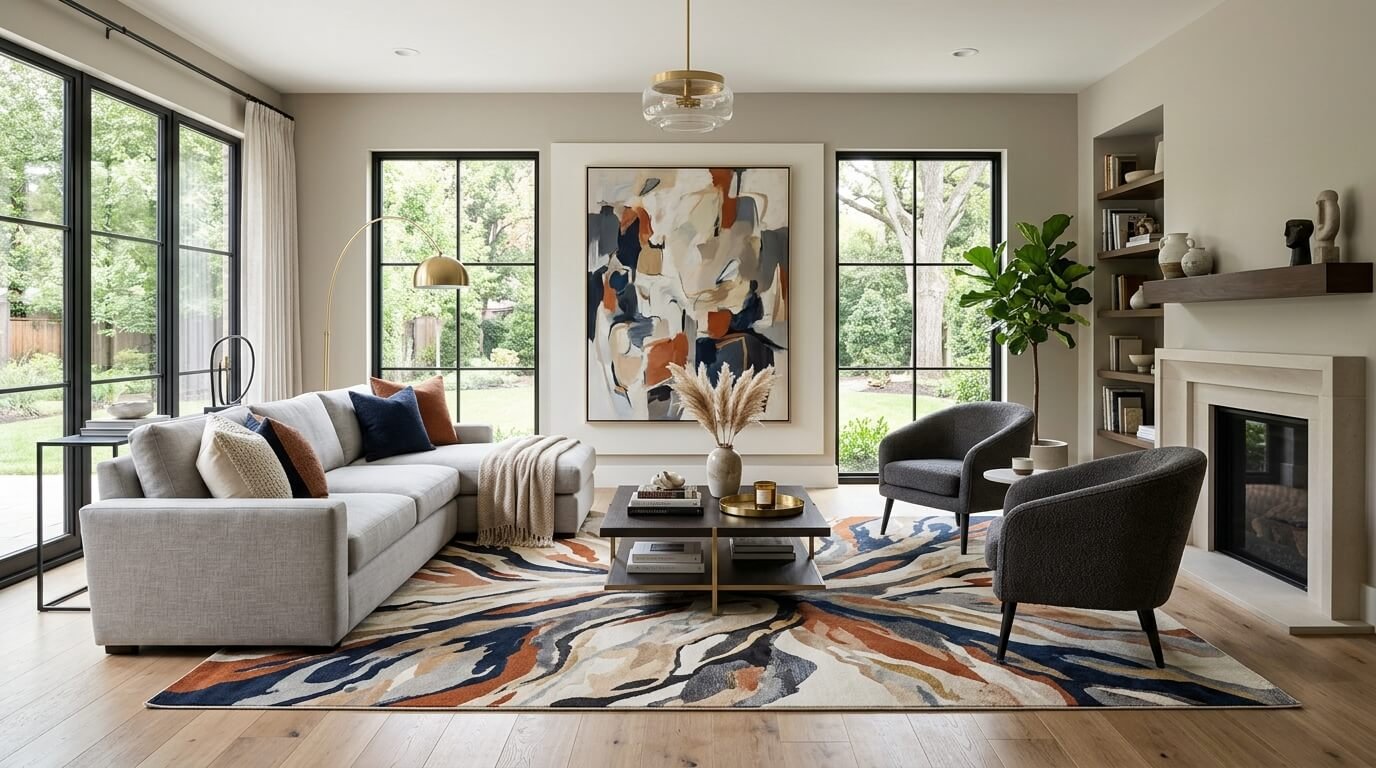
For example, a cream sectional can work with an abstract rug containing muted blue, rust, charcoal, or green.
Keep the surrounding accessories relatively controlled if the rug has a strong pattern.
A large rug can also help visually connect a sofa, coffee table, and accent chairs into one seating zone.
2. Create a Calm Bedroom With a Soft Abstract Rug
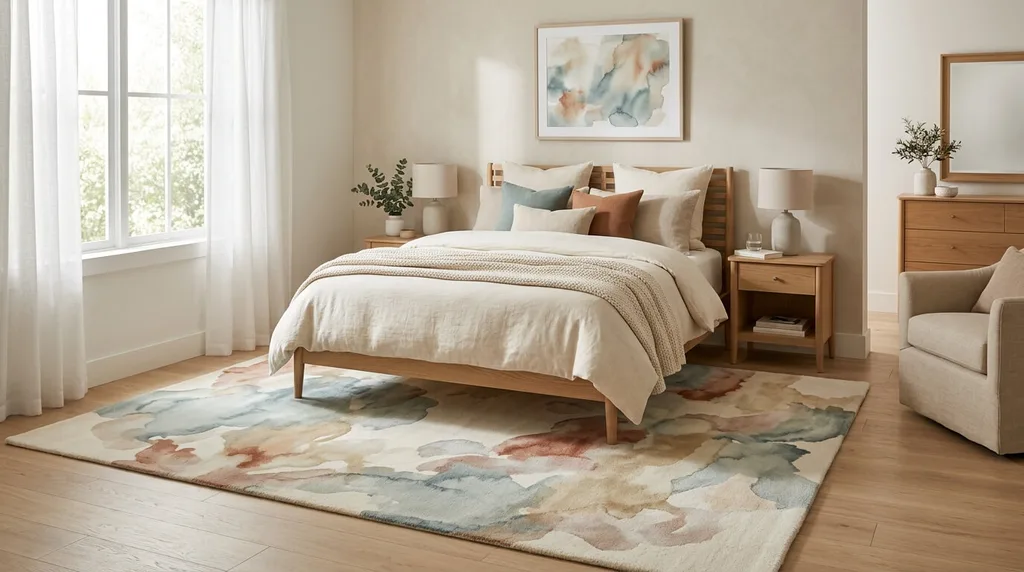
Abstract rugs do not have to be colorful.
A design using cream, beige, taupe, gray, muted blue, or soft green can introduce movement without making the bedroom feel visually loud.
Place the rug so it extends visibly around the bed rather than disappearing almost completely underneath it.
Pair a subtle abstract pattern with solid or lightly textured bedding.
The result can feel layered without becoming busy.
3. Add Personality Under a Dining Table
An abstract rug can make a dining area feel more defined, especially in an open-plan home.
Choose a pattern that complements the table rather than fighting it.
A simple wooden table may work with a more expressive rug. A highly sculptural or visually complicated table may benefit from a quieter design.
Most importantly, make sure the rug is large enough to accommodate the chairs when they are pulled out.
A rug that ends immediately behind the table legs can become frustrating to use and visually undersized.
4. Make a Home Office More Interesting
Home offices can easily become visually plain because they often contain a desk, chair, storage, and little else.
An abstract rug can add personality while defining the work area.
For a clean look, consider:
- A two- or three-color abstract design
- A low-pile construction
- Neutral furniture
- Simple wall decor
- One or two colors repeated elsewhere
If the rug already contains a strong pattern, avoid adding several competing patterns around the desk.
5. Use an Abstract Runner in an Entryway
A hallway or entryway can be a good place for an abstract runner because the floor becomes a narrow visual canvas.
A long flowing pattern can guide the eye through the space.
Choose a design that works with the surrounding walls, doors, flooring, and lighting.
In a narrow entryway, avoid selecting a rug simply because its pattern looks interesting in a product photograph. Check its dimensions first and make sure enough floor remains visible around it.
6. Try an Abstract Rug in a Small Room
Small rooms do not automatically require tiny rugs.
The better question is whether the rug fits the furniture and leaves the room feeling organized.
A restrained abstract design can introduce depth without adding another layer of visual clutter.
Large-scale flowing shapes, tonal designs, and softer contrast can be useful options when you want pattern without a highly repetitive appearance.
Avoid choosing a very complicated pattern simply because the rug is small.
A small rug can still have a large visual impact.
7. Define Zones in an Open-Plan Home
In an open-plan layout, rugs can help visually separate areas without adding walls.
For example, a large abstract rug can define the living room while another rug identifies a dining area.
The two rugs do not have to match.
They can share a color family, similar visual weight, or a complementary palette.
This creates separation while keeping the larger space visually connected.
8. Keep a Neutral Room From Feeling Flat
A neutral room does not have to be boring.
If your furniture and walls are mostly neutral, an abstract rug can introduce subtle changes in tone and texture.
Consider a design using:
- Cream
- Beige
- Warm gray
- Charcoal
- Taupe
- Soft brown
This approach works especially well when you want visual interest without introducing bright colors.
Use texture elsewhere—such as wood, linen, woven materials, or ceramics—to keep the room layered.
9. Let a Colorful Abstract Rug Lead the Room
If you want the rug to become the main statement piece, choose one with a clear color story.
Then pull one or two smaller colors from the rug into the room.
For example, a rug containing deep green, cream, and rust could be paired with:
- A neutral sofa
- A rust-colored cushion
- Green artwork
- Warm wood furniture
The room does not need to become perfectly color-matched.
A few repeated visual connections are enough.
How to Style an Abstract Rug Without Making the Room Look Chaotic
The easiest approach is to give the rug some visual breathing room.
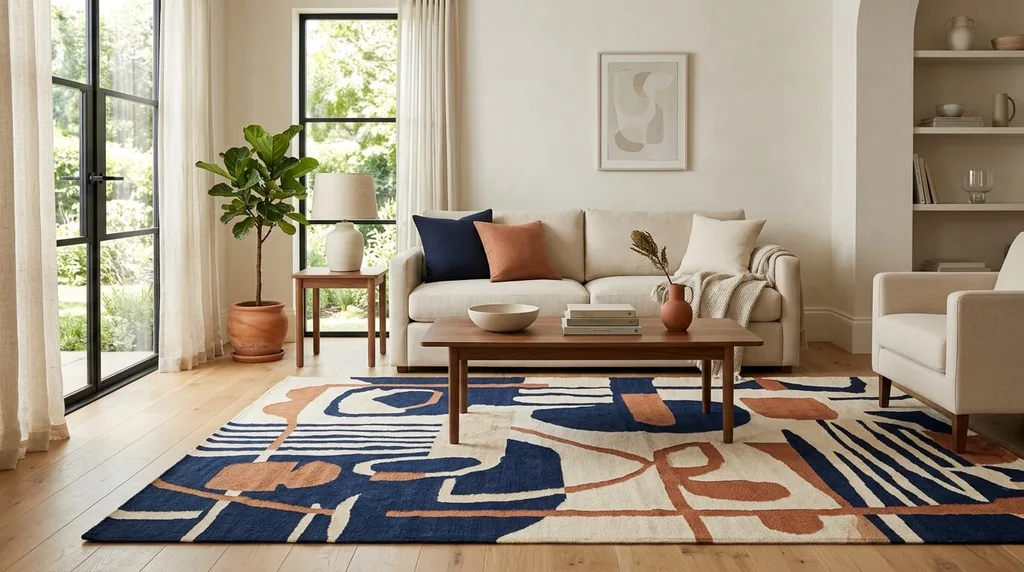
For more practical ideas on balancing bold patterns, furniture, and color, see this guide to styling abstract rugs without making a room look chaotic.
If the rug is the strongest pattern in the room, allow other elements to be quieter.
That does not mean everything needs to be plain.
You can still use texture through:
- Linen
- Bouclé
- Wood
- Leather
- Woven baskets
- Ceramic accessories
- Natural stone
- Soft textiles
Texture creates interest without introducing another competing pattern.
Use the One-Statement-Piece Principle
When an abstract rug has a dramatic design, treat it as the room’s primary visual statement.
That could mean choosing:
- A simple sofa
- Solid-color curtains
- Restrained cushions
- Less complicated artwork
- Clean-lined furniture
This creates a visual hierarchy.
The eye knows where to look first.
Repeat One Rug Color Elsewhere
You can make an abstract rug feel integrated by repeating one of its secondary colors elsewhere.
For example:
Rug: navy, cream, and terracotta
Room: cream sofa + navy artwork + terracotta cushion
You are not creating a matching furniture set. You are creating subtle connections.
This color-extraction approach is also recommended by current rug styling guidance because it helps an expressive pattern feel intentional rather than disconnected.
Balance Strong Patterns With Quiet Surfaces
If your rug is highly detailed, give the eye a few quieter areas.
A plain wall, solid sofa, simple curtains, or natural wood furniture can provide that visual rest.
This is particularly useful when working with open-plan rooms where several areas are already visible at once.
Common Abstract Rug Mistakes to Avoid
Choosing the Rug Before Measuring
A rug can look completely different in a room than it does online.
Measure the space and furniture before ordering.
Using a Rug That Is Too Small
An undersized rug can make furniture arrangements appear disconnected.
The rug should visually anchor the area rather than float in the middle of it.
Matching Every Color Exactly
Exact matching can make a room feel overly coordinated.
Instead, repeat one or two colors from the rug in small amounts.
Combining Too Many Patterns
An abstract rug plus patterned wallpaper, patterned curtains, patterned upholstery, and several competing prints can quickly become overwhelming.
If the rug is bold, simplify something else.
Ignoring Furniture Scale
A huge rug with tiny furniture can feel unbalanced.
Likewise, a small rug under a large sectional may appear lost.
Consider the size and visual weight of everything around it.
Choosing a High-Maintenance Rug for a Busy Area
A delicate rug may not be the best choice for a busy entryway or frequently used living space.
Consider cleaning, foot traffic, pets, children, and furniture movement before choosing the construction.
Assuming Every Abstract Rug Is Modern
Abstract designs can work with many decorating styles.
The surrounding colors, materials, furniture shapes, and pattern intensity often determine whether the overall room feels modern, transitional, eclectic, minimalist, or something else.
Frequently Asked Questions
What is an abstract rug?
An abstract rug uses non-representational shapes, lines, colors, textures, or painterly patterns instead of relying primarily on traditional motifs. The design is usually intended to create visual movement or artistic expression rather than depict a specific object.
Are abstract rugs still good for home decor?
Yes. Abstract rugs remain a flexible decorating choice because they can introduce color, pattern, texture, and visual movement. Their suitability depends more on the rug’s scale, palette, and relationship with the room than on the label “abstract.”
How do I style an abstract rug?
Start by allowing the rug to establish the room’s visual direction. Keep other patterns controlled, use neutral or simply textured furniture when the rug is bold, and repeat one or two colors from the rug elsewhere in the room.
What furniture looks good with an abstract rug?
Neutral sofas, natural wood furniture, simple upholstered chairs, leather pieces, and clean-lined tables can all work well with abstract rugs. The best combination depends on the rug’s colors and visual intensity.
Can I put an abstract rug in a small room?
Yes. The rug should be sized for the furniture arrangement rather than automatically chosen as a tiny accent. In a small room, a restrained palette, larger-scale design, or lower visual contrast can help maintain a sense of openness.
Should an abstract rug match the furniture?
It does not need to match exactly. A better approach is to coordinate the rug with the room’s existing colors and materials. Repeating one or two rug colors elsewhere can create cohesion without making everything look identical.
What color abstract rug is easiest to decorate with?
Neutral abstract rugs in shades such as cream, beige, gray, taupe, charcoal, or muted earth tones are generally easier to combine with different furniture colors. However, a colorful rug can work very well when the rest of the room is relatively restrained.
Are abstract rugs good for living rooms?
Yes. Living rooms often benefit from rugs that define the seating arrangement and introduce a focal point. An abstract design can work particularly well when the furniture is relatively simple or neutral.
Can an abstract rug go under a dining table?
Yes, provided the rug is large enough for the table and chairs. The chairs should remain on the rug when pulled away from the table so they do not repeatedly catch the rug’s edge.
Final Thoughts
An abstract rug can change the character of a room without requiring a complete redesign.
The trick is not simply finding the most interesting pattern. Start with the practical questions:
What size does the room need?
How will the furniture sit on it?
Which colors already exist?
How much pattern can the space handle?
How easy will the rug be to maintain?
Once those questions are answered, choosing the design becomes much easier.
For a bold room, a quieter abstract rug may provide balance. For a neutral room, a colorful design can become the focal point. In a small room, a controlled pattern can add interest without creating unnecessary visual noise.
Think of the rug as one part of the entire room—not a separate decoration.
When its size, color, pattern, texture, and placement work together, an abstract rug can make the space feel more intentional, comfortable, and complete.
Related resources: 12 Window Seat Storage Ideas for an Amazing Upgrade · What Is Smart Home Interior Design? Design Smarter