A bedroom can have beautiful furniture and bedding and still feel unfinished when the walls are bare.
The right wall decor can change that without requiring a complete makeover. A large piece of artwork can create a focal point, a mirror can make a small room feel more open, and simple wall paneling can give a builder-basic bedroom more architectural character.
But choosing bedroom wall decor ideas isn’t just about finding something you like. The size of your wall, the furniture underneath it, your decorating style, budget, and whether you rent or own all affect what will look and work best.
Here are 35 ideas to inspire your next update, along with practical advice for choosing the right size, placement, materials, and installation method.
How to Choose Bedroom Wall Decor
Before buying artwork or ordering wallpaper, take a look at the wall as a whole.
Start by asking:
- What does this wall need? A focal point, color, texture, storage, lighting, or simply visual interest?
- What’s already nearby? Consider your bed, headboard, nightstands, dresser, windows, and doors.
- How much space do you have? A narrow wall needs a different solution from a large wall behind a king-size bed.
- How permanent do you want the change to be? Homeowners may consider paneling or built-ins, while renters may prefer removable options.
- What’s your budget? A thrifted frame arrangement can be surprisingly effective, while larger investments might include custom framing or built-in shelving.
Most importantly, don’t feel obligated to decorate every blank wall. A bedroom usually looks better when one or two areas act as focal points and the remaining walls provide some breathing room.
Bedroom Wall Decor Ideas for Every Style and Space
1. Hang One Oversized Piece of Art
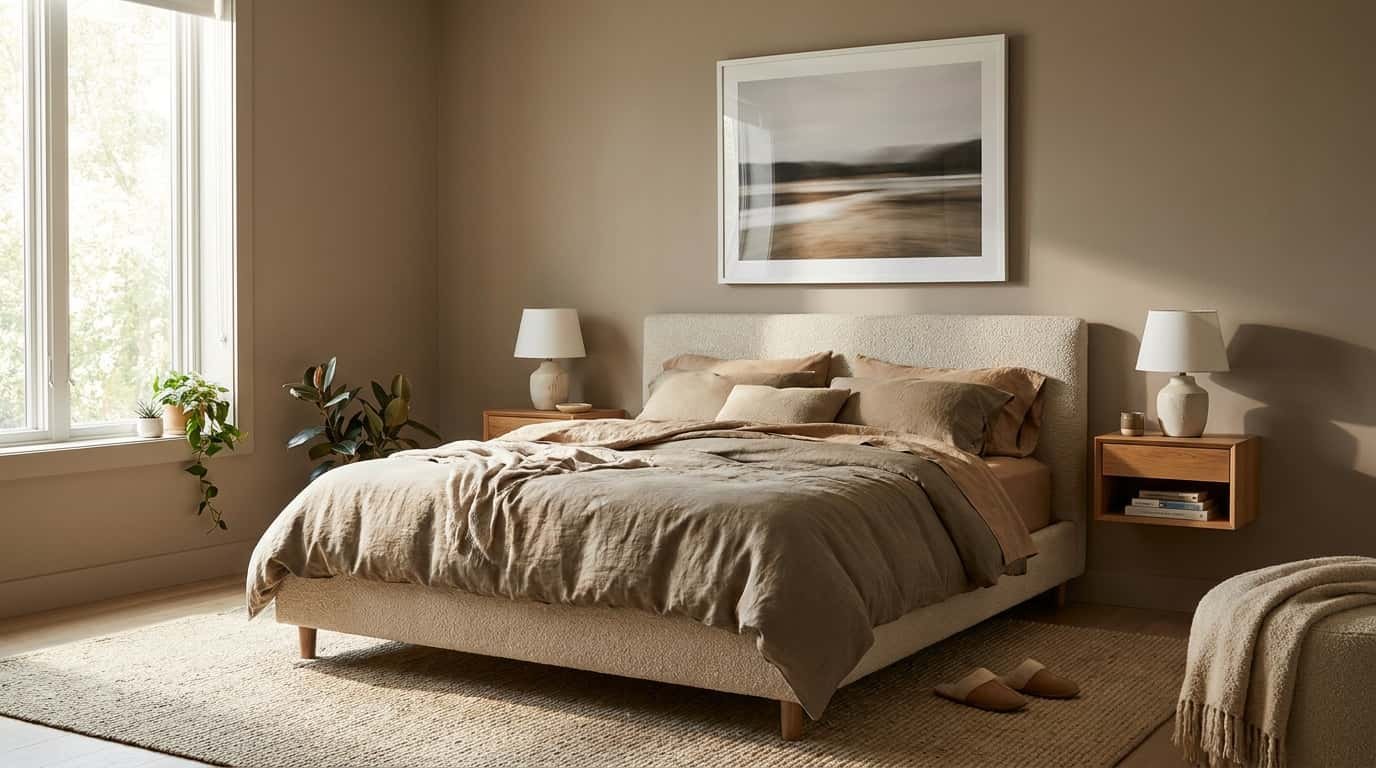
One large artwork can have more impact than several small pieces scattered across a wall.
Try an abstract painting, landscape, oversized photograph, or botanical print above the bed. This approach works particularly well in minimalist bedrooms where you want one strong focal point.
For example, a large horizontal print above a queen bed can visually anchor the entire bed rather than leaving the wall looking unfinished.
2. Create a Gallery Wall
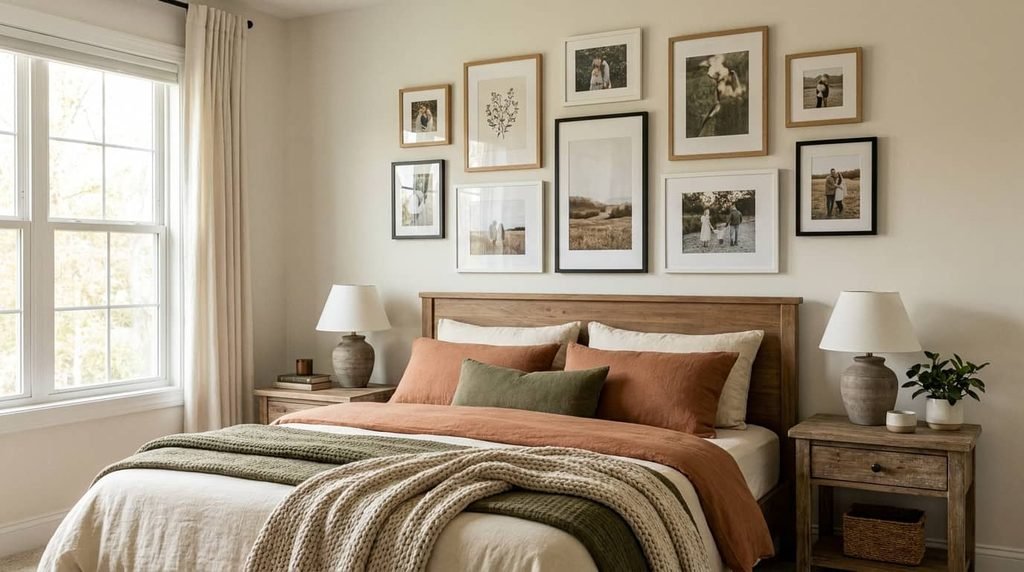
A gallery wall lets you combine photographs, artwork, illustrations, and meaningful objects in one display.
For a cohesive look, repeat something throughout the arrangement. You could use matching black frames, similar matting, or artwork that shares a few colors.
Don’t start by drilling holes. Arrange everything on the floor first, then make paper templates and tape them to the wall. It’s much easier to change the layout before you’ve committed to the placement.
3. Add a Large Bedroom Mirror
A mirror can be both decorative and functional.
When possible, place one opposite or near a window so it can reflect natural light. A tall floor mirror works well on an empty wall, while an oversized round or arched mirror can anchor a dresser.
Think about what the mirror will reflect. A beautiful mirror facing a cluttered corner won’t necessarily make the room feel better.
4. Install Picture Ledges
Picture ledges are useful when you like changing your decor frequently.
Layer framed prints, photographs, books, and a few small objects on the ledge. Unlike a traditional gallery wall, you can rearrange the display without moving multiple hooks.
Keep the styling relatively simple. Three or four thoughtfully chosen pieces will usually look more polished than filling every inch of shelf space.
5. Add Wall Sconces
Wall sconces can solve two problems at once: empty walls and inadequate bedside lighting.
A pair installed on either side of the bed creates symmetry and frees up valuable nightstand space. Plug-in sconces can also be a practical choice for renters or anyone who doesn’t want to alter existing electrical wiring.
Choose fixtures that relate to the bedroom’s style. Simple black fixtures can suit a modern room, while brass or aged-metal finishes can complement more traditional spaces.
6. Try Removable Wallpaper
Removable wallpaper can completely change a bedroom without the permanence of traditional wallpaper.
A common approach is to use it on the wall behind the bed as an accent wall. Botanical patterns, subtle geometrics, textured designs, and murals can all work.
Order a sample before committing. A pattern that looks understated on a small screen can feel much bolder when repeated across an entire wall.
7. Install Wood Wall Paneling
Wood paneling adds texture and architectural interest to a plain wall.
Board-and-batten can give a bedroom a traditional feel, while vertical slats create a more contemporary look. Natural wood adds warmth, while painted paneling can blend more seamlessly with the rest of the room.
You don’t need to panel the entire bedroom. A single feature wall can provide plenty of impact.
8. Hang a Tapestry or Textile
Textile wall decor brings softness to a room filled with hard surfaces.
A woven tapestry, quilt, fabric panel, or macramé piece can work especially well in boho, relaxed, coastal, and eclectic bedrooms.
This is also a useful option for renters, provided the hanging method is suitable for the item’s weight and the wall surface.
9. Display Family Photos
Your bedroom is an ideal place to display photographs that have personal meaning.
Try a structured grid of black-and-white photos above a dresser or a row of matching frames behind the bed.
You don’t need expensive prints. Consistent framing and thoughtful spacing can make inexpensive photographs feel like a deliberate design feature.
10. Add Floating Shelves
Floating shelves provide a place for both decoration and useful storage.
Use them for books, small plants, framed photographs, candles, or objects you’ve collected over time.
Before installation, check the shelf’s weight capacity and use hardware appropriate for your wall type. A shelf filled with books needs substantially more support than one holding a few lightweight frames.
11. Paint an Accent Wall
Wall decor doesn’t have to be something you hang.
A carefully chosen paint color can turn a plain wall into the room’s focal point. Deep greens, muted blues, warm neutrals, terracotta, and charcoal can all create different moods.
For a straightforward update, paint only the wall behind the bed and keep the other walls relatively quiet.
12. Frame Botanical Prints
Botanical artwork adds color and a natural feeling without requiring additional furniture.
Vintage botanical illustrations suit traditional bedrooms, while large-scale botanical photography can work in contemporary spaces.
A set of three coordinated prints can also fill the wall above a dresser without competing with the bed’s focal point.
13. Hang Decorative Baskets
Woven baskets add texture and dimension to a wall.
Arrange several shallow baskets above a dresser or on a large empty wall. They work especially well with boho, farmhouse, coastal, and natural-material interiors.
Keep the arrangement intentional by repeating a material, color, or general shape.
14. Use Sculptural Wall Decor
If framed art feels too predictable, add something with three-dimensional form.
Carved wood, metal sculptures, woven pieces, and other dimensional objects can create shadows and texture as the light changes throughout the day.
This works particularly well against a simple painted wall.
15. Display Vintage Artwork
Vintage art can make a bedroom feel collected rather than overly coordinated.
Look for landscapes, botanical prints, architectural drawings, maps, or thrifted paintings. The pieces don’t have to come from the same period.
Repeating a frame finish or color can tie different artwork together.
16. Create a Travel Memory Wall
Turn postcards, maps, photographs, and other travel memories into bedroom wall art.
For example, eight or nine similarly framed travel photographs can create a personal gallery wall above a dresser or along a large blank wall.
Because the display tells a story, it can feel more meaningful than generic decorative prints.
17. Install a Picture Rail
A picture rail can make it easier to hang and rearrange artwork while adding architectural character.
Artwork hangs from the rail using hooks and cords, so you’re not repeatedly drilling new holes whenever you change the arrangement.
This can be particularly effective in bedrooms with tall ceilings or traditional architectural details.
18. Paint an Arch Behind the Bed
A painted arch can create the visual effect of a headboard without purchasing one.
Choose a color that contrasts gently with the rest of the wall and position the arch so it frames the bed.
This is a relatively inexpensive DIY project and can give a simple bedroom a custom feel.
19. Add Wainscoting
Wainscoting introduces architectural detail and can make a plain bedroom feel more finished.
Traditional bedrooms often suit raised or paneled molding, while simpler square or rectangular profiles can work in transitional and contemporary spaces.
For a subtle result, paint the molding and wall in the same color.
20. Create a Slat Wall
A vertical slat wall can add warmth while drawing attention toward the ceiling.
Use it behind the bed as a statement feature and keep the rest of the wall decor restrained.
Because the slats already create a strong pattern, you generally don’t need a busy gallery wall on top of them.
21. Install a Wall Mural
A mural can make a bedroom wall feel like an intentional design feature rather than a blank surface.
Consider landscapes, abstract designs, botanical scenes, or subtle architectural patterns.
Choose the image based on how you want the bedroom to feel, not simply because the design is currently trending. You’ll see it every morning and night.
22. Use Peel-and-Stick Decals
Wall decals offer an easy way to introduce pattern or personality without a permanent change.
They’re particularly useful in rental bedrooms, children’s rooms, or spaces where you expect your style to change.
For a more sophisticated look, use a restrained design rather than covering the entire wall with small decorative elements.
23. Display Decorative Plates
Decorative plates can add pattern, color, and texture to an unexpected area of the bedroom.
Arrange them in a cluster above a dresser or on a large empty wall. Mixing sizes can make the display more interesting, provided the colors or materials create some visual connection.
Use secure hardware appropriate for the weight of the plates.
24. Hang a Large Clock
A large clock can fill an empty wall while still serving a practical purpose.
Choose a frame that relates to the furniture in the room. Wood can add warmth to a rustic or traditional bedroom, while a simple metal design may suit a contemporary space.
25. Create a Reading Wall
If your bedroom has a reading chair, give that small area its own identity.
Add a compact bookshelf, artwork, and a reading light to create a comfortable reading zone.
This works particularly well in larger bedrooms where a blank wall might otherwise feel disconnected from the main sleeping area.
26. Combine Artwork With a Dresser
The wall above a dresser is another opportunity for a focal point.
Try one large mirror, two coordinated prints, or a single oversized artwork. Keep enough space between the furniture and wall decor so the two elements feel connected without appearing crowded.
A lamp or small decorative object on the dresser can add another layer without requiring more wall space.
27. Integrate the TV Into the Wall Design
If you have a TV in the bedroom, it doesn’t have to dominate the room.
Consider surrounding it with restrained artwork or incorporating it into a built-in or paneled wall.
Avoid adding so much decoration around the screen that the entire wall becomes visually noisy.
28. Decorate a Narrow Wall
Narrow walls are easy to overlook because many common decor pieces are designed for wider spaces.
Use a vertically oriented print, narrow mirror, sconce, or vertically stacked collection of frames.
The goal is to work with the wall’s proportions rather than forcing a horizontal arrangement into it.
29. Create a No-Drill Gallery Wall
Renters can still create a gallery wall without making permanent holes.
Lightweight artwork can be displayed using removable hanging products designed for the item’s weight and the specific wall surface. Larger pieces can sometimes be leaned on a dresser or console instead.
Don’t assume adhesive is suitable for heavy mirrors, shelves, or oversized frames. Always follow the product’s weight limit and installation instructions.
30. Layer Artwork on a Dresser
Not every piece of bedroom wall art needs to be mounted.
Lean two or three framed pieces against the wall on top of a dresser, overlapping a smaller frame in front of a larger one.
This arrangement is inexpensive, flexible, and easy to change when you want a different look.
31. Add Built-In Shelving
If you’re undertaking a larger renovation, built-in shelving can transform an empty bedroom wall.
Combine open shelves for artwork and books with closed storage for items you don’t want on display.
This is a bigger investment than hanging artwork, but it can solve both a decor and storage problem.
32. Let the Headboard Be the Feature
You don’t necessarily need wall art if your headboard makes a strong enough statement.
A tall upholstered headboard, wood headboard, or custom built-in design can occupy much of the wall behind the bed.
This approach works particularly well in minimalist bedrooms where fewer, larger elements create a cleaner appearance.
33. Try a Two-Tone Wall
Two related paint colors can add interest without requiring artwork or construction.
A horizontal division can visually change the proportions of a tall room, while a vertical color block can emphasize height.
For a subtle effect, choose shades that are related rather than creating an extremely high-contrast division.
34. Use a Large Textile as a Headboard Alternative
A large quilt, woven wall hanging, or fabric panel can provide some of the softness associated with an upholstered headboard.
It can also add pattern and texture without committing to a new piece of furniture.
Make sure the mounting system is appropriate for the item’s size and weight, especially when it will hang over the bed.
35. Leave Some Walls Empty
Sometimes the best wall decor idea is knowing when to stop.
If you already have oversized artwork above the bed, a mirror opposite it, and substantial furniture, adding another gallery wall may make the bedroom feel cluttered.
Negative space allows your strongest pieces to stand out.
Bedroom Wall Decor Ideas for Small Bedrooms
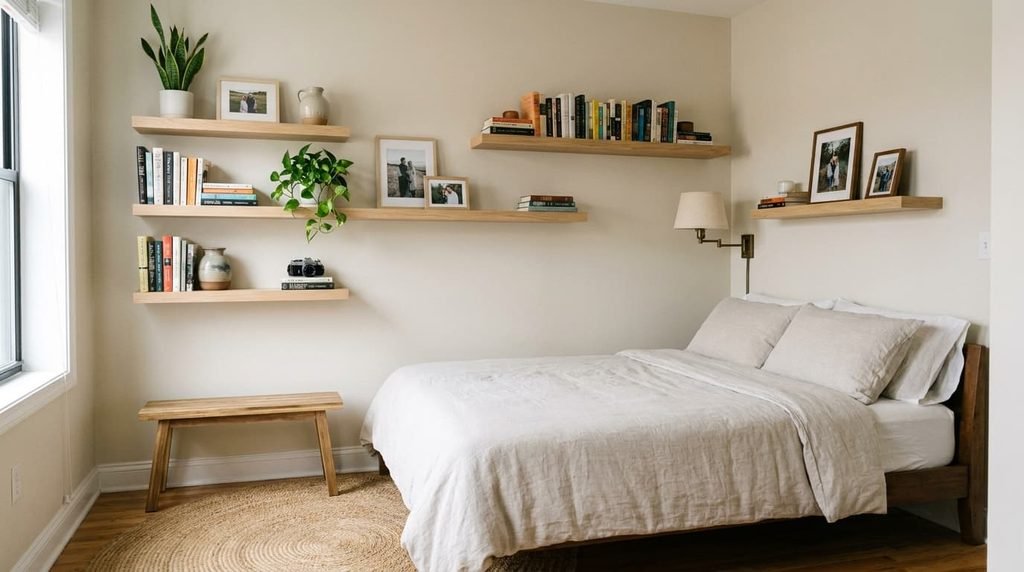
Small bedrooms benefit from decor that performs more than one job.
A mirror can add visual depth. Floating shelves can provide storage without consuming floor space. Wall sconces can replace bulky bedside lamps. Vertical artwork can draw the eye upward.
But don’t assume that everything in a small bedroom needs to be tiny.
One appropriately sized artwork can look cleaner than six small pieces scattered across a wall. The goal is to reduce visual clutter, not eliminate scale.
If your bedding, curtains, and rug already have strong patterns, choose quieter wall decor. If the room is mostly neutral, one colorful artwork or textured wall treatment can give it more personality without overwhelming the space.
Bedroom Wall Decor Ideas for Renters
Rental-friendly decorating is mostly about choosing changes that can be reversed.
Good options include:
- Removable wallpaper
- Lightweight framed artwork
- Removable hanging systems
- Leaning mirrors
- Picture ledges where appropriate
- Textile wall hangings
- Peel-and-stick decals
- Artwork displayed on dressers and shelves
Before installing anything, check your lease and understand what your landlord permits.
Most importantly, don’t confuse “removable” with “risk-free.” Adhesive products have weight limits and surface requirements. Follow the manufacturer’s instructions, particularly when installing anything over a bed.
What Should You Put Above the Bed?
The wall above the bed is usually the bedroom’s main focal point, so proportion matters.
A useful starting point is to make the overall artwork or gallery arrangement roughly two-thirds to three-quarters of the bed’s width. This isn’t a strict design rule, but it provides a helpful sense of scale.
For example, if your queen bed is about 60 inches wide, an artwork grouping around 40–45 inches wide may feel more balanced than a single 20-inch print.
Good choices include:
- One oversized artwork
- Two coordinated prints
- Three-piece artwork sets
- A gallery wall
- A large textile
- Decorative wall paneling
- A statement headboard
Avoid placing heavy or poorly secured objects directly over the bed. Proper mounting is especially important in this location.
How Big Should Bedroom Wall Decor Be?
Think about the entire composition, not just the dimensions of an individual frame.
If a dresser is 60 inches wide, for example, a tiny piece of artwork may look lost above it. A larger piece or grouped arrangement can establish a stronger visual relationship.
The same principle applies to gallery walls. If six frames collectively form a display that’s 42 inches wide, judge that entire 42-inch composition when deciding whether it suits the wall.
One simple trick can prevent a lot of expensive mistakes: use painter’s tape to mark the approximate outer dimensions of the artwork on the wall before you buy it.
Stand back and look at the outline from the doorway, from the bed, and from other places where you’ll normally see it.
How to Decorate a Large Empty Bedroom Wall
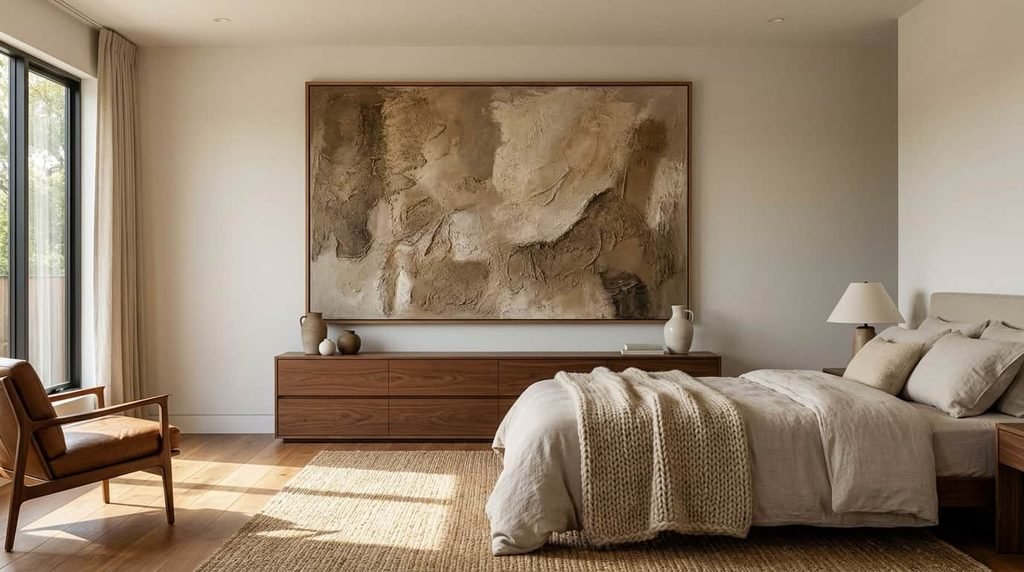
A large wall usually needs scale, not simply more decorations.
Consider starting with one substantial feature:
- Oversized artwork
- Large mirror
- Gallery wall
- Wallpaper mural
- Wood paneling
- Built-in shelving
- Large textile
If you prefer several smaller pieces, make sure they work together as one large composition.
For example, nine small frames arranged in a structured grid can successfully fill a large wall, while the same nine frames randomly scattered around the wall may look accidental.
How to Match Wall Decor With Your Bedroom
Your wall decor doesn’t need to match your bedding exactly. It needs to relate to it.
If your bedding has a bold floral pattern, choose simpler artwork that picks up one or two of its colors.
If your bedding is solid white, beige, or gray, you have more freedom to introduce color, texture, or pattern on the wall.
Your headboard matters too. A tall, patterned headboard already creates a strong focal point, so adding an equally busy gallery wall directly above it may make the room feel crowded.
Think coordination rather than matching.
You can connect pieces through:
- Color
- Texture
- Material
- Shape
- Frame finish
- Overall mood
Bedroom Wall Decor Ideas by Budget
You don’t need a large budget to make a blank wall look finished.
Under $25
Consider:
- Thrifted frames
- Printable artwork
- Personal photographs
- Postcards
- DIY painted designs
- Simple textile pieces
Presentation matters at this price point. A collection of inexpensive frames can look intentional when the arrangement is carefully planned.
$25–$75
This budget opens up options such as:
- Framed prints
- Small or medium mirrors
- Picture ledges
- Removable wallpaper for an accent area
- Coordinated artwork sets
$75–$200
Consider investing in:
- Oversized artwork
- Better-quality mirrors
- Larger textile pieces
- More substantial wall treatments
- Multiple coordinated frames
$200 and Up
For a larger project, you might consider:
- Custom framing
- Statement artwork
- Built-in shelving
- Extensive wall paneling
- Professionally installed features
If you’re spending more, prioritize things you’ll keep for years. A well-framed piece of oversized artwork can have more lasting impact than a collection of inexpensive decorations chosen simply to fill space.
Bedroom Wall Decor Mistakes to Avoid
Choosing artwork that’s too small
A small frame can disappear on a large wall. Measure the available space and think about the overall footprint before purchasing.
Hanging everything too high
Artwork should have a visual relationship with the furniture beneath it. Avoid placing pieces so high that they seem disconnected from the bed or dresser.
Filling every empty wall
Space isn’t wasted space. It gives the eye somewhere to rest and makes your main decorative pieces more noticeable.
Creating competing focal points
A statement headboard, bold wallpaper, oversized artwork, and dramatic gallery wall may all look good individually—but together they can compete.
Choose one primary focal point and let the other elements support it.
Buying before measuring
That artwork that looked perfect online can feel surprisingly small when it arrives. Measure first and, when possible, mock up its size with painter’s tape.
Using unsuitable mounting hardware
A lightweight print and a heavy mirror require very different installation approaches.
Match the hardware to the object’s weight and your wall type, and follow the manufacturer’s installation instructions.
Matching everything too literally
Your wall art doesn’t need to be the exact color of your comforter. A shared undertone, texture, or accent color is often enough to make the room feel cohesive.
A 10-Minute Plan for Decorating Your Bedroom Wall
Before spending money, take ten minutes to plan.
1. Photograph the wall.
Take a photo from the doorway and another from the bed.
2. Measure the wall.
Record its width and height.
3. Measure the furniture below it.
Measure your bed, dresser, desk, or console.
4. Choose the focal point.
Decide whether you want artwork, a mirror, wallpaper, paneling, shelving, or another feature.
5. Estimate the overall footprint.
Think about how much wall the complete arrangement should occupy.
6. Make a template.
Use paper, cardboard, or painter’s tape to mark the approximate size.
7. Step back.
Check the proposed arrangement from several viewpoints.
8. Simplify if necessary.
If it feels crowded, remove an element rather than automatically adding more space.
9. Check installation requirements.
Make sure your chosen hardware and wall surface are appropriate for the weight.
10. Buy or install.
Once the proportions look right, you’re ready to commit.
This simple process can save you from buying artwork that’s too small, installing shelves in the wrong place, or creating a gallery wall that feels unbalanced.
Frequently Asked Questions
What looks good on a bedroom wall?
Oversized artwork, gallery walls, mirrors, floating shelves, textiles, wallpaper, wood paneling, sconces, and painted accent walls can all work well. The best choice depends on your room’s proportions, furniture, style, and budget.
What should I put above my bed?
Popular choices include oversized artwork, coordinated prints, gallery walls, textiles, wall paneling, and statement headboards. Whatever you choose, make sure the scale works with the bed and that anything mounted overhead is securely installed.
How do you decorate a large empty wall in a bedroom?
Start with scale. An oversized artwork, large mirror, gallery wall, wallpaper, wood paneling, or built-in shelving will usually have more impact than several unrelated small decorations.
How big should wall art be above a bed?
A useful starting point is for the artwork or complete grouping to occupy roughly two-thirds to three-quarters of the bed’s width. Adjust based on the headboard, ceiling height, wall dimensions, and composition.
How can I decorate my bedroom walls without nails?
Try removable hanging products for appropriately lightweight pieces, leaning artwork, picture ledges, textiles, removable wallpaper, and decals. Always check the product’s weight rating and surface requirements.
Should bedroom wall art match the bedding?
Not exactly. Instead, coordinate the colors, textures, materials, or overall mood. If your bedding is busy, simpler artwork can create balance; if the bedding is plain, the wall can carry more visual interest.
How many pieces of wall art should be in a bedroom?
There’s no ideal number. One large piece may be enough for a small wall, while a larger wall might benefit from a gallery. Focus on the scale and balance of the complete arrangement rather than a specific number.
Final Thoughts
The best bedroom wall decor ideas aren’t necessarily the most expensive or the trendiest. They’re the ones that fit your room.
Before buying anything, measure the wall, consider the furniture around it, and decide what you want the wall to accomplish. Then choose one strong focal point and give it enough space to stand out.
For one bedroom, that might mean an oversized print above a queen bed. For another, it could be a thrifted gallery wall, removable wallpaper in a rental, floating shelves in a small room, or a wood-paneled feature wall.
Good wall decor isn’t about filling every blank spot. It’s about making the space feel intentional.