The best kitchen cookbook storage ideas do two jobs: keep your favorite recipes within easy reach and stop your counters from becoming another storage shelf. The right solution depends on how often you cook from your books, how much wall or cabinet space you have, and whether you want the collection visible or tucked away.
Cookbooks are awkward to store because they are useful kitchen tools and attractive decor at the same time. A shelf full of them can add color and personality, but a random pile beside the coffee maker quickly becomes clutter.
The good news? You don’t need a dedicated cookbook library to make them work.
Start by deciding which books deserve kitchen space
Before buying a shelf or rearranging a cabinet, pull out the cookbooks you actually use.
That distinction matters more than the size of your collection.
Keep the books you reach for regularly close to your main prep area. Older, seasonal, specialty, or rarely used books can live farther away in a pantry, utility closet, dining room cabinet, or another nearby storage spot. Better Homes & Gardens recommends using existing kitchen storage for frequently used cookbooks and moving overflow collections into other practical areas of the home.
This creates a simple two-zone system:
Everyday books stay accessible. Everything else gets quieter storage.
That one decision makes the rest of your Kitchen Cookbook Storage Ideas much easier.
1. Install a slim floating shelf
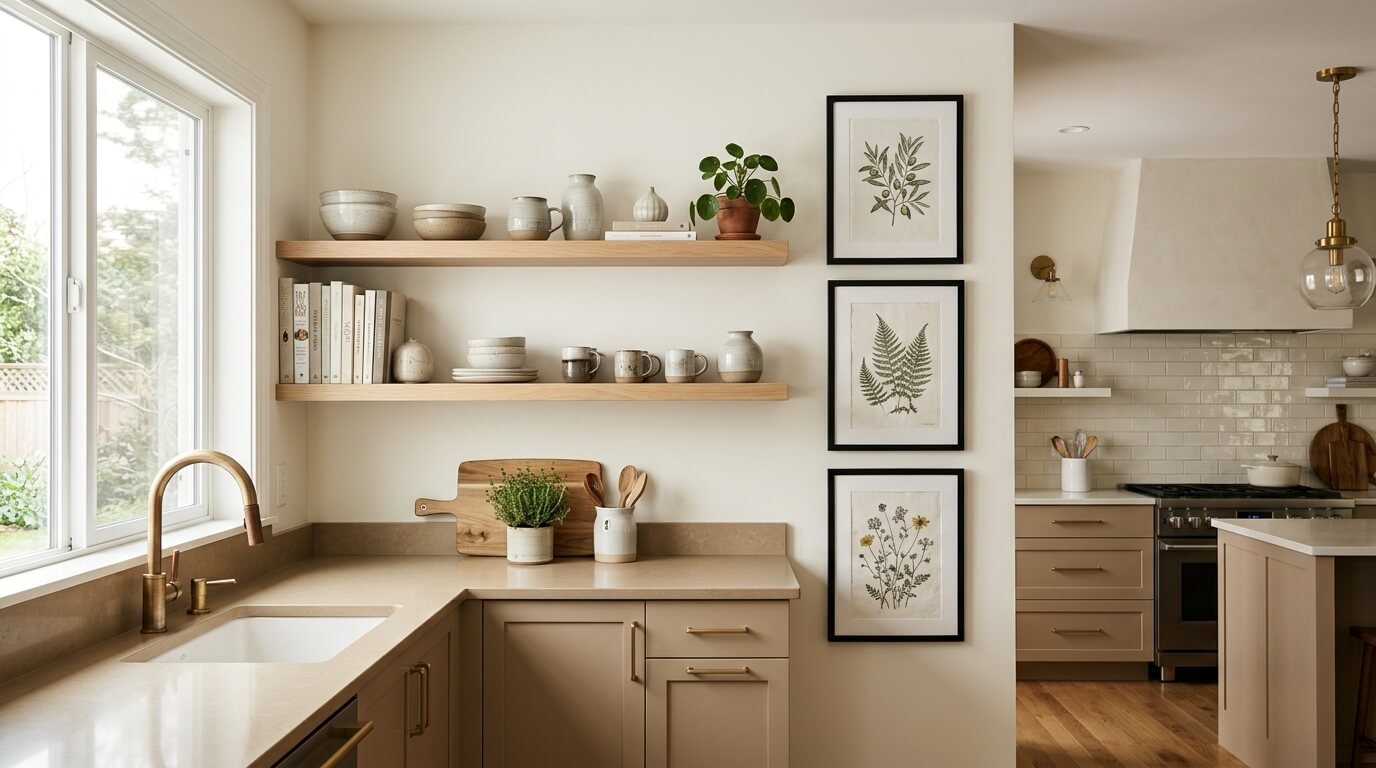
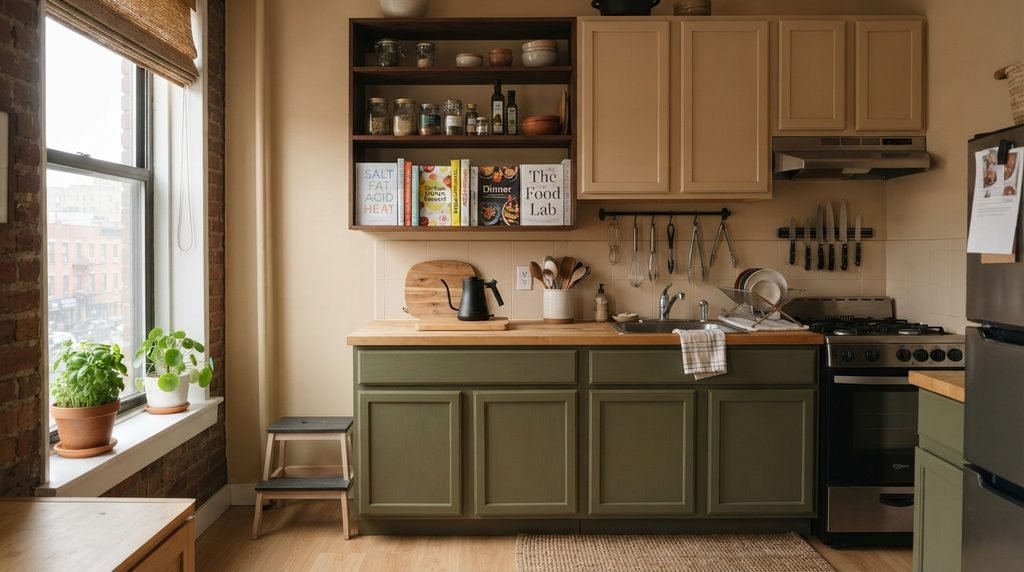
A floating shelf is one of the cleanest Kitchen Cookbook Storage Ideas for a kitchen with unused wall space.
Instead of giving up valuable counter area, use a narrow section of wall between cabinets, beside a pantry, or on another convenient wall. Homes & Gardens specifically recommends floating or picture-style shelving as a way to keep cookbooks accessible while turning them into part of the room’s decor.
Don’t automatically fill the entire shelf.
A row of books with a little breathing room usually looks more intentional than cramming every cookbook you own into one place. You can stand the books upright, group them by subject, or place a small stack beside them.
For a rental, choose a shelf solution that suits the wall and your lease restrictions rather than assuming permanent installation is an option.
Best for: kitchens with unused wall space and a small-to-medium collection.
2. Turn an open cabinet section into a cookbook nook
Already have open shelving? You may not need another storage product at all.
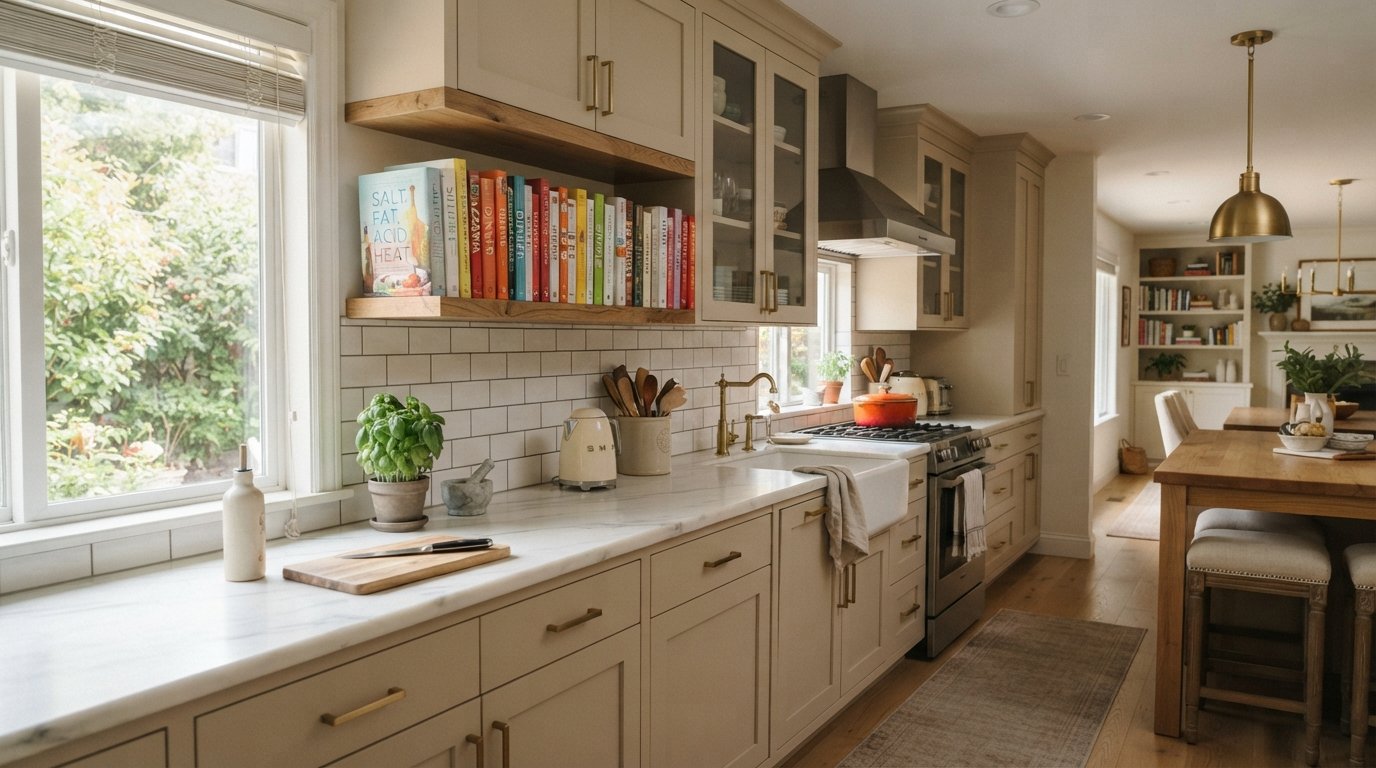
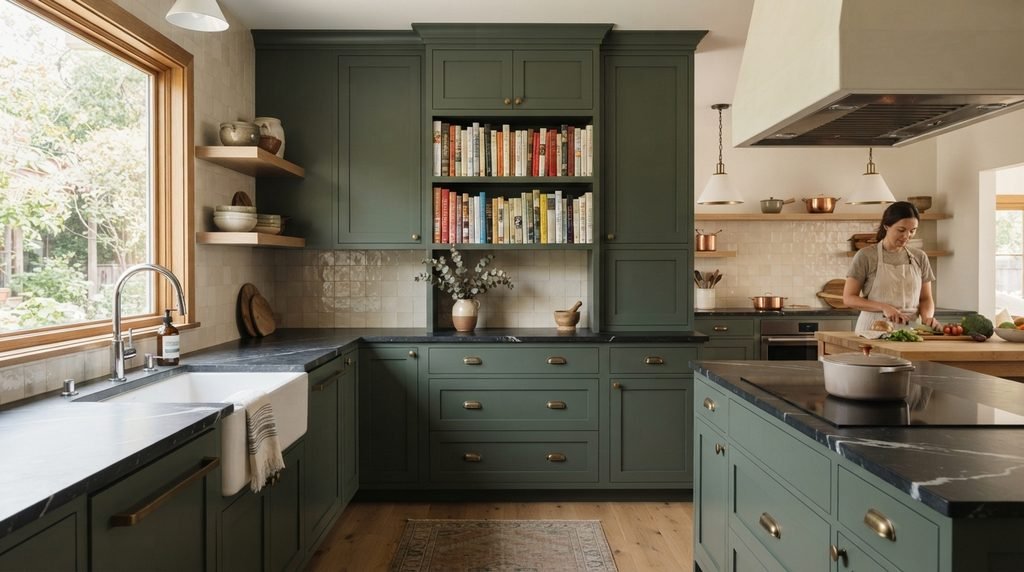
Dedicate one section to cookbooks and let the books fill an otherwise awkward gap. This works especially well between upper cabinets or beneath a section of open shelving.
Hausmatter shows how cookbooks can sit on open shelves between kitchen cabinets, where the surrounding cabinetry naturally frames the collection.
The advantage is visual consistency. Your books look like part of the kitchen rather than something added afterward.
Just keep the location practical. A shelf directly beside an area where cooking mess regularly reaches the books is not my first choice. Put the display somewhere convenient but away from the busiest splash zone.
Best for: kitchens that already have open shelving or an unused cabinet section.
3. Use a countertop cookbook stand for the books you use constantly
If you open the same cookbook several times a week, hiding it inside a cabinet defeats the purpose.
A cookbook stand gives you a dedicated place for the current favorite while keeping the book upright and easy to reference. The Kitchn recommends countertop bookends and cookbook display as practical options for frequently used books.
This works particularly well when you don’t have enough wall space for shelving.
There is one rule I’d stick to: display one or two books, not your entire collection.
A small stand looks intentional. Ten books stacked around it start competing with your workspace.
Choose a stable stand and place it where you can read the open pages without forcing yourself to lean across the cooking area.
Best for: frequent cooks and small collections.
4. Give a kitchen cart a dedicated cookbook shelf
A kitchen cart is useful because it moves.
If your kitchen has an island cart, bar cart, or similar piece with an open lower shelf, that space can become a compact cookbook station. The Kitchn has featured kitchen carts as a storage option for cookbook collections, essentially turning the lower section into a small library within the kitchen.
This is especially useful in a kitchen where wall space is already occupied.
Put your most-used books on the upper or easiest-to-reach section and less frequently used titles below. If the cart moves around, keep heavier books positioned securely rather than building a tall, unstable stack.
The other benefit is flexibility. You can move the cart when you need more working room.
Best for: renters, compact kitchens, and flexible layouts.
5. Store cookbooks in a basket when you want less visual clutter
Not every cookbook needs to be on show.
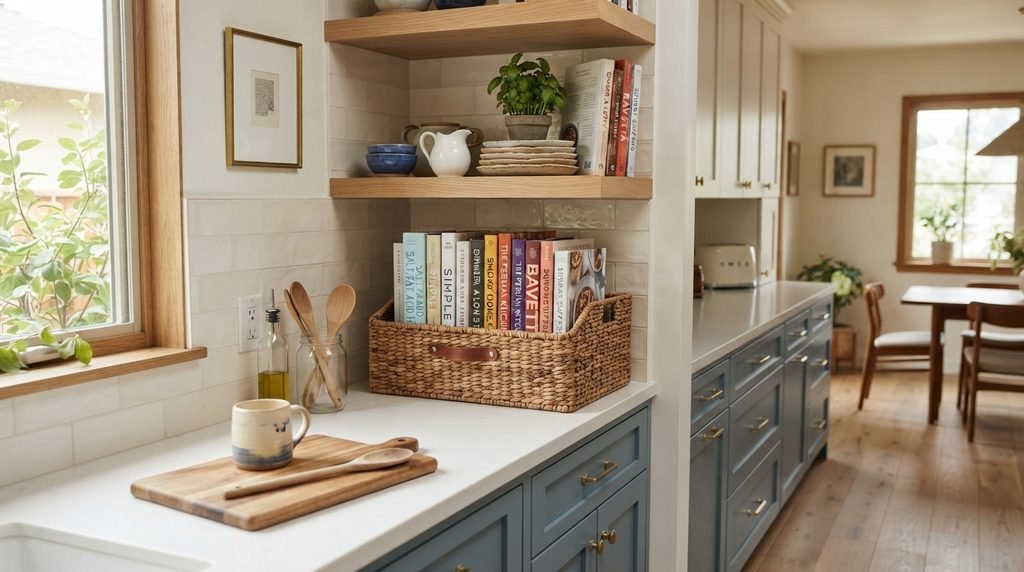
A basket on an existing shelf gives you a softer storage solution while keeping the books together. The Kitchn recommends placing cookbooks that don’t need to remain visible inside a cabinet or basket to reduce visual clutter.
This is one of the simplest cookbook organization ideas if your kitchen already feels busy.
Use a basket for books you still want nearby but don’t reach for every day. You can also separate categories into different baskets if your collection is large enough to justify it.
The important part is accessibility. Don’t put the basket behind three other containers and call it organized. If retrieving a book becomes annoying, you’ll stop using the system.
Best for: busy kitchens where open displays feel too crowded.
6. Build a small cookbook shelf into the kitchen island
If you’re renovating or designing a kitchen from scratch, consider giving cookbooks a permanent home inside the island.
An open end panel or dedicated shelving section can create useful Kitchen Cookbook Storage Ideas without consuming additional wall space. Homes & Gardens specifically highlights integrating cookbook storage into a kitchen island.
This option looks particularly intentional because the storage is designed with the kitchen rather than added later.
It doesn’t need to be a huge bookcase. A narrow vertical compartment can be enough for the cookbooks you use most.
Think about access before committing to the location. The shelf should be easy to reach without becoming a place where people constantly bump into the books as they move around the island.
Best for: homeowners planning a remodel or new kitchen.
7. Use a windowsill for a small collection
A wide kitchen windowsill can become surprisingly useful cookbook storage.
The Kitchn has featured cooks who keep books on kitchen windowsills, and Homes & Gardens also lists window shelves among its cookbook organization solutions.
This works best with a modest collection rather than a tall stack.
Keep the arrangement low enough that it doesn’t interfere with the window’s normal use. Also consider the conditions around the window before making it a permanent storage location. If the area gets damp or receives direct sunlight for long periods, another location might be a better fit for valuable books.
For a decorative look, display a few favorite covers and keep the remaining books elsewhere.
Best for: kitchens with deep, usable windowsills.
8. Add a narrow wall rack when floor space is tight
A narrow wall rack can make sense when your kitchen has almost no spare floor or counter space.
Instead of installing deep shelving, use a shallow storage solution that keeps books vertically organized against the wall. Similar slim racks and wall-mounted cookbook displays appear throughout current cookbook-display inspiration, including dedicated wall shelves and racks.
This is particularly useful for Kitchen Cookbook Storage Ideas because the footprint stays minimal.
The trick is choosing the right collection size. A slim rack is better suited to a curated group than a large library. If you have dozens of books, forcing everything into one narrow display will make the wall look crowded.
Use it for your favorites and move the rest to closed storage.
Best for: small kitchens with limited floor and counter space.
9. Move the larger collection to a nearby bookcase
Sometimes the best answer isn’t another kitchen shelf.
If your Kitchen Cookbook Storage Ideas collection has outgrown the kitchen, a standalone bookcase in a nearby dining area or utility space can keep everything organized without filling the cooking zone. The Kitchn and Livingetc both discuss standalone shelving as a practical option for larger cookbook collections.
This is where frequency-based organization becomes useful.
Keep a handful of everyday books in the kitchen. Put the rest in the nearby bookcase.
You can then organize the larger collection by cuisine, subject, author, size, or even color. There isn’t one universally correct system; The Kitchn notes that cooks organize collections in several different ways depending on personal preference.
I’d choose frequency of use first and a secondary system second. There is little value in alphabetizing a cookbook collection if you still have to search through it every night for the book you actually use.
Best for: serious home cooks and large collections.
10. Create a curated cookbook display instead of storing everything
Your Kitchen Cookbook Storage Ideas don’t have to behave like a traditional bookshelf.
A few attractive covers can become part of your kitchen decor. Stack two or three books, lean another against them, or use bookends to create a small display on an open shelf.
The goal isn’t to make every cookbook visible. It’s to make the collection feel intentional.
Current design-focused guides repeatedly treat cookbooks as decor as well as functional objects, using open shelves, stands, stacks, and selected covers to add personality to kitchens.
This approach works especially well if you have beautiful books you enjoy looking at but don’t use every day.
Keep the practical books accessible. Let the prettier ones do some decorating.
Best for: homeowners who want their Kitchen Cookbook Storage Ideas to contribute to the kitchen’s style.
How do you choose the right Kitchen Cookbook Storage Ideas for a small kitchen?
Small kitchens need fewer books in the active zone, not necessarily fewer books overall.
Start with the books you use most. A slim wall shelf, countertop stand, narrow rack, or small basket is usually more useful than trying to squeeze a full cookbook library into a tiny kitchen.
If counter space is already scarce, I’d skip the permanent countertop stack. Use a wall-mounted option or store most of the collection elsewhere.
For renters, prioritize movable solutions such as a kitchen cart, freestanding bookcase, basket, or countertop stand. For homeowners planning a renovation, built-in island or cabinet storage makes more sense.
That is the difference between storing books and actually designing a storage system.
How should you organize the books once you have a storage spot?
Don’t make the Kitchen Cookbook Storage Ideas system more complicated than the collection.
For a small group, frequency of use is enough:
- Everyday cookbooks at the easiest-to-reach level.
- Occasional books behind or below them.
- Seasonal and specialty books farther away.
- Decorative favorites where they look good.
For a larger collection, add one organizing rule. Cuisine, baking, vegetarian cooking, entertaining, or author are all reasonable categories.
Color works if your priority is appearance. Subject or frequency works better if your priority is finding a recipe quickly.
You can also combine the two: organize the main collection by subject, then create a small display of visually appealing favorites.
What should you avoid when storing cookbooks in the kitchen?
The biggest mistake is treating every storage location as equally useful.
A cookbook shelf beside the busiest part of the kitchen might look good in a photograph but become irritating in everyday use. The same applies to a giant countertop stack: it technically stores the books, but it also consumes work surface.
Avoid storing books where they regularly get in the way of food preparation, and don’t build a system that requires moving several objects every time you want one recipe.
Also resist the urge to fill every shelf.
Space is useful. It gives you room to pull a book out, add a new favorite, or change the display without reorganizing the entire kitchen.
The easiest system is usually a two-level one
You don’t need a complicated Kitchen Cookbook Storage Ideas system.
Keep a small working collection in the kitchen and store the rest nearby.
For most homes, I’d choose one visible solution such as a floating shelf, stand, or open cabinet section—and one hidden or secondary solution, such as a basket, pantry shelf, or nearby bookcase.
That gives you the best balance of access and appearance.
Start by pulling every cookbook out today. Pick the books you actually reach for, give those the prime kitchen location, and move the rest somewhere they can wait without taking over your prep space.