A window seat does two jobs particularly well: it gives you a comfortable place to sit and puts otherwise awkward floor space to work. The best window seat storage ideas go one step further by matching the storage style to what you actually need to keep there.
If you’re planning one from scratch, don’t choose the prettiest bench first. Choose the easiest way to reach your stuff.
Which window seat storage idea is right for your room?
For quick reference, think about the contents before the cabinet style. Bulky blankets and seasonal pillows make sense in a lift-up compartment. Toys, books, or everyday supplies are easier to manage in drawers or open cubbies. Cabinet doors are useful when you want concealed storage with adjustable shelving.
That distinction sounds simple, but it changes the whole design.
The following ideas cover the main configurations worth considering, plus a few combinations that make more sense than using one Window Seat Storage Ideas across the entire bench.
1. Use a lift-up seat for bulky, rarely accessed items
A hinged seat is probably the simplest form of hidden window seat storage.
The entire top opens, giving you access to one large compartment underneath. That makes this configuration particularly useful for things that are awkward to fit into conventional drawers: spare pillows, folded throws, seasonal textiles, or other bulky items.
The downside is just as obvious.
You have to open the seat to reach anything inside. If the bench is covered by a large cushion, that cushion needs somewhere to go while you’re getting into the compartment.
So I’d use a lift-up design when the storage is more “store it and forget it” than “grab it every day.”
A professional window-seat project documented by Journal of Light Construction used a large lift-up lid alongside drawers, showing how the two access methods can be combined rather than forcing the whole bench into one configuration.
Best for: blankets, spare bedding, pillows, seasonal items.
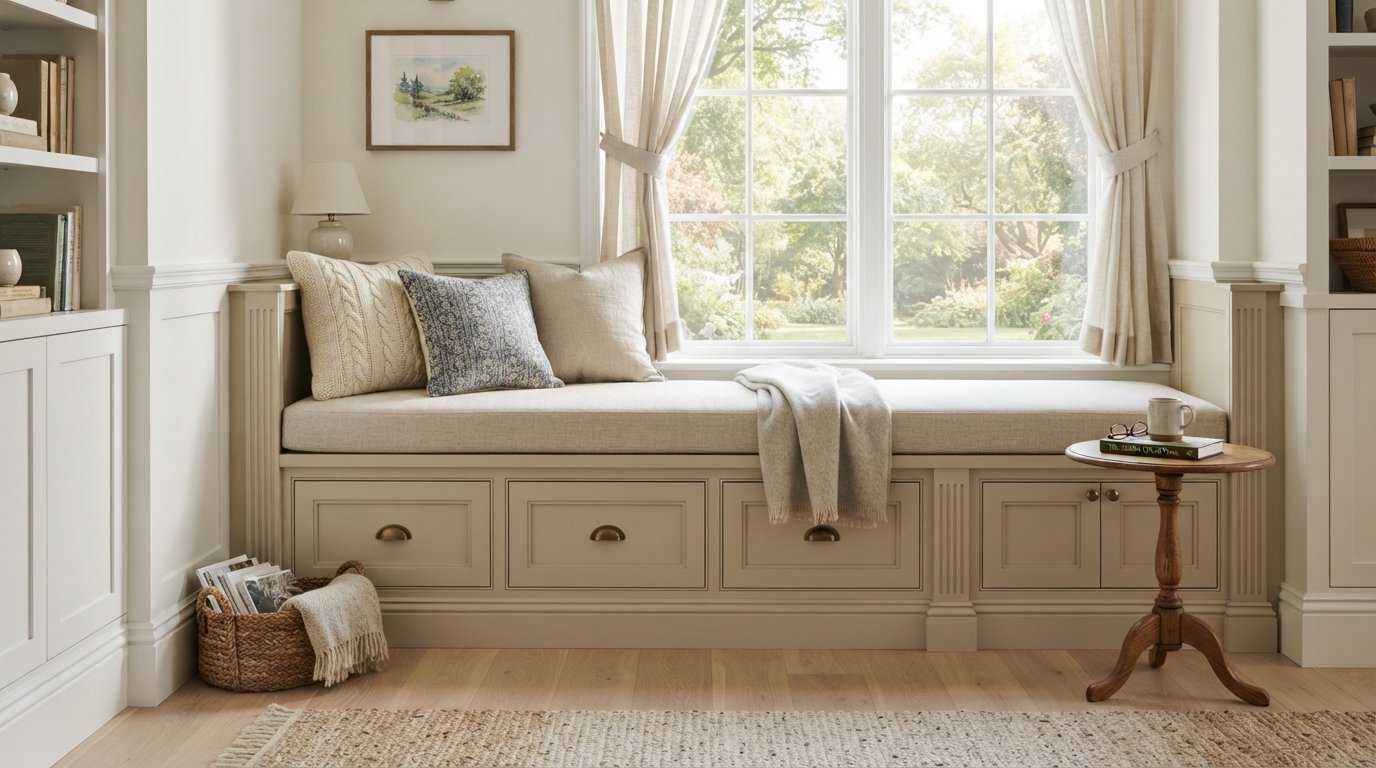
2. Install drawers when you use the storage every day
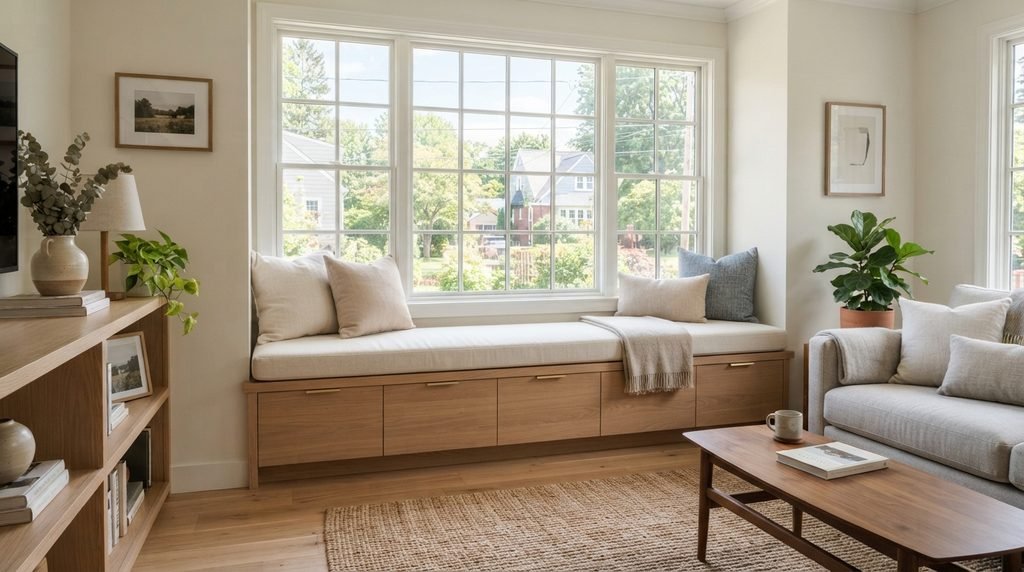
If you expect to reach into the bench frequently, drawers deserve serious consideration.
You sit on the cushion, pull the drawer open, take out what you need, and close it. There is no lifting a seat or moving a cushion.
That convenience is the whole point.
DecorPad’s design gallery shows numerous built-in window seats using multiple drawers beneath the cushion, including designs with three or more drawer fronts and decorative pulls.
Drawers also make it easier to divide the contents. Instead of digging through one deep cavity, you can give different sections different jobs.
One drawer for toys. Another for books or craft supplies. Another for spare linens.
The exact layout should follow your storage needs rather than a fixed number of drawers.
Best for: frequently used items, toys, books, crafts, household supplies.
3. Try cabinet doors for a cleaner furniture look
Not every homeowner wants a row of drawer fronts.
Cabinet doors give a window seat a more furniture-like appearance, particularly when the bench sits alongside existing built-ins.
Behind the doors, you can use shelving to divide the cavity. That makes cabinet-style storage especially useful when the items you’re storing vary in size.
There is another visual advantage: the door fronts can match surrounding cabinetry.
This approach appears in professional built-in designs where window seats are paired with cabinets or shelving on either side, making the bench feel like part of the room’s original millwork rather than an isolated piece of furniture.
Best for: living rooms, offices, built-in walls, mixed-size household storage.
4. Leave part of the base open for baskets
Sometimes hiding everything behind a door is unnecessary.
Open cubbies underneath a window bench let you slide in baskets, bins, or books without opening anything. That makes this one of the more practical window bench storage ideas for spaces where people are constantly grabbing and putting things away.
It also gives you an opportunity to add texture. Woven baskets under a painted bench can soften an otherwise very built-in-looking installation.
The catch is clutter.
Open storage displays whatever is inside it. If the baskets become a dumping ground, the whole window seat starts looking messy.
Use this design when you are comfortable with visible storage or when baskets will contain the visual chaos.
Best for: mudrooms, kids’ rooms, playrooms, books, everyday accessories.
5. Combine drawers and cabinets instead of choosing one
Why force every item to use the same access method?
A longer window seat has enough room to divide the storage into zones. Drawers can handle smaller, frequently used items while cabinet doors hold larger or less frequently accessed things.
This combination is specifically used in custom window-seat projects because different contents benefit from different access arrangements.
For example, imagine a living-room bench:
The drawers hold remote controls, books, games, or small household items. A cabinet section stores larger cushions or throws.
That is a much more useful arrangement than building one enormous cavity simply because it provides the most volume.
Best for: long benches, family rooms, multipurpose spaces.
6. Build a reading nook with storage underneath
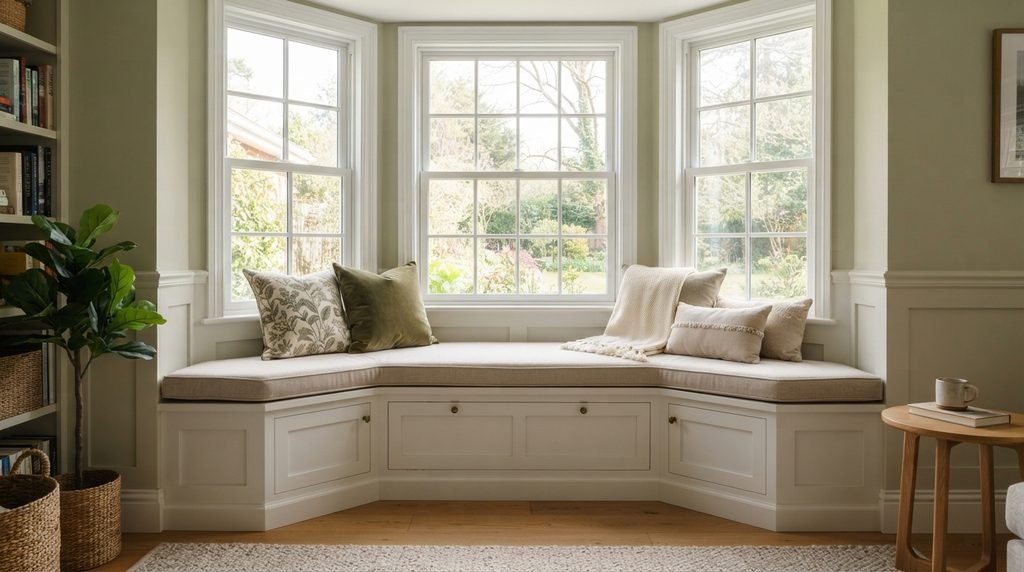
A window seat doesn’t have to look like a storage cabinet with a cushion slapped on top.
Build the Window Seat Storage Ideas into a proper reading nook.
A cushioned bench under the window, shelves on the sides, and carefully planned storage below can turn an otherwise empty alcove into a dedicated reading area. Design galleries show this approach repeatedly in bedrooms, offices, dens, and children’s rooms.
The trick is keeping the Window Seat Storage Ideas useful without making the seating uncomfortable.
Don’t let the desire for maximum storage dictate every dimension. The seat still has to function as a seat.
Best for: reading corners, bedrooms, home offices, libraries.
7. Give a child’s room storage they can actually reach
A window seat can be particularly useful in a child’s room because the Window Seat Storage Ideas are positioned low.
But the configuration matters.
Drawers or open baskets are easier for children to access than a heavy cushion that has to be lifted. A low drawer can become a toy zone, while open cubbies can hold books where they’re easy to see.
DecorPad’s gallery includes numerous examples of storage window seats in children’s bedrooms and nurseries, while other guides specifically highlight drawers and open Window Seat Storage Ideas for toys and books.
Don’t make every compartment a catch-all. Giving each section a simple purpose makes cleanup much easier.
Best for: toys, books, stuffed animals, craft supplies.
8. Turn a bay window into a full storage bench
Bay windows create one of the most natural locations for a Window Seat Storage Ideas because the available footprint already creates a defined nook.
Instead of putting a small chair in the middle and leaving the corners awkward, a fitted bench can follow the shape of the window.
Storage can run beneath the seat, with drawers or cabinet doors arranged according to the available sections.
This is one area where copying a picture from Pinterest or an inspiration gallery is a bad idea. Bay windows vary considerably in shape, angles, sill heights, and surrounding trim.
Measure the actual space first.
Then design the bench around it.
9. Add side shelving for books and display items
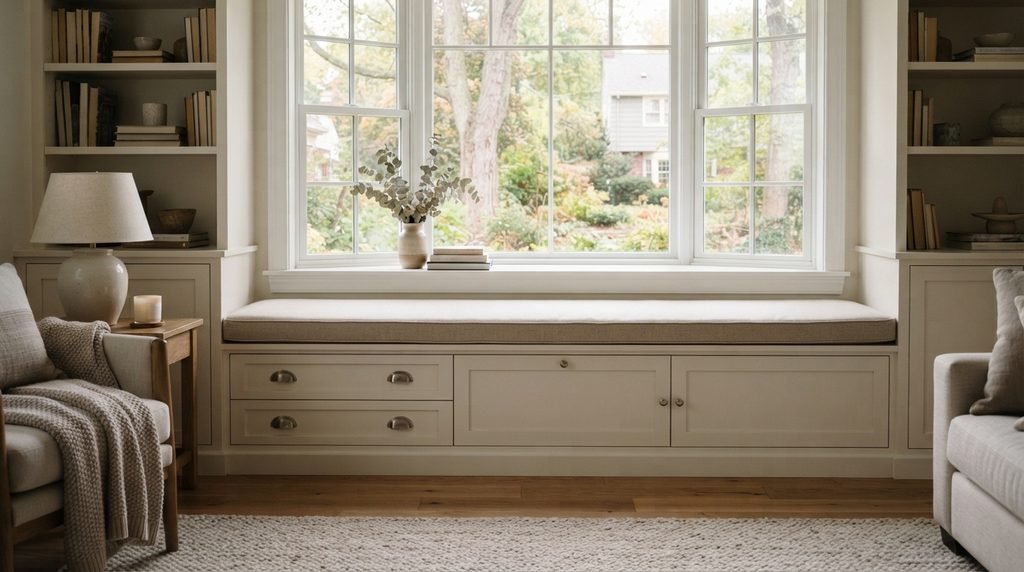
The storage doesn’t have to stop at the seat.
If your window seat sits between two walls, narrow shelving on either side can make the entire nook more useful. You gain a place for books, framed photos, baskets, or decorative objects while keeping the seat itself focused on concealed storage.
A documented custom window-seat project used adjustable shelving units on both side walls in addition to the storage below the bench.
This is especially effective in a reading nook because the things you want nearby are at arm’s reach.
Just don’t fill every available inch with cabinetry. The seat needs breathing room visually and physically.
Best for: books, decor, reading nooks, offices.
10. Use a combination of open and closed Window Seat Storage Ideas
Here’s a good compromise if you can’t decide between cubbies and cabinets.
Keep some sections open and close the rest.
Open sections can handle attractive baskets or books. Closed sections hide the things you don’t want on display.
This is especially useful in a family room where storage has two jobs: keeping frequently used things accessible and keeping visual clutter out of sight.
The combination also gives the bench more visual variation. A completely closed base can look heavy, while an entirely open base can look busy.
Best for: family rooms, playrooms, multipurpose spaces.
11. Divide a long bench into separate Window Seat Storage Ideas
A long bench doesn’t need one long storage compartment.
Breaking it into sections gives each part a purpose and makes the storage easier to organize. It also lets you choose different access methods across the same piece.
For example, one section could use drawers, another could have cabinet doors, and a third could be a lift-up compartment.
This is more than a design trick. The professional JLC example used both a lift-up lid and drawers because the homeowner wanted the benefits of both arrangements.
If you’re planning a custom installation, decide what each section is supposed to store before the cabinetmaker starts drawing the fronts.
That one conversation can prevent a lot of wasted Window Seat Storage Ideas.
12. Match the bench to the room’s existing built-ins
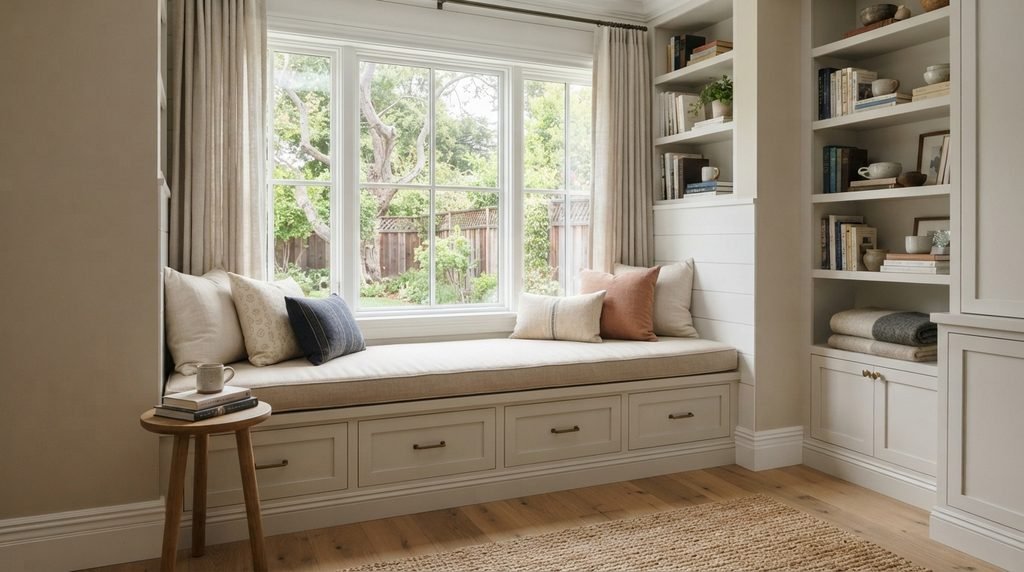
The most convincing built in window seat storage usually doesn’t look like an add-on.
Match the bench to the room.
If the room already has painted cabinetry, use compatible trim and finishes. If the window seat is part of a larger wall of shelving, make the base look like another cabinet section.
This approach shows up repeatedly in professional interiors, where window seats are integrated with surrounding shelving, cabinets, paneling, or other millwork.
You don’t need elaborate detailing.
Consistent proportions and materials usually do more for the finished appearance than adding decorative features everywhere.
What should you actually store inside a window seat?
Start with the things you already struggle to find a home for.
Soft, compressible items are an obvious fit: blankets, pillows, spare linens, and seasonal textiles. Toys and books also work well when the storage is easy for the household to reach.
The wrong approach is treating the cavity as a giant junk drawer.
Before building the bench, make a short inventory:
- Daily-use items: choose drawers or open storage.
- Weekly-use items: drawers or cabinets work well.
- Bulky, occasional items: consider lift-up storage.
- Attractive items: open cubbies or shelves make sense.
- Messy items: hide them behind doors or drawers.
That simple sorting exercise is more useful than choosing storage based on a photo.
Don’t forget what is behind the wall
This is the part inspiration galleries cannot tell you.
Before committing to a built-in, inspect the window area and identify anything that could interfere with the installation. That includes existing trim, outlets, heating equipment, and other features that occupy the space beneath or beside the window.
One documented window-seat project specifically dealt with a radiator beneath the windows, showing why the existing conditions matter before the cabinet layout is finalized.
If a radiator, vent, plumbing, or electrical component is involved, don’t simply box it in because the finished rendering looks good.
Plan around it.
For a custom build, also make sure the seat structure is designed to support the intended load. An MDF-focused construction guide likewise emphasizes that the seat needs adequate support beneath the panels rather than relying on the sheet material alone.
How deep and tall should a Window Seat Storage Ideas be?
There isn’t one universal dimension that should be copied into every room.
That’s clear from professional work: in one JLC project, the builder said he typically aimed for an approximately 18-inch seat height but built that particular seat at 25 inches because the client requested it.
That’s a useful lesson.
Comfort should be designed around the actual room and user, not a number found in an inspiration post.
Check the existing window, sill, trim, radiator or vent locations, cushion thickness, and how you want the bench to be used. If it’s primarily a reading seat, comfort takes priority. If it’s more of a decorative perch with occasional storage, the design priorities change.
What are the biggest window seat storage mistakes?
The prettiest option isn’t always the most usable.
A few mistakes show up repeatedly in storage-seat designs.
Choosing lift-up storage for everyday items.
If you open the compartment several times a day, moving a cushion and lifting the lid will get irritating.
Building one enormous cavity.
Maximum volume doesn’t automatically mean maximum usefulness. Small items disappear into deep storage.
Ignoring the cushion.
A hinged top becomes much less convenient when a thick, heavy cushion has to be removed every time.
Forgetting surrounding furniture.
A drawer that opens into a sofa, coffee table, or narrow walkway isn’t practical.
Copying dimensions from another room.
A window seat in a deep bay window is not the same project as a shallow bedroom alcove.
Using open storage for everything.
Visible baskets and cubbies need some level of organization. Otherwise the storage becomes part of the clutter.
Skipping the pre-build inventory.
This is probably the easiest mistake to avoid. Know what you’re storing before you decide how the bench opens.
So, which Window Seat Storage Ideas would I choose?
If the storage is mostly for bulky items you rarely access, I’d choose a lift-up bench.
For daily-use items, I’d spend the extra effort on drawers.
For a family room or long built-in, I’d combine drawers with cabinet storage.
For a kid’s room, I’d prioritize low drawers or accessible baskets.
And for a reading nook, I’d put as much thought into the seating and nearby shelving as the storage underneath.
The goal isn’t to squeeze the maximum number of things beneath the window. It’s to create a seat you’ll actually enjoy using while giving the awkward space underneath a clear job.
Before ordering materials or calling a cabinetmaker, measure the window area, inspect what’s already installed beneath it, and write down exactly what you want to store. That list should determine the storage configuration not the other way around.
Related resources: What Is Smart Home Interior Design? Design Smarter · Home Hacks DecoradTech: 25 Smart Home Upgrades and Decor Ideas