The right curtains can change the look and feel of a living room without replacing the furniture or repainting the walls. They can soften harsh sunlight, improve privacy, add texture, and make windows feel like a deliberate part of the room’s design.
But choosing living room curtains involves more than picking a color you like. The fabric, length, width, hanging position, window shape, and amount of light you want to keep or block all affect the final result.
If you’re looking for curtains for living room spaces, these 15 ideas will help you find a style that works with both your decor and your everyday needs.
15 Curtains for Living Room Ideas to Try
1. Choose Soft Linen Curtains
Linen and linen-blend curtains are a good choice when you want a relaxed room with natural-looking texture.
The slightly irregular weave keeps neutral curtains from looking completely flat, while lightweight linen can soften incoming daylight without making the room feel heavy.
Popular shades include:
- Soft white
- Oatmeal
- Flax
- Warm beige
- Light taupe
Linen curtains pair naturally with wood furniture, woven baskets, plants, jute rugs, and other organic textures.
If your living room already contains several patterns, choose a solid linen panel to keep the windows from competing with the rest of the decor.
2. Try Floor-Length Neutral Curtains
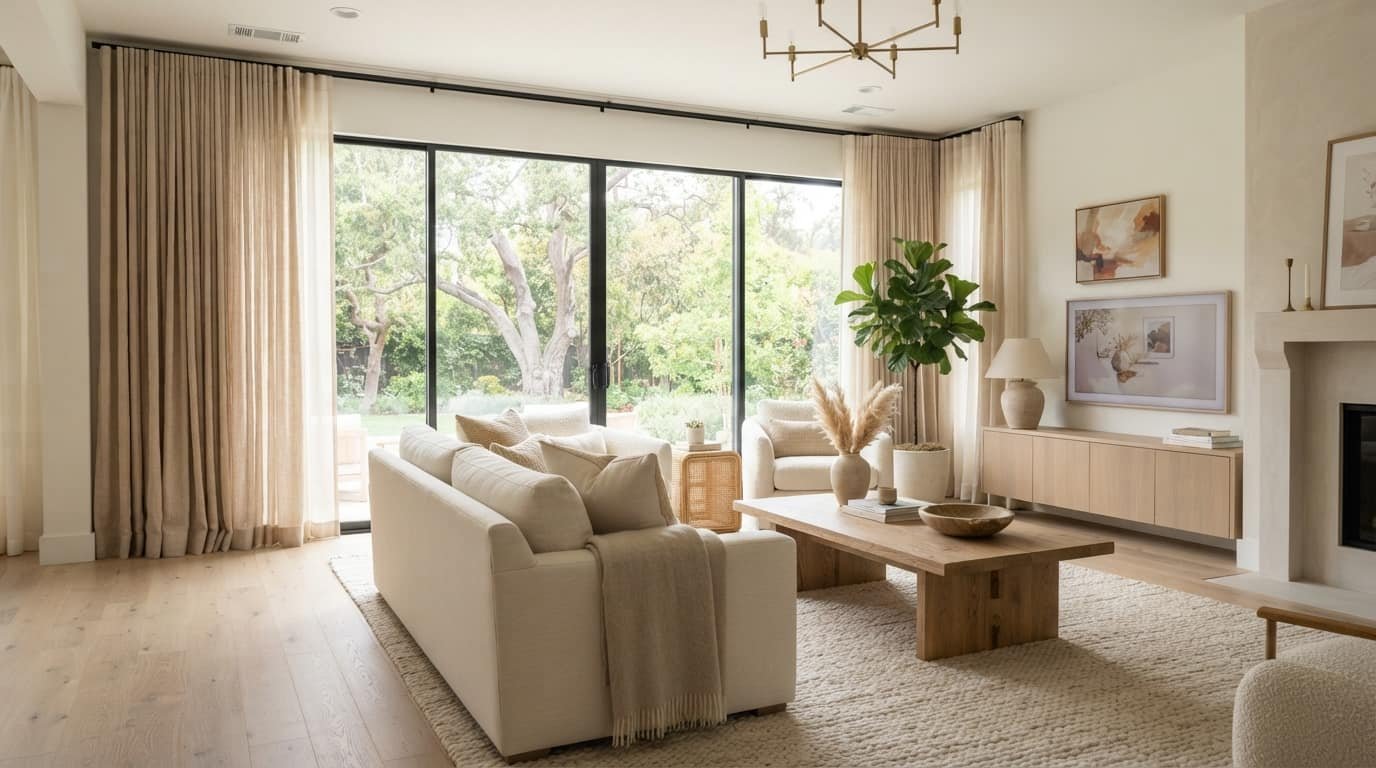
Floor-length curtains can give the room a polished, finished appearance and help visually connect the windows with the rest of the space.
Flexible neutral shades include:
- Ivory
- Beige
- Greige
- Warm gray
- Cream
Rather than matching the sofa exactly, choose a curtain color that relates to another feature, such as the rug, walls, upholstery, flooring, or wood finishes.
When the room allows it, hanging curtains high and letting them extend toward the floor can also create a stronger sense of height.
3. Use Sheer Curtains to Keep the Room Bright
Sheer curtains work well when natural light is a priority.
They can soften direct sunlight and provide some daytime privacy without making the room feel closed off. This can be especially useful for windows facing a sidewalk, neighboring property, or another area where you want some separation.
White and off-white sheers create an airy look, while warmer ivory and beige tones can make the room feel softer.
Remember that sheer fabric usually offers limited privacy at night when indoor lights are on. If nighttime privacy matters, consider layering sheers with another curtain or window treatment.
4. Layer Sheers With Heavier Drapes
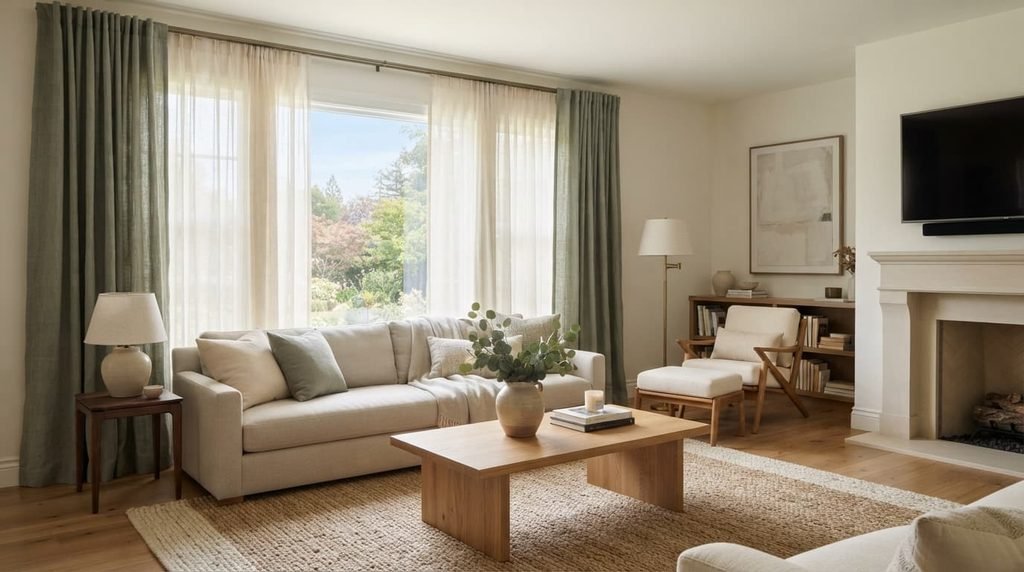
layered curtains
Two-layer curtains give you more control over light, privacy, and the overall mood of the room.
Keep the sheer layer closed during the day to filter sunlight, then close the outer drapes when you want more privacy or less light.
Simple combinations include:
- Sheer white + warm beige
- Sheer ivory + muted green
- White sheer + soft gray
- Natural sheer + taupe
The layers do not need to match exactly. They simply need to work together in color, texture, and overall weight.
Layered curtains are particularly practical for living rooms that need to serve different purposes throughout the day.
5. Match Curtains Closely to the Wall Color
For a calm and streamlined appearance, choose curtains that are close to the wall color.
This reduces visual contrast around the windows and can make a smaller room feel more cohesive.
For example:
- White walls → ivory curtains
- Beige walls → sand or taupe curtains
- Pale gray walls → soft gray curtains
- Warm cream walls → oatmeal curtains
The curtains do not have to be exactly the same shade as the walls. A slight difference in tone or texture can add depth while maintaining a cohesive look.
6. Add Subtle Contrast Around the Windows
Curtains can also provide controlled contrast instead of blending into the walls.
Warm beige curtains can add depth to white walls, while muted blue or green curtains can introduce color to a room dominated by warm neutrals.
One easy way to keep the result coordinated is to repeat the curtain color somewhere else in the room.
You could pick up the same shade in:
- Throw pillows
- Artwork
- An area rug
- An accent chair
- Decorative accessories
You don’t need to repeat the color everywhere. One or two connections are usually enough.
7. Bring in Warm Earth Tones

Earth-tone curtains can make a living room feel warmer without relying on a busy pattern.
Consider shades such as:
- Terracotta
- Olive
- Camel
- Rust
- Clay
- Warm brown
- Muted sage
These colors work naturally with cream, beige, natural wood, and other warm finishes.
If the room already has several strong colors, choose a muted earth tone rather than an extremely saturated shade. The goal is to support the existing palette rather than make the curtains the only feature that stands out.
8. Make Patterned Curtains the Focal Point
Patterned curtains can add personality when the rest of the living room is relatively simple.
Consider:
- Subtle geometric prints
- Botanical patterns
- Stripes
- Small-scale motifs
- Soft abstract designs
A useful approach is to let the curtain pattern influence the room’s accent colors. If the fabric contains blue, cream, and muted green, for example, you can repeat one or two of those colors in pillows or artwork.
Avoid matching every accessory to the curtain pattern. Repeating a few colors creates coordination without making the room feel overly staged.
9. Add Depth With Velvet Curtains
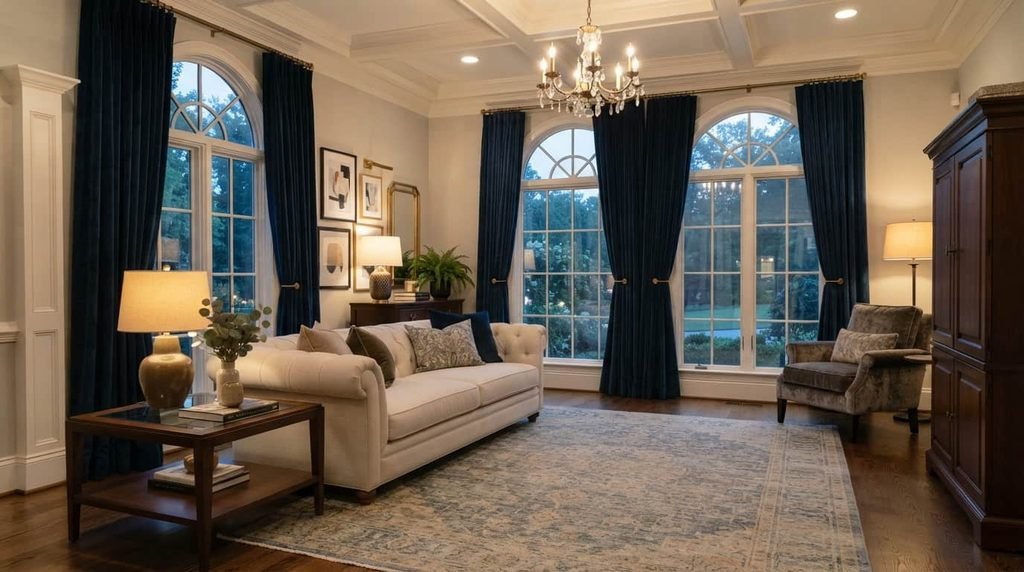
Velvet curtains bring visual weight and a richer texture to a living room.
They can suit traditional, classic, transitional, or more dramatic interiors, particularly when paired with substantial furniture and warm lighting.
Because velvet generally looks heavier than sheer or lightweight fabrics, consider the room’s size and natural light before choosing it.
Deeper shades such as forest green, navy, burgundy, and chocolate brown can create a dramatic effect. For a softer look, choose dusty or muted versions instead.
10. Keep Curtains Light in a Small Living Room
Small living rooms often benefit from window treatments that do not add unnecessary visual weight.
Light-colored curtains can help maintain an open appearance, particularly when they are similar to the wall color.
You can also reduce bulk by choosing a fabric and heading style that creates clean, controlled folds rather than excessive fullness.
Think about the furniture around the window, too. A curtain panel that overlaps a sofa, shelving unit, or other furniture may be difficult to open and close.
The goal isn’t simply to make the room look larger. It’s to make the available space feel comfortable and functional.
11. Use Wider Panels for Large Windows
Large windows can handle more substantial curtain panels.
Avoid choosing panels that barely cover the opening. Instead, measure the entire area the curtains need to cover and consider how much fabric is needed for natural folds.
If the curtains are primarily decorative and will stay open, extending the rod beyond the window can allow the fabric to stack beside the glass rather than covering it.
For curtains that regularly close, make sure there is enough total width to cover the window comfortably.
Always measure the installation area rather than relying only on the glass dimensions.
12. Choose the Right Treatment for Bay Windows
Bay windows require a little more planning because their shape affects both the hardware and the way curtains hang.
Depending on the layout, you might use:
- A curved or flexible track
- Separate curtain sections
- Multiple rods
- Curtains positioned outside the bay
- Lightweight panels that preserve the openness of the window
If the bay window already provides plenty of natural light, lightweight curtains can soften the area without overwhelming its architectural shape.
If the bay is used as a reading nook or seating area, also consider how the curtains will interact with the furniture.
13. Keep Modern Living Room Curtains Simple
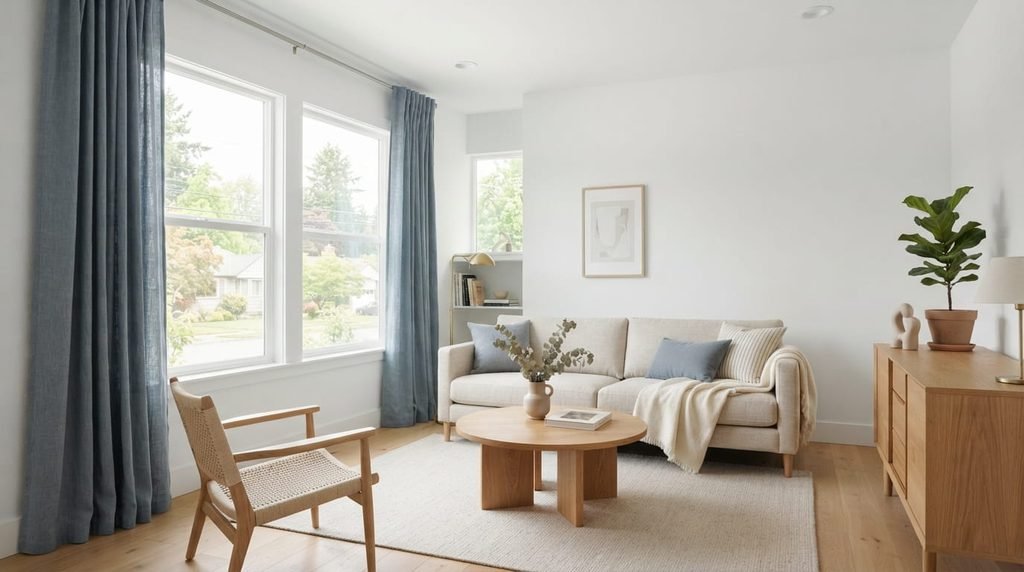
Modern interiors generally work well with simple curtain designs and clean lines.
That doesn’t mean the fabric needs to be completely plain. A subtle weave or natural texture can provide visual interest without introducing a busy pattern.
Good choices include:
- Solid linen
- Cotton blends
- Subtle woven fabrics
- Simple neutral drapes
- Minimal pleated panels
Keep the curtain hardware relatively simple as well if you want an understated appearance.
This approach is especially useful when the room already has statement furniture, strong artwork, or noticeable architectural features.
14. Add Texture With Woven Curtains
If your living room contains many smooth surfaces—such as leather seating, painted walls, glass, or polished furniture—textured curtains can add softness and visual depth.
Look for woven fabrics with a noticeable texture rather than relying entirely on patterns.
You can reinforce that layered feeling with other tactile materials such as:
- Wool
- Jute
- Wood
- Bouclé
- Knitted textiles
- Woven baskets
This gives the room more dimension without requiring lots of additional decoration.
15. Use Simple Decorative Details
Sometimes a small detail is enough to make a curtain treatment feel more distinctive.
Consider:
- Contrast edging
- A subtle stripe
- Simple trim
- Decorative curtain rods
- Minimal tiebacks
- Small-scale patterns
Keep the detail restrained if the room already contains a patterned rug, statement sofa, bold artwork, or decorative lighting.
A simple border or textured fabric may provide enough character without making the window treatment compete with everything else.
How to Choose Curtains for Your Living Room
The best curtains aren’t necessarily the ones that look good in a photograph. They also need to work with the way you use the room.
Start With Light and Privacy
Think about what you need the curtains to accomplish before choosing a fabric or color.
Ask yourself:
- Does the room receive strong morning or afternoon sun?
- Do you need daytime privacy?
- Do you need nighttime privacy?
- Do you want to preserve natural light?
- Does sunlight create glare on a television or computer screen?
If keeping the room bright is the priority, sheer or light-filtering curtains may be suitable.
If you need stronger privacy or light control, consider heavier curtains or a layered window treatment.
For rooms with significant glare or direct sunlight, combining curtains with another window treatment can provide more control.
Choose the Right Curtain Fabric
Fabric affects both the appearance and performance of your window treatment.
Linen and linen blends: Good for relaxed, natural interiors and visible texture.
Cotton: A versatile option that works across many decorating styles.
Sheer fabrics: Useful when you want to soften daylight while maintaining an airy appearance.
Velvet: Adds weight, softness, and a richer visual effect.
Synthetic blends: Depending on the specific fabric, these can offer practical care and durability.
Think about maintenance as well as appearance. If the curtains will be opened and closed frequently or the room is used by children or pets, a fabric that is easier to care for may make more sense.
Get the Curtain Length Right
Curtain length can have a major effect on the finished appearance.
Floor-length curtains are a common choice when the layout allows them, but the correct length ultimately depends on the window, furniture, doors, heating equipment, and other obstacles.
Measure from the point where the rod or track will be installed to the point where you want the curtain to finish.
Check for:
- Radiators
- Baseboards
- Heating vents
- Window seats
- Furniture
- Doors
- Built-in shelving
Don’t assume that one curtain length will work for every window in the house.
Measure the Curtain Width
Width matters just as much as length.
Start by measuring the width of the window or the full area you want the curtains to cover. Then consider how much fabric you’ll need to create the amount of fullness you want.
If the curtains will remain open most of the time, make sure there is enough wall space beside the window for the panels to stack without covering too much glass.
If the curtains will regularly close, make sure the combined panel width provides adequate coverage.
The exact amount of fullness depends on the fabric, heading style, and the look you’re trying to achieve, so follow the manufacturer’s recommended measurements when available.
Consider Curtain Heading Styles
The way curtains attach to the rod affects both their appearance and how easily they move.
Common options include:
Rod pocket: The rod passes through a sewn pocket. This creates a simple look but may be less convenient for curtains that are opened frequently.
Grommet: Metal rings are built into the top of the panel, creating clean folds and allowing the curtain to slide along the rod.
Back tab: Fabric loops sit behind the top edge of the curtain, giving a relatively clean appearance.
Pleated: Pleated headings create a more structured look and can work well in traditional or tailored interiors.
Choose the heading based on both style and how often you’ll use the curtains.
Pick a Color That Relates to the Room
Curtain color should work with the existing room rather than being selected in isolation.
Look at:
- Wall color
- Sofa upholstery
- Area rug
- Flooring
- Wood finishes
- Artwork
- Accent colors
You can choose curtains that blend into the room, coordinate with existing colors, or provide controlled contrast.
One simple strategy is to choose a color that already appears somewhere in the room but use a different tone or texture. This creates a connection without making every element look identical.
How High Should Living Room Curtains Hang?
There isn’t one universal measurement that works for every window.
The correct curtain height depends on the ceiling, window placement, trim, hardware, and overall proportions of the room. However, placing the rod above the window frame rather than directly across the top of the glass can create a more intentional appearance.
Extending the rod beyond the sides of the window can also give the curtains room to stack when open, provided the surrounding wall space allows it.
Before installing the hardware, check:
- Window and door clearance
- Nearby trim
- Wall construction and suitable anchors
- HVAC vents
- Furniture placement
- Rod and finial dimensions
- Where the curtains will stack when open
If you’re renting, check your lease before drilling. Tension rods or other removable solutions may be appropriate for some situations, although they may not support every curtain type or weight.
Common Living Room Curtain Mistakes to Avoid
Choosing Curtains That Are Too Short
Curtains that stop awkwardly above the floor can make the window treatment look disconnected from the room.
Measure from the actual rod or track position instead of estimating from the window itself.
Matching Everything Exactly
Your curtains don’t need to be the exact same color as your sofa, pillows, or rug.
Coordinate colors and textures instead so the room feels connected without looking overly matched.
Ignoring Light and Privacy Needs
A curtain can look beautiful but still be inconvenient if it blocks too much daylight or doesn’t provide enough privacy.
Decide what you need from the window treatment before choosing its appearance.
Buying Before Measuring
Measure both the window and the installation area before purchasing.
Check the width, height, rod position, clearance, and space available for the panels to stack.
Using Too Many Competing Patterns
A patterned rug, colorful furniture, bold artwork, and highly patterned curtains can compete for attention.
If the room already contains several strong patterns, a solid curtain with interesting texture may create a more balanced result.
Forgetting the Curtain Rod
The hardware is part of the overall window treatment.
Consider the rod finish, thickness, finials, brackets, and placement along with the curtains themselves.
A well-chosen curtain can still look unfinished if the hardware is poorly proportioned or positioned.
Choosing a High-Maintenance Fabric Without Considering Everyday Use
Some fabrics require more care than others. Before buying, check the cleaning instructions and think about how frequently the curtains will be handled.
A beautiful fabric isn’t a practical choice if its maintenance doesn’t fit your household.
Frequently Asked Questions About Living Room Curtains
What type of curtains are best for a living room?
It depends on your priorities. Sheer curtains work well when preserving daylight is important, while heavier curtains can provide more privacy and light control. Layered curtains offer flexibility when you want both.
Should living room curtains touch the floor?
Floor-length curtains are a popular choice because they can create a polished appearance and visually connect the window to the floor. However, the appropriate length depends on furniture, doors, heating equipment, and the layout of the room.
Should curtains match the sofa?
No. Curtains don’t have to match the sofa exactly. They can coordinate with the sofa, walls, rug, artwork, flooring, or another accent color already present in the room.
What color curtains make a living room look bigger?
Light, low-contrast curtains can help a small living room maintain an open appearance. Choosing curtains that are close to the wall color can also reduce visual divisions around the windows.
Are sheer curtains enough for a living room?
They can be enough if your main goals are filtering daylight and providing some daytime privacy. However, sheer curtains generally provide limited nighttime privacy when interior lights are on.
Should living room curtains be wider than the window?
The required width depends on how the curtains will be installed and used. Extending the treatment beyond the window can give the panels room to stack beside the glass when open, provided enough wall space is available.
What curtains work best for a small living room?
Light-colored and relatively simple curtains can work well in small spaces. Choose a suitable length, width, and installation position so the treatment doesn’t interfere with furniture or make the window area feel unnecessarily crowded.
How do I make living room curtains look more expensive?
Focus on proportion and installation rather than simply choosing a more expensive fabric. Correct measurements, suitable fullness, well-positioned hardware, consistent curtain lengths, and a fabric that complements the room can make a noticeable difference.
Conclusion
Choosing curtains for living room spaces is ultimately about balancing style with everyday function.
Start with the practical questions: How much light do you want? How much privacy do you need? How often will the curtains be opened? How much maintenance are you willing to handle?
Then consider the room’s existing colors, textures, furniture, and window proportions.
From soft linen and sheer panels to layered drapes, textured fabrics, and patterned curtains, there are plenty of ways to create a window treatment that suits your space.
Measure carefully, choose the fabric and hanging style based on how you’ll actually use the room, and coordinate the curtains with the elements you already have.
A thoughtful curtain choice can be a relatively simple update, but it can make a noticeable difference to the room’s light, comfort, privacy, and overall finish.
Related resources: Choosing Balcony Furniture: A Practical Room-by-Room Guide · Dining Rooms Design: 15 Ideas for a Beautiful, Functional Space