
How to Fix Squeaky Floors starts with finding the exact source of the noise. A squeaky floor can be more than annoying. One loose floorboard can wake someone up at night, make a hallway noisy, or leave you wondering whether something is wrong underneath the flooring.
The good news is that many squeaks can be fixed without replacing the entire floor. The right solution depends on where the movement is happening and whether you can access the floor from above or below.
Before grabbing a drill or hammer, locate the exact squeaky spot. Then determine whether the noise comes from rubbing floorboards, a loose connection between the subfloor and joists, or another source of movement. Once you know the cause, you can choose a repair that actually addresses it.
Key Takeaways
- Most floor squeaks are caused by movement and friction between flooring components.
- Finding the exact source should come before attempting a repair.
- Minor board-to-board friction may respond to a suitable dry lubricant.
- Gaps between the subfloor and joists can sometimes be stabilized with a shim.
- Loose subfloor connections may require appropriate fastening.
- Specialized repair kits can help when you need to work from above.
- Soft, sagging, damaged, or extensively squeaky floors may need professional inspection.
Why Do Floors Squeak?
Floors usually squeak when two components move against each other under pressure.
For example, a hardwood floorboard may rub against another board. A subfloor may also move slightly against a floor joist when someone walks across it. Loose fasteners, small gaps, wood movement, and changes in temperature or humidity can all contribute to the problem.
The sound itself does not tell you exactly which component is responsible. That’s why the first step should always be locating the movement.
A floor that simply makes an occasional noise is different from one that feels soft, unstable, or noticeably uneven. If you notice those additional problems, investigate further instead of treating the squeak as a purely cosmetic issue.
How to Find the Source of a Squeaky Floor
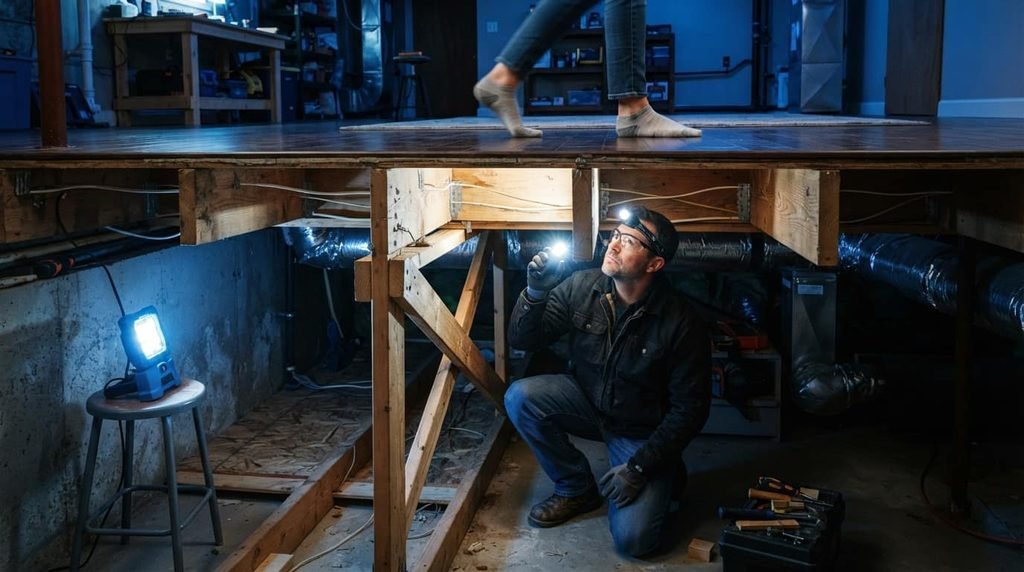
Start by walking slowly across the room.
Don’t rush from one end to the other. Put your weight on individual sections and listen for the point where the squeak begins.
When you find it, mark the area with painter’s tape.
If you have access to a basement or crawl space, the diagnosis becomes easier. Have another person walk across the floor while you listen and watch the underside.
Look for:
- A visible gap between the subfloor and a floor joist
- Movement in the subfloor when someone steps above
- Loose or separated flooring components
- Fasteners that appear loose or improperly positioned
- A particular board moving independently from the surrounding floor
Once you’ve identified the likely source, decide whether the repair should be done from above or below.
How to Fix Squeaky Floors From Below
If you have an unfinished basement, crawl space, or other accessible area beneath the floor, you can often work on the problem without disturbing the finished flooring.
1. Fill a Small Gap With a Wood Shim
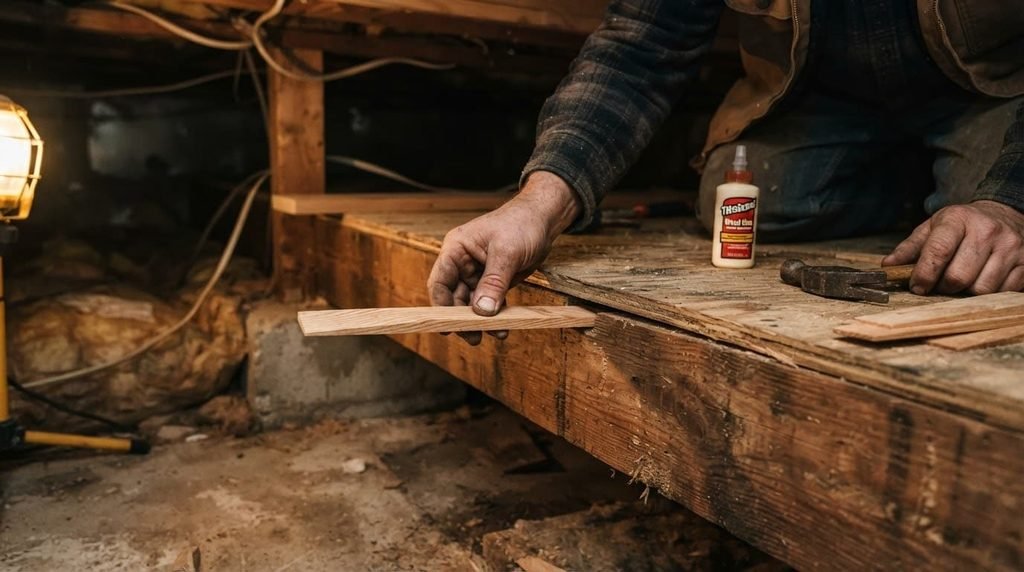
A small gap between the subfloor and a joist can allow the floor to move when someone walks above.
A thin wood shim can help fill that gap and reduce the movement.
Apply a suitable construction adhesive or carpenter’s glue to the shim if appropriate for the repair, then gently slide it into the gap. The goal is to fill the existing space, not force the subfloor upward.
Don’t hammer the shim aggressively. Overdriving it can lift the subfloor and potentially create another problem.
2. Secure the Subfloor to the Joist
If there is no obvious gap but the subfloor is moving against the joist, an appropriate fastener may help pull the components together.
Before choosing a screw, determine the thickness of the flooring assembly and the location of the joist. The fastener must be suitable for the materials and short enough to avoid penetrating the finished flooring above.
Having someone stand on the squeaky area while the repair is made can help hold the floor in its normal position.
This method should be performed carefully. Never drill blindly when you don’t know what may be concealed within the floor assembly.
3. Add Support to a Larger Moving Area
A squeak that extends across several adjacent boards may involve more than one loose connection.
In some situations, additional wood blocking or a suitable cleat can provide support beneath the subfloor and reduce movement.
This is more involved than fixing a single squeaky spot. Measure the area first and make sure any added support fits securely against the existing framing.
If the floor has significant movement, damaged framing, or signs of water damage, don’t rely on additional blocking as a quick fix. The underlying problem may require a more thorough repair.
4.How to Fix Squeaky Floors From Above
Sometimes there is no practical access underneath the floor. You may have a finished basement ceiling, a slab beneath the room, or another obstacle preventing access from below.
In that situation, repairs may need to be made from the finished floor side.
5. Reduce Minor Friction Between Floorboards
If two hardwood boards are rubbing against each other, a suitable dry lubricant worked into the seam may reduce the friction responsible for the squeak.
This is most appropriate for a minor surface-level squeak.
Work the lubricant into the joint rather than spreading a large amount across the finished floor. Clean up excess material afterward according to the product instructions.
If the noise continues, don’t keep adding lubricant. A persistent squeak may be coming from movement underneath the boards.
6. Use Appropriate Fasteners on Exposed Hardwood
A loose hardwood board may sometimes be secured from above with an appropriate flooring or trim fastener.
The repair needs to be positioned carefully so the fastener engages the supporting material without creating unnecessary damage.
For finished hardwood, a visible hole may need to be filled with a suitable wood filler or matching repair product.
This approach is best reserved for situations where you can confidently identify the construction beneath the board. Don’t drill into an unknown floor simply to see whether the squeak disappears.
7. Use a Specialized Floor Repair Kit
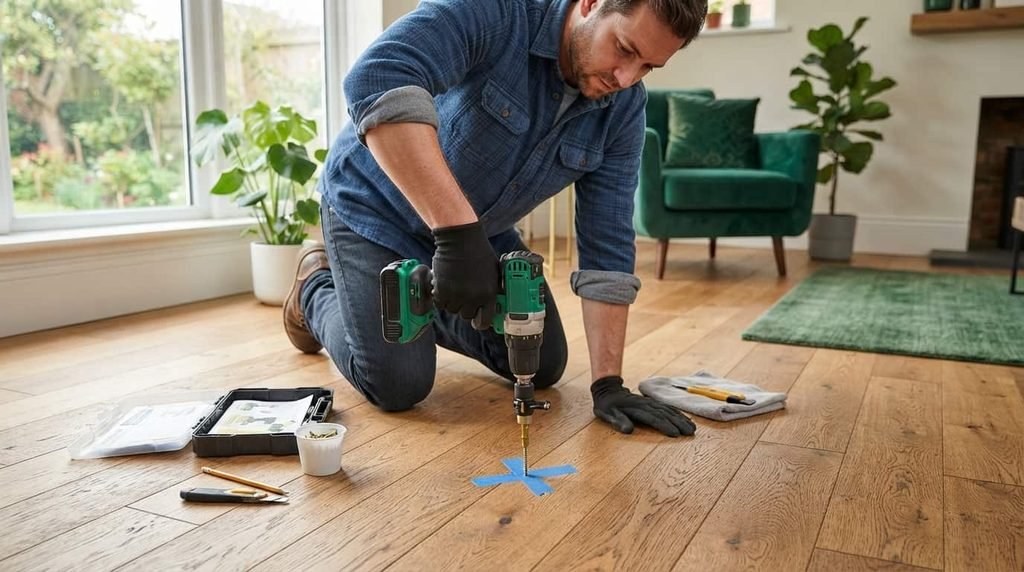
Specialized squeaky-floor repair kits can be useful when the floor needs to be secured from above while keeping the repair relatively inconspicuous.
Some systems use specially designed breakaway screws and an alignment fixture to secure the flooring assembly to a joist. After the screw is driven to the correct depth, the head can be designed to break away below the surface.
These systems are particularly useful for certain hardwood and carpeted floor applications where access from underneath isn’t available.
Always follow the instructions for the specific repair system rather than assuming all repair kits work the same way.
How to Fix Squeaky Floors Under Carpet
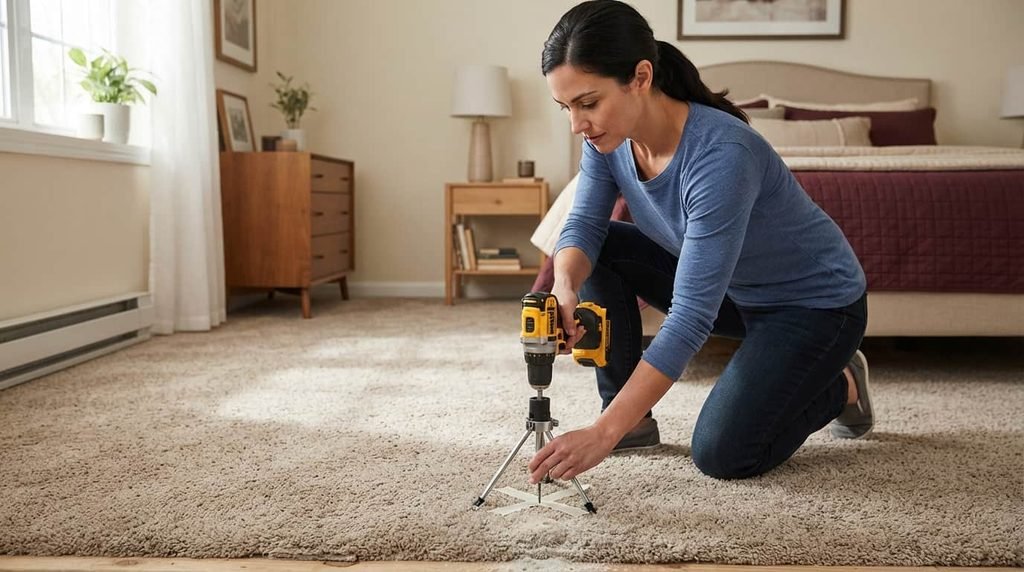
Carpet makes it harder to see what’s happening beneath the finished surface, but the repair process still begins with locating the squeak.
Walk slowly across the carpet and mark the noisy area.
If you can access the floor from underneath, inspect the subfloor and joists while someone walks above. This can make it easier to identify the exact point of movement.
If you cannot work from below, a specialized carpet-floor repair kit may be an option. Some systems are designed to locate the joist and secure the floor through the carpet while leaving little visible evidence of the repair.
Avoid randomly driving ordinary screws through carpet. The wrong fastener or installation method can damage the carpet fibers and may not solve the underlying movement.
Which Squeaky Floor Fix Should You Try?
The simplest way to choose a repair is to match the method to the problem.
| What you find | Possible approach |
|---|---|
| Floorboards rubbing together | Suitable dry lubricant |
| Small gap between subfloor and joist | Wood shim |
| Subfloor moving against a joist | Appropriate fastening |
| Larger area of subfloor movement | Additional support or blocking |
| Hardwood with no access below | Carefully planned repair from above |
| Carpeted floor with no access below | Specialized carpet-floor repair system |
| Soft, sagging, or damaged floor | Professional inspection |
This approach is better than trying every repair method at random.
Common Mistakes When Fixing Squeaky Floors
Repairing Before Finding the Cause
A squeak can come from several different points within the floor assembly. Mark the problem area before making any permanent repair.
Using a Screw That’s Too Long
A fastener that is too long can penetrate through the finished flooring. Measure the floor assembly and choose hardware appropriate for the repair.
Overdriving a Shim
A shim should fill a gap without forcing the subfloor upward. Too much pressure can create another source of movement.
Drilling Without Knowing What’s Below
Never assume the space beneath a floor is empty. Pipes, wiring, ducts, and other components may be concealed within the building assembly.
Treating Every Squeak With Lubricant
Lubrication may help with board-to-board friction, but it won’t correct every subfloor or framing problem.
Ignoring Other Signs of Floor Damage
A squeak combined with sagging, softness, unevenness, water damage, or significant movement deserves more attention than a simple isolated noise.
When Should You Call a Professional?
A small, isolated squeak can often be approached as a DIY maintenance project when you can clearly identify its source and understand the floor construction.
Professional help is a better choice when:
- A large portion of the floor squeaks.
- The floor feels soft or spongy.
- You notice sagging or significant unevenness.
- There are signs of water damage.
- The subfloor appears damaged.
- Floor joists or other framing appear compromised.
- You cannot determine what’s causing the movement.
- You are unsure about hidden utilities before drilling.
- Previous repairs have failed.
A professional can determine whether the problem is limited to loose flooring or whether the floor system needs more substantial repair.
Frequently Asked Questions
How do you fix a squeaky floor?
First, locate the exact source of the squeak. Then determine whether the movement is between floorboards, between the subfloor and joists, or somewhere else. Depending on the cause, you may use a suitable dry lubricant, wood shim, appropriate fastener, additional support, or a specialized repair kit.
What is the easiest way to stop a squeaky floor?
For a minor squeak caused by rubbing floorboards, a suitable dry lubricant may be one of the least invasive options. If the subfloor is moving against a joist, securing or shimming the connection may be more effective.
Can you fix a squeaky floor from underneath?
Yes. If you can access the underside through a basement or crawl space, you can inspect the subfloor and joists directly. Depending on the cause, a shim, suitable adhesive, fastening, or additional support may help reduce movement.
How do you fix a squeaky hardwood floor?
Start by identifying whether the hardwood boards are rubbing against each other or whether the movement is coming from underneath. Minor surface friction may respond to lubrication, while loose connections may require careful fastening or repair from below.
How do you fix a squeaky floor under carpet?
Locate the squeak first. If you can access the underside, inspect the subfloor and joists while someone walks above. Without underside access, a specialized carpet-floor repair system may be suitable for certain floor assemblies.
Why do floors squeak more at certain times of the year?
Wood responds to changes in moisture and environmental conditions. Expansion and contraction can alter how flooring components fit together and may make existing movement more noticeable.
Does a squeaky floor mean the floor is damaged?
Not necessarily. A squeak can result from ordinary movement between flooring components. However, squeaking combined with softness, sagging, water damage, or significant unevenness should be investigated more carefully.
Conclusion
Knowing how to fix squeaky floors starts with finding the movement rather than immediately adding screws or lubricant.
Walk across the floor slowly, mark the exact noisy area, and inspect the relationship between the floorboards, subfloor, and joists. If the problem is minor surface friction, lubrication may be enough. If the subfloor is moving, a shim, appropriate fastening, or additional support may provide a more targeted solution.
When access from below is available, you can often diagnose the problem without disturbing the finished floor. When it isn’t, specialized repair methods may provide another option.
And if the floor is soft, sagging, extensively damaged, or difficult to diagnose, treat the noise as a reason to investigate further rather than simply trying to silence it.
Related resources: 15 Small Bathroom Renovation Ideas for Smart Luxury · How to Soundproof Interior Door: 5 Proven Best Hacks