A kitchen can have plenty of cabinets and drawers and still feel cluttered. Often, the problem isn’t a lack of storage. It’s that the available space isn’t being used in a way that makes everyday tasks easier.
The right kitchen organization products can help you find utensils faster, make deep cabinets easier to reach, keep pantry items visible, and give awkward spaces a practical purpose. But buying an organizer for every messy spot isn’t necessarily the answer. Some products genuinely save space and time, while others simply give clutter another container.
The better approach is to identify the problem first, measure the space, and then choose a storage solution that fits the way you actually use your kitchen.
Prior to purchasing an organiser, address the issue
Before shopping for kitchen storage solutions, look at what’s making the space difficult to use.
If your utensil drawer is always mixed up, you probably need dividers rather than more drawer space. If you keep losing items at the back of a cabinet, a pull-out organizer may help more than another storage bin.
Start by removing expired food, duplicates, broken utensils, and things you never use. There is little point organizing items that shouldn’t be taking up valuable space in the first place.
Then measure the area you’re trying to improve.
For a cabinet, check the usable width, depth, and height. For a drawer, measure the inside rather than the outside of the cabinet. For under-sink storage, measure around pipes and other plumbing instead of assuming the cabinet is one open rectangle.
Also consider accessibility. Something you use every day shouldn’t be buried behind items you only need once a month.
A useful process is:
Declutter → Measure → Identify the problem → Choose the product → Check the fit
That simple sequence can prevent many unnecessary purchases.
Best Kitchen Organization Products for Drawers
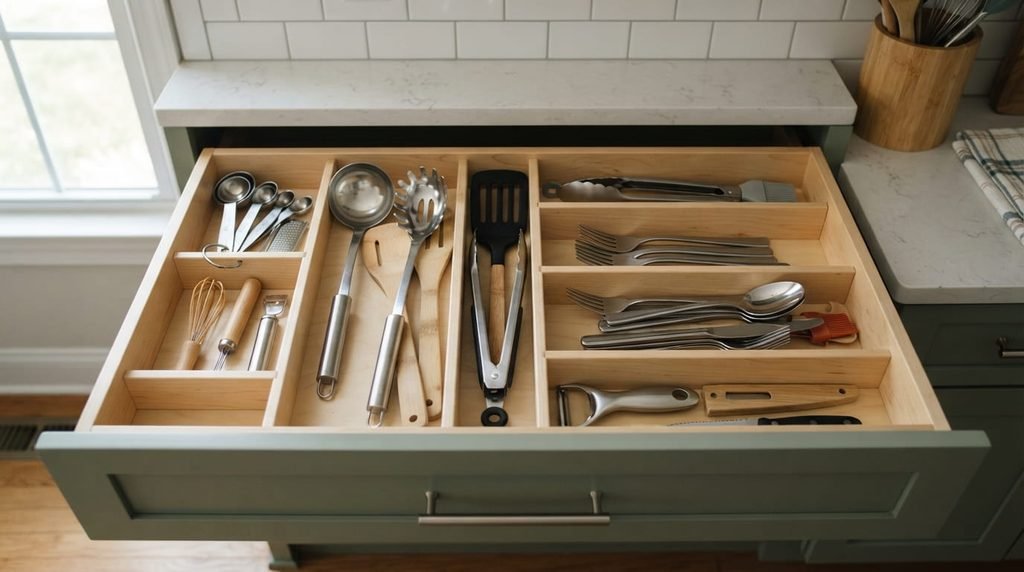
Drawers are convenient because everything is close at hand, but without some separation, small items quickly become a jumble.
Adjustable Drawer Dividers
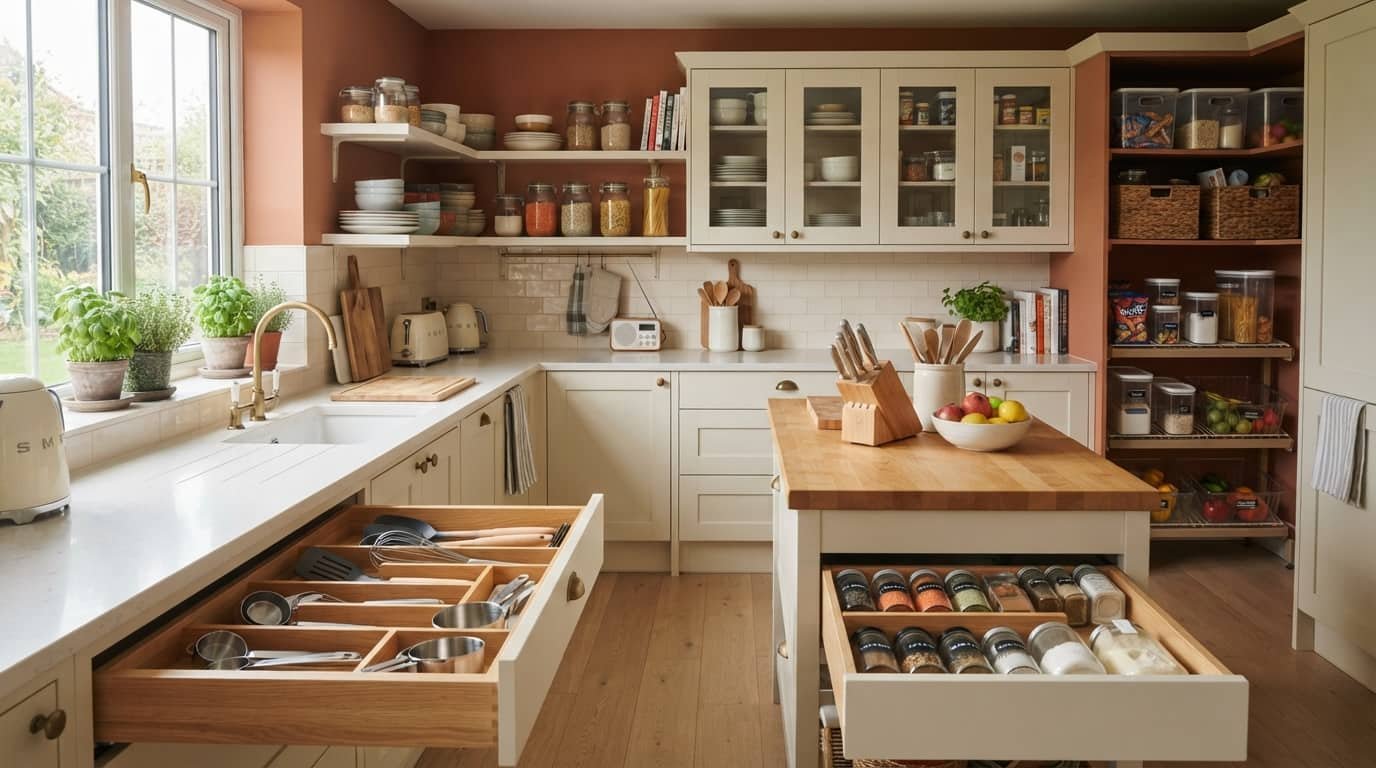
Adjustable dividers work well for cooking utensils, measuring spoons, serving tools, and other loose items.
They’re especially useful when drawer contents change over time. You can move the dividers instead of replacing the entire organizer.
Before buying, check the drawer’s interior width, depth, and height. A divider that fits the width but is too tall can prevent the drawer from closing properly.
Utensil Trays
A traditional utensil tray can be enough to separate forks, spoons, knives, and smaller tools.
For a narrow drawer, look for a compact or expandable design rather than trying to squeeze a large tray into the available space. If the drawer holds more cooking tools than flatware, choose an arrangement that reflects what you actually use.
Knife Drawer Inserts
If you prefer storing knives in a drawer, a dedicated knife insert can keep blades separated and prevent them from moving around loosely.
Choose an insert that fits securely and provides enough space for the knives you own. Safety should take priority over squeezing the maximum number of knives into one drawer.
Smart Ways to Organize Kitchen Cabinets
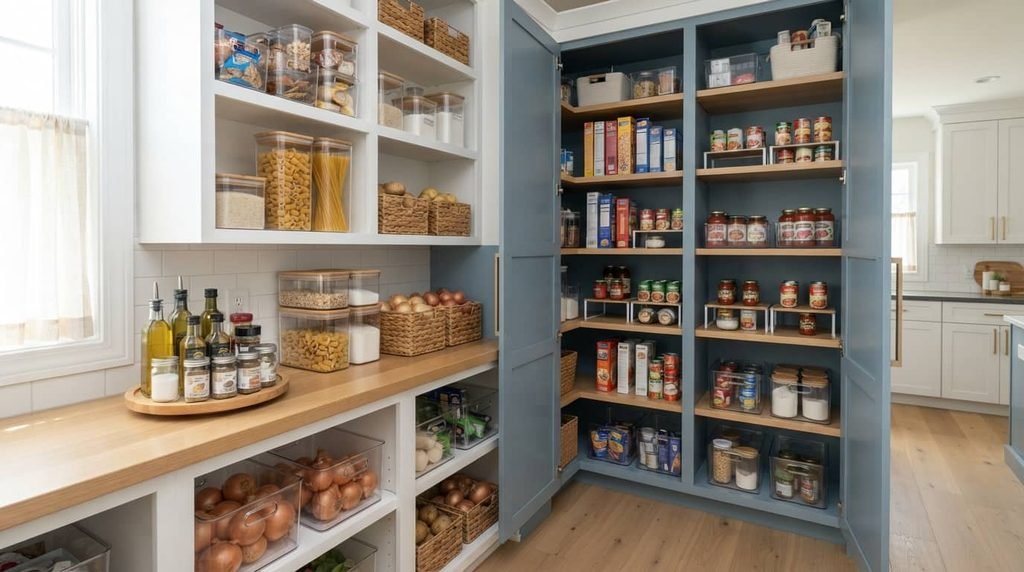
Cabinets often contain plenty of storage space, but poor visibility and difficult access can make that space frustrating to use.
Shelf Risers
Shelf risers are useful when there is a large amount of unused vertical space inside a cabinet.
For example, if your mugs occupy only the bottom half of a shelf, a riser can create another level for smaller cups or bowls.
They work best when there is enough clearance for both levels. If your shelves are already low, adding a riser can make the cabinet harder to use rather than more efficient.
Pull-Out Cabinet Organizers
Deep lower cabinets are a common source of wasted space. Items pushed toward the back can become difficult to see or reach.
A pull-out organizer brings the contents forward, making it easier to access items without reaching deep into the cabinet.
These can be particularly useful for pots, pans, cleaning supplies, or other heavier items stored in lower cabinets.
Check the cabinet opening and interior dimensions before purchasing. Also account for hinges, doors, and other obstructions.
Lazy Susans
A lazy Susan can be useful in deep or awkward cabinets where bottles and jars tend to disappear behind one another.
They’re practical for sauces, oils, condiments, baking ingredients, and other smaller containers.
However, they aren’t a universal solution. In a shallow cabinet, a turntable may take up more usable space than it creates.
Stackable Storage Bins
Storage bins are helpful when you want to group similar items together.
You might use one for baking supplies, another for snacks, and another for small kitchen tools. Instead of searching through an entire shelf, you can pull out the relevant category.
Choose a bin based on what you actually store. A huge container filled with unrelated items doesn’t solve clutter—it simply hides it.
Pantry Storage Products That Improve Visibility
Pantries can become difficult to manage because food packages come in different shapes and sizes. The goal isn’t necessarily to make everything look identical. It is to make ingredients easy to see, reach, and put away.
Clear Pantry Bins
Clear bins can group similar foods while allowing you to see what’s inside.
For example, breakfast items can go in one bin while baking ingredients stay together in another. This can be more practical than transferring every individual item into a separate container.
Stackable Food Containers
Stackable containers can make better use of vertical pantry space and are particularly useful for dry ingredients that come in awkward bags or boxes.
But don’t assume every food needs to be transferred into a matching container. If the original packaging is easy to identify, easy to seal, and already fits your shelf, leaving it alone may be the better choice.
Can Organizers
If canned food tends to form unstable piles, a can organizer can keep cans in rows and make them easier to see.
Choose a size that matches your actual collection. Buying a large organizer for a small number of cans simply consumes space you could use elsewhere.
Pantry Door Storage
The inside of a pantry door can provide useful storage for smaller and lighter items.
It can work well for spices, wraps, packets, or other shallow products. Just make sure the added weight doesn’t interfere with the door closing properly.
Spice Storage for a Less Cluttered Cabinet
Spices are small, but they can create a surprisingly frustrating storage problem. Bottles get pushed behind one another, labels face different directions, and duplicate containers are easy to overlook.
A tiered spice rack raises the bottles in the back so more labels remain visible.
A pull-out spice organizer can be a better option for a narrow, deep cabinet because it brings the bottles toward you.
Magnetic spice storage can free up cabinet space, but it only makes sense if you have an appropriate surface and a secure way to keep the containers in place.
The right choice depends on how many spices you own and how often you use them. If you reach for the same six spices every day, you probably don’t need a storage system designed for dozens of jars.
Organizing Pots, Pans, and Lids
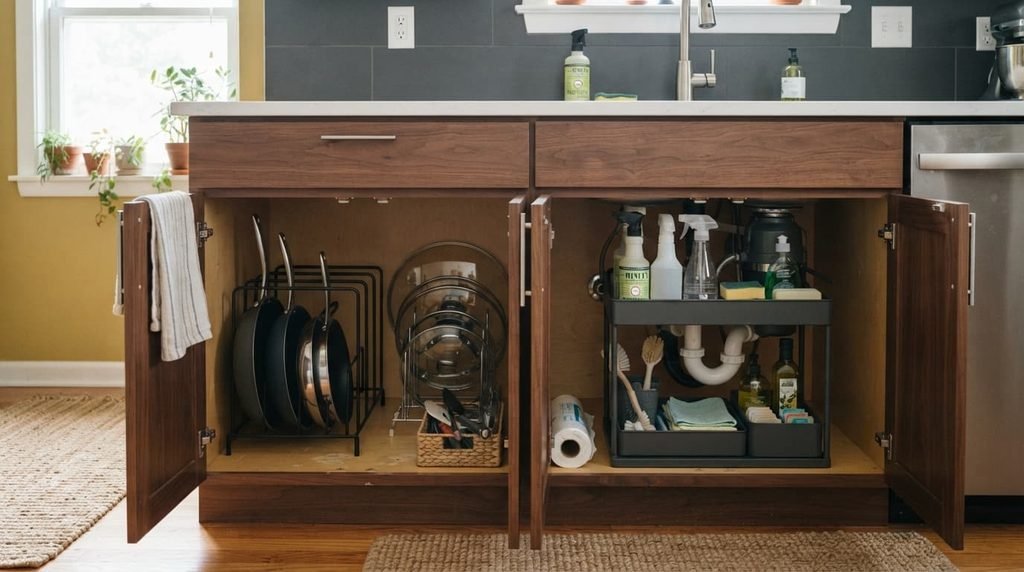
Cookware is another area where the storage method can affect how easily you use the kitchen.
Stacking several frying pans saves horizontal space, but reaching the pan at the bottom means moving everything above it.
A vertical pan organizer lets you store cookware separately so you can remove one pan without disturbing the rest.
Lid racks can solve a similar problem. Instead of balancing lids inside a cabinet or stacking them awkwardly on top of pans, you can give them a dedicated position.
For larger cookware collections, a pull-out organizer can make lower cabinets easier to access.
The important question isn’t simply, “How much can I fit?”
Ask, “Can I get what I need without moving everything else?”
Countertop Storage: Use It Carefully
Countertop organizers can make frequently used items more accessible, but they can also make a kitchen feel more crowded.
A utensil holder may be useful for tools you use every day. A small basket can keep frequently used items together. A dedicated appliance area can make sense for equipment that gets used regularly.
But not everything needs to live on the counter.
Before adding another organizer, ask whether the item could be stored inside a cabinet, underneath an upper cabinet, or on a wall instead.
The goal is to keep your countertop functional not to cover it with storage containers.
Making Better Use of the Space Under the Sink
The cabinet beneath the sink is often awkward because plumbing takes up valuable room.
A two-tier organizer can separate cleaning supplies into different levels. A pull-out bin can make products at the back easier to reach, while a small caddy can keep similar supplies together.
Measure around the plumbing before buying anything. The cabinet may look large from the outside, but pipes can significantly reduce the usable area.
For safety, keep household cleaning products separate from food, dishes, and food-preparation equipment. If young children are in the home, use appropriate child-safety measures for cleaning products as well.
Kitchen Storage Solutions for Small Kitchens
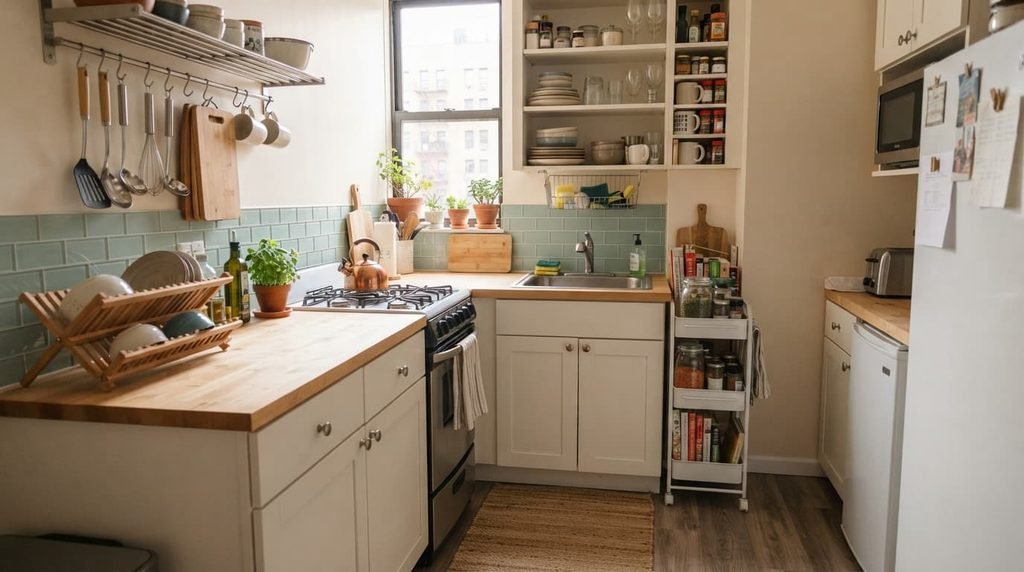
Small kitchens benefit most from products that use existing space more efficiently without taking over the room.
Consider:
- Vertical shelf risers
- Wall-mounted racks
- Over-the-door organizers
- Under-shelf baskets
- Magnetic storage
- Narrow rolling carts
- Compact drawer dividers
A narrow rolling cart, for example, can turn a small gap beside a refrigerator into useful pantry or kitchen-supply storage.
Under-shelf baskets can use the space beneath a cabinet shelf without permanently changing the cabinetry.
Renters may want to prioritize removable or no-drill solutions that improve storage without requiring permanent modifications.
In a small kitchen, a good organizer should ideally do at least one of three things: use vertical space, make an awkward area accessible, or serve more than one storage purpose.
How to Choose the Right Kitchen Organization Products
When you’re unsure what to buy, start with the storage problem rather than the product.
| Storage problem | Product to consider |
|---|---|
| Messy utensil drawer | Adjustable drawer divider |
| Wasted cabinet height | Shelf riser |
| Hard-to-reach cabinet | Pull-out organizer |
| Crowded spice cabinet | Tiered spice rack |
| Stacked frying pans | Vertical pan organizer |
| Loose cookware lids | Lid rack |
| Cluttered under-sink cabinet | Two-tier or pull-out organizer |
| Limited kitchen space | Vertical or wall-mounted storage |
| Deep pantry shelves | Bins or a turntable |
This approach keeps you from buying products simply because they look useful online.
Kitchen Organization Mistakes to Avoid
Buying Before Measuring
A product that doesn’t fit cannot solve the problem. Measure the usable space first and check for hinges, pipes, doors, and other obstructions.
Organizing Before Decluttering
If you have duplicates, expired food, or things you never use, another container won’t fix the underlying problem.
Over-Organizing
Not every object needs a dedicated box or divider. Sometimes the best storage solution is simply having fewer things in the space.
Ignoring Accessibility
A cabinet can look beautifully organized while still being frustrating to use. Everyday items should generally be easier to reach than things you use occasionally.
Buying Too Many Matching Containers
Matching containers can create a neat appearance, but buying a complete set before understanding your needs can waste money and storage space.
Start with the problem areas instead.
Filling the Counter With Organizers
If your solution to kitchen clutter is adding storage containers everywhere, you may end up with less usable workspace.
Look for opportunities to use drawers, cabinets, walls, and vertical space first.
Which Kitchen Organization Products Are Actually Worth Buying?
The most useful products are the ones that remove a recurring frustration.
A drawer divider is worthwhile if your utensils are constantly mixed together. A pull-out cabinet organizer can be valuable if you regularly struggle to reach items at the back. A shelf riser makes sense when you’re wasting vertical cabinet space.
On the other hand, an organizer probably isn’t worth buying if you don’t have a specific problem for it to solve.
A good test is simple:
Does this product make something easier to find, reach, store, or clean?
If the answer is yes, it may be a worthwhile addition. If it only makes the space look more organized for a few days, you may be better off decluttering first.
Frequently Asked Questions
What are the most useful kitchen organization products?
Useful options include drawer dividers, shelf risers, cabinet organizers, pantry bins, cookware organizers, and under-sink storage. The best choice depends on the layout of your kitchen and the specific storage problem you’re trying to solve.
How do I organize a small kitchen?
Use vertical and underused spaces wherever possible. Shelf risers, wall-mounted storage, over-the-door organizers, narrow carts, and under-shelf baskets can add storage without taking much floor or counter space.
What should I measure before buying kitchen organizers?
Measure the usable width, depth, and height of the space. For drawers, measure the inside dimensions. For cabinets, also check shelf spacing, door clearance, hinges, and plumbing where applicable.
Are kitchen drawer organizers worth it?
They can be, especially when utensils and small tools frequently become mixed together. Adjustable dividers are a flexible option if you expect the contents of the drawer to change.
How can I organize kitchen cabinets without remodeling?
Use existing cabinets more efficiently with shelf risers, bins, turntables, drawer organizers, removable racks, and pull-out organizers. These options can improve accessibility without changing the cabinetry itself.
Final Thoughts
Effective kitchen organization isn’t about owning the most storage products. It’s about making the space you already have easier to use.
Start with the areas that cause daily frustration. Declutter before adding storage, measure before purchasing, and choose products based on how you actually cook and store things.
A few well-chosen kitchen organization products can make a noticeable difference but only when each one has a clear job to do.
Related resource: 10 Kitchen Cookbook Storage Ideas for a Stylish Space
Related resource: Kitchen Upgrading Tips Mintpaldecor: 21 Smart Ideas