The right curtains can change much more than the look of a window. They can soften harsh sunlight, improve privacy, reduce glare, make a bedroom darker, and give a room a more finished appearance.
But choosing curtains isn’t as simple as picking a color you like. The best option depends on the room, window size, amount of sunlight, privacy needs, fabric, lining, and even the curtain rod you already have.
If you’re shopping for home focus curtains, use this guide to work through those decisions before you buy. You’ll learn how to choose the right curtain type, measure your windows, compare fabrics, and avoid common mistakes.
1. Start With What You Need the Curtains to Do
Before looking at colors and patterns, identify the main job your curtains need to perform.
Ask yourself:
- Do I want to block sunlight or simply soften it?
- How much privacy do I need?
- Does the room get too hot or cold near the window?
- Do I need the room to become very dark at night?
- Am I mainly looking for decoration?
- Do I need curtains that are easy to clean?
Your answer will narrow your choices considerably.
For example, a large living-room window that gets strong afternoon sunlight may benefit from light-filtering curtains. A bedroom facing a brightly lit street may need blackout curtains instead.
Starting with function prevents a common shopping mistake: buying curtains that look attractive but don’t solve the problem you actually have.
2. Choose Curtains According to the Room
Different mixes of seclusion, elegance, and light control are required for different rooms.
Living Room
Living rooms often benefit from a balance between daylight and privacy. Light-filtering or lined curtains can soften sunlight while keeping the room comfortable and welcoming.
If the window faces a street or neighboring homes, consider layering sheer curtains with heavier panels. You can leave the sheers closed during the day and draw the main curtains when you need more privacy.
If you already have a dedicated article about curtains for living rooms, keep this section brief and link readers there for more detailed styling ideas.
Bedroom
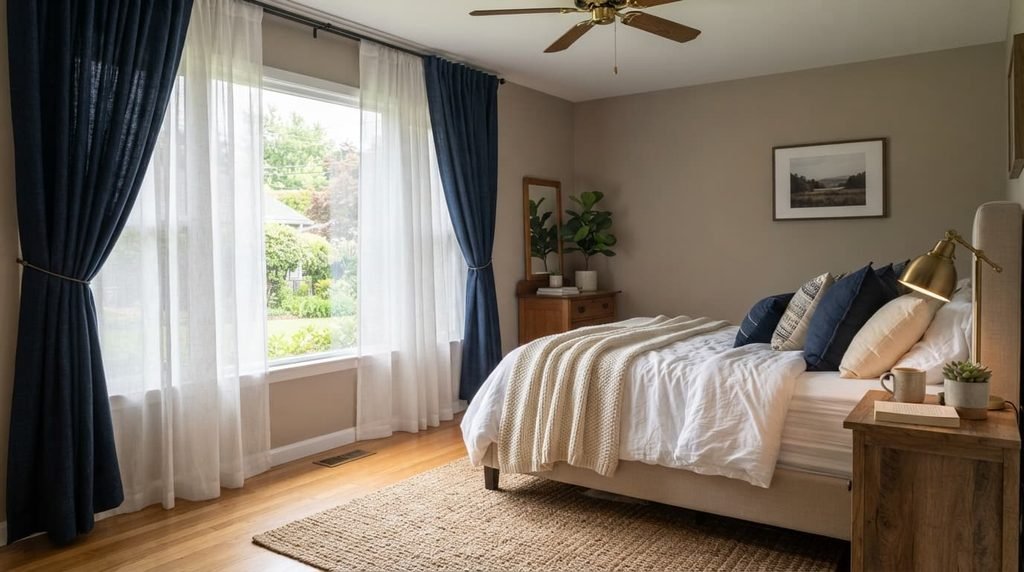
Bedrooms usually need stronger privacy and light control. Blackout or room-darkening curtains can help when early morning sunlight, streetlights, or nearby buildings make the room too bright.
Thermal-lined curtains may also be worth considering if temperature around the window is a concern.
For example, a bedroom with a window facing east can receive strong morning sunlight. A blackout curtain can be useful if you prefer a darker sleeping environment.
Home Office
Home offices need a balance between natural light and screen comfort.
If sunlight creates glare on your monitor, light-filtering curtains can soften it without turning the room into a dark workspace.
For a desk directly beside a bright window, choose a curtain that allows you to adjust light throughout the day rather than relying on a permanently closed blackout panel.
Dining Room
In a dining room, appearance may play a larger role, but light and privacy still matter.
A textured solid curtain can add depth to a simple dining area, while a subtle pattern can work as an accent when the rest of the room is relatively plain.
3. Decide How Much Light and Privacy You Want
Curtain descriptions can become confusing because terms such as sheer, light-filtering, room-darkening, and blackout are sometimes used interchangeably.
They aren’t the same.
| Curtain type | Light control | Privacy | Common use |
|---|---|---|---|
| Sheer | Low | Limited, especially at night | Living rooms, layering |
| Light-filtering | Moderate | Moderate | Living rooms, offices |
| Room-darkening | High | High | Bedrooms, media rooms |
| Blackout | Very high | High | Bedrooms, nurseries |
Sheer Curtains
Sheer curtains allow plenty of daylight through and create a softer appearance around the window.
They’re useful when you want an airy look, but they shouldn’t be treated as a complete privacy solution at night. Once indoor lights are on, silhouettes and activity may become visible from outside.
Light-Filtering Curtains
These reduce brightness while allowing some natural light into the room. They’re a practical choice when you want more coverage than sheers without making the room significantly darker.
Room-Darkening Curtains
Room-darkening curtains are designed to reduce substantially more incoming light. They’re useful for bedrooms, media rooms, and other spaces where controlling brightness matters.
Blackout Curtains
Blackout curtains are designed to block a high amount of incoming light. They’re particularly useful when darkness is a priority.
Remember that the curtain fabric isn’t the only factor. Light can still enter around the edges or above the curtain if the window treatment doesn’t cover those areas.
4. Compare Curtain Fabrics Before You Buy
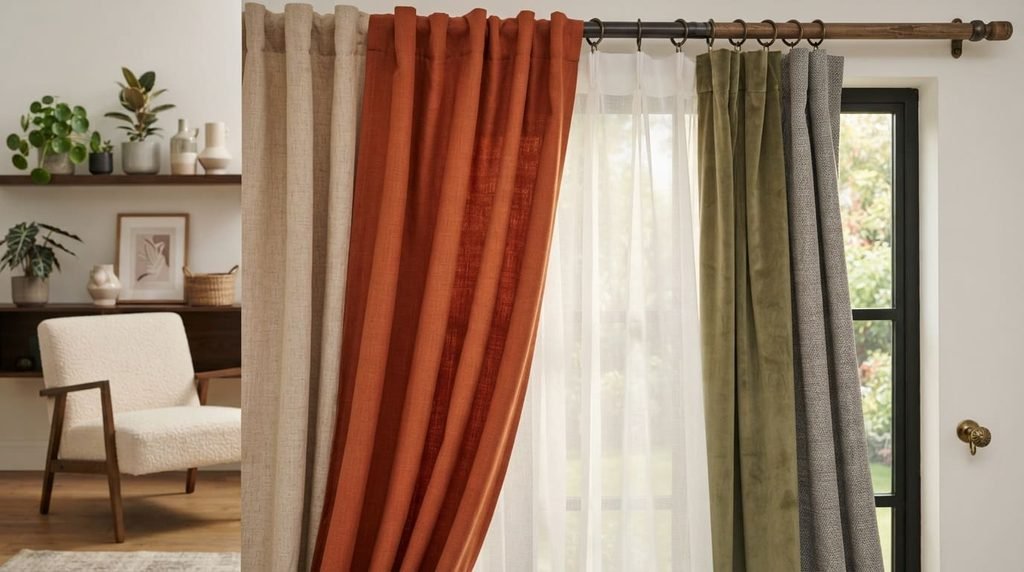
The fabric affects the curtain’s appearance, weight, drape, maintenance, and overall feel.
Cotton
Cotton curtains offer a versatile, comfortable look and are available in many colors and patterns. They’re suitable for a range of casual and traditional interiors.
Linen
Linen and linen-look curtains have a relaxed, natural appearance. They’re a good fit for interiors that favor an airy or understated style.
Their natural texture can be part of the appeal, so don’t expect every linen curtain to have a perfectly crisp appearance.
Velvet
Velvet has a heavier, richer appearance and can add visual depth to bedrooms or formal living spaces.
Because it is visually substantial, however, it may feel too heavy in a small room that already contains dark or bulky furnishings.
Polyester
Polyester curtains are widely available in different weights, colors, patterns, and finishes. They’re often a practical option when easy-care materials are important.
Sheer Fabrics
Sheer fabrics are useful for softening daylight and creating a light, airy appearance. They’re especially versatile when paired with a second curtain layer.
For example, white sheers combined with neutral blackout panels allow you to adjust both privacy and light throughout the day.
5. Know the Difference Between Blackout, Thermal, and Lined Curtains
These terms describe different features, so don’t assume they mean the same thing.
| Type | Primary purpose | Consider it when… |
|---|---|---|
| Standard lined | Appearance and basic coverage | You want a traditional finished look |
| Blackout | Strong light reduction | You need a darker room |
| Thermal | Helps limit heat transfer through the window area | Temperature control is a concern |
| Blackout + thermal | Combines both features | You need strong light control and thermal performance |
Thermal curtains can help reduce heat transfer through the window area, but their actual effect varies with the curtain construction, window, gaps around the treatment, and installation.
If you’re mainly trying to make a bedroom darker, prioritize the curtain’s light-blocking properties. If temperature is also a concern, look for a product specifically described as thermal or insulated.
6. Measure Your Windows Before Buying
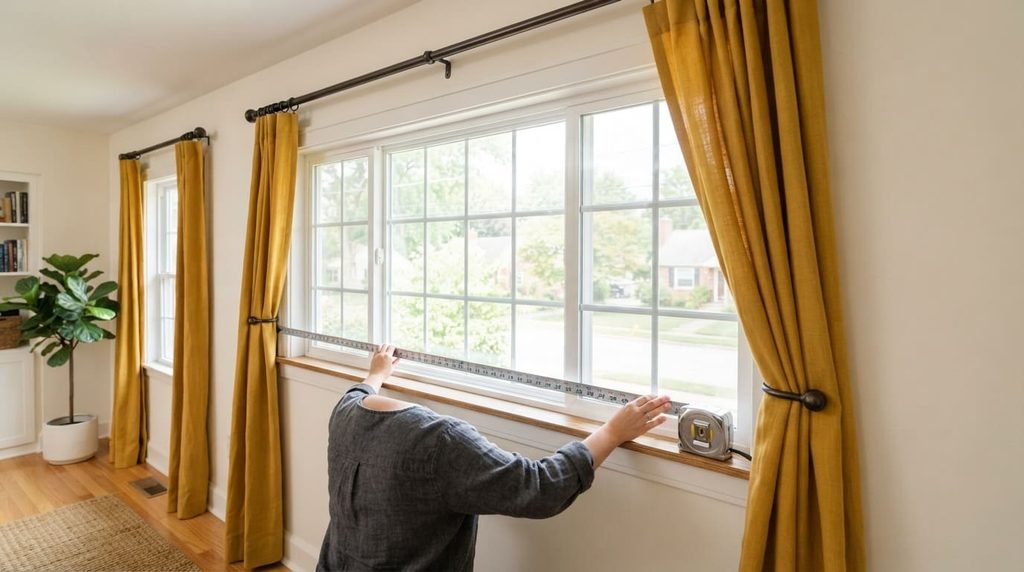
Getting the measurements wrong can turn a good curtain choice into a frustrating purchase.
Measure the Width
Don’t automatically measure only the glass.
If you’re using a curtain rod, consider the rod width and where the curtains will sit when open. Extending the rod beyond the window frame can allow more of the glass to remain uncovered.
You also need enough fabric width to create natural folds.
For example, if the area you need to cover is 60 inches wide and you want approximately 2× fullness, you would need around 120 inches of total curtain fabric.
When buying ready-made panels, check the width of each panel, not just the package description.
Measure the Length
Decide where you want the curtain to end before ordering.
Common options include:
- Sill length
- Below-sill length
- Floor length
- Slightly breaking at the floor
- Extra-long curtains with some pooling
For a clean, practical look, floor-length curtains that finish just above the floor are often easier to maintain than curtains with substantial fabric pooling.
Check Your Hardware
Your existing curtain rod or track also matters.
An eyelet curtain, for example, needs a compatible rod. Pencil-pleat or pinch-pleat curtains may require hooks or another attachment system.
Measure first, then shop.
7. Choose the Right Curtain Header and Hanging Style
The header affects both appearance and installation.
Eyelet or Grommet
Eyelet curtains have large openings reinforced along the top and slide directly onto a compatible curtain rod. They suit many modern interiors and create relatively broad folds.
Pencil Pleat
Pencil-pleat curtains have gathered fabric along the top and can be attached using compatible hooks or hardware.
They’re flexible and work across a range of interior styles.
Pinch Pleat
Pinch pleats create more structured, tailored folds and can suit traditional or formal rooms.
Rod Pocket
Rod-pocket curtains have a fabric sleeve through which the rod passes. They’re simple but may not slide as easily as some other styles.
Tab Top
Tab-top curtains use fabric loops that sit around the rod. They have a relaxed decorative appearance but may not be the best choice when you frequently open and close the curtains.
If you’re replacing curtains but keeping your existing hardware, hardware compatibility should come before appearance.
8. Use Curtain Placement to Improve the Room’s Proportions
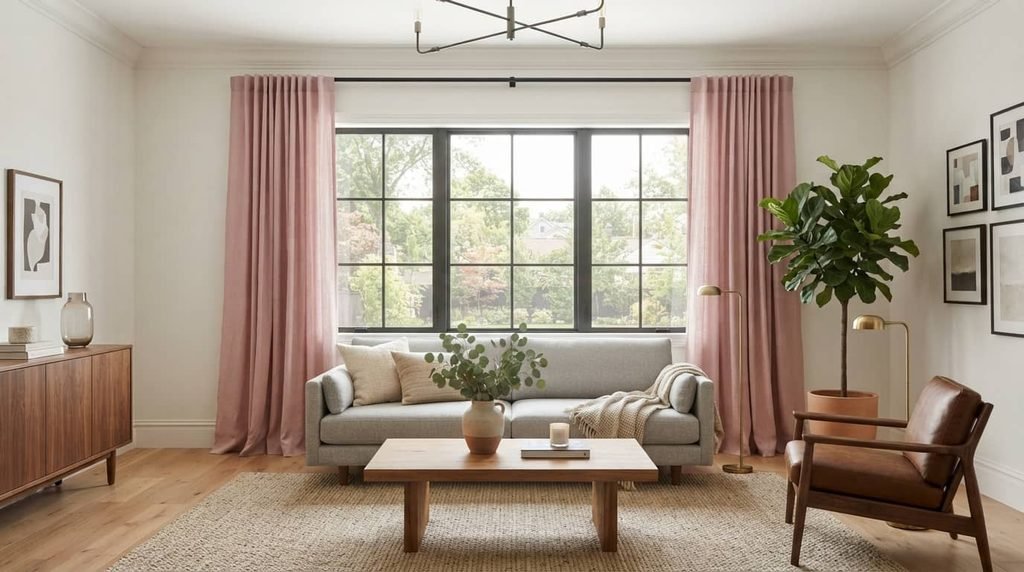
Where you hang curtains can affect how a window and room look.
If the curtain rod is mounted very close to the top of a window, the window may appear shorter. Mounting the rod higher, when the wall and window construction allow it, can draw the eye upward.
Extending the rod beyond the sides of the window can also make the window treatment feel wider and allows the curtains to sit beside the glass when open.
This is especially useful for smaller windows.
For example, if thick curtains cover a significant portion of a small window even when open, extending the rod farther to each side gives the panels somewhere to stack without blocking as much natural light.
Don’t overdo the effect, though. Curtain placement should work with the actual window, wall space, trim, and hardware.
9. Match Curtains to Your Existing Décor
Once you’ve solved the practical requirements, choose the color, pattern, and texture.
Coordinate Colors Rather Than Matching Everything
Your curtains don’t need to be exactly the same color as your sofa or walls.
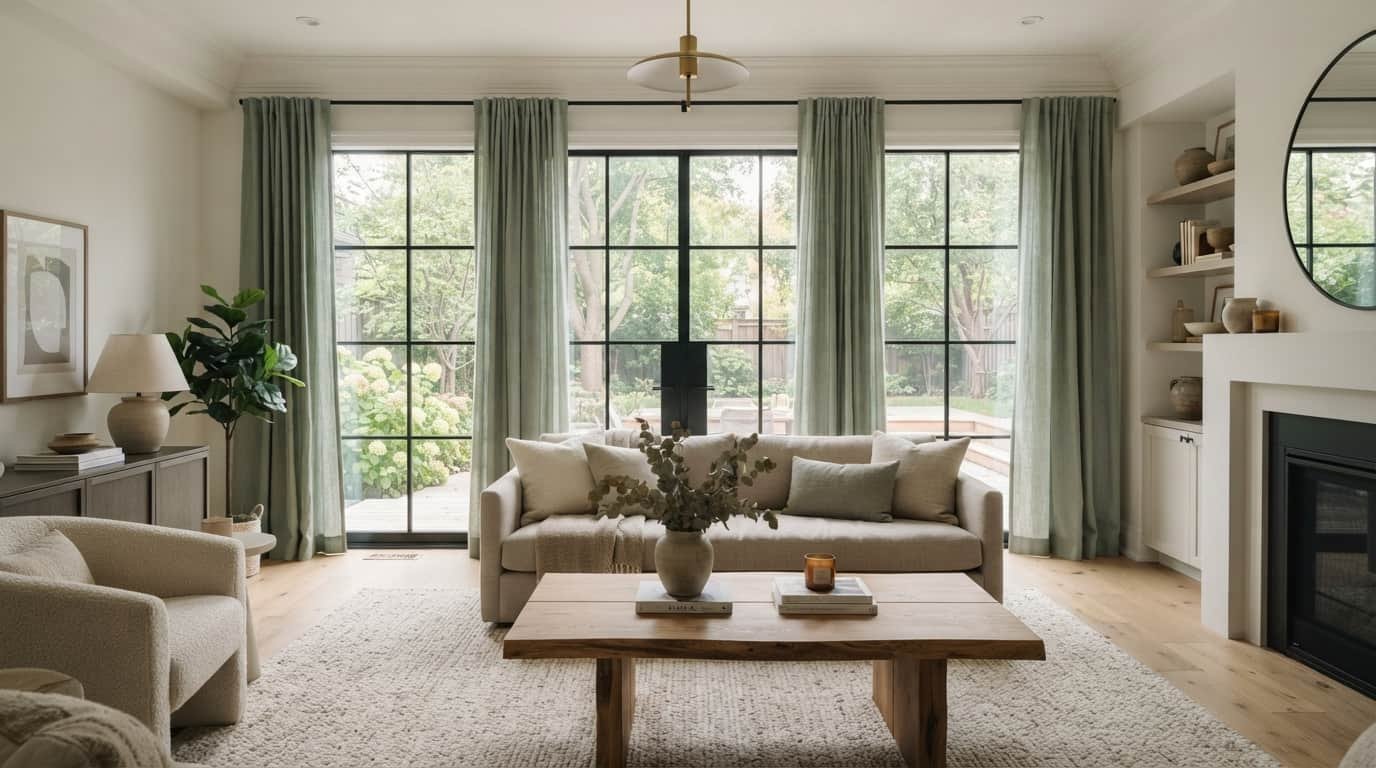
If a room has warm beige walls and a cream sofa, for example, taupe, muted green, warm gray, or another complementary shade can create more visual depth than another identical cream surface.
Use Patterns Strategically
Patterned curtains can become a focal point.
They’re easier to balance when the rest of the room is relatively simple. If you already have a patterned rug, busy upholstery, and decorative wallpaper, a solid curtain may create a calmer result.
Add Texture
Texture can make neutral interiors feel more interesting without introducing another strong color.
Linen-look, woven, velvet, and other textured curtains can add depth while keeping the color palette restrained.
Consider Layering
Layering is one of the most flexible window-treatment options.
A common combination is:
Sheer layer + heavier curtain layer
During the day, the sheers can soften the window while allowing daylight through. At night, the heavier curtains can provide additional privacy and light control.
This setup is particularly useful in living rooms and bedrooms where requirements change throughout the day.
Common Curtain-Buying Mistakes to Avoid
Even attractive curtains can look wrong when the practical details are overlooked.
Measuring Only the Window Glass
The glass doesn’t necessarily represent the full area your curtains need to cover. Consider the rod or track, overlap, and desired fullness.
Buying Curtains That Are Too Short
Curtains that stop awkwardly above the floor can make some rooms look unfinished. Decide on the finished length before ordering.
Forgetting Panel Width
A curtain package may contain one panel or two. Always check the product dimensions and calculate the total width you’ll have when all panels are combined.
Choosing the Wrong Header
Make sure the curtain header works with your existing rod or track.
Choosing Fabric Only for Its Appearance
Consider maintenance, weight, light exposure, and how the material will hang.
Using Blackout Curtains Where You Need Daylight
Blackout curtains are useful when darkness is important, but they aren’t necessary for every room.
Ignoring Nighttime Privacy
A sheer curtain may look private during the day but provide little privacy after sunset when interior lights are on.
Choosing Too Much Fullness or Too Little
Too little fabric can make curtains look flat. Excessive fabric can create unnecessary bulk, especially in a small room.
Matching Every Element in the Room
A coordinated room doesn’t require identical colors everywhere. Slight variations in tone and texture usually create more visual interest.
A Simple Home Focus Curtains Buying Checklist
Before you purchase, check these points:
- Room: Where will the curtains be used?
- Light: How much daylight do you want?
- Privacy: Do you need daytime, nighttime, or both?
- Function: Do you need blackout or thermal properties?
- Width: Have you measured the rod or track?
- Length: Where should the curtains finish?
- Fullness: Is there enough fabric for natural folds?
- Header: Does it work with your hardware?
- Fabric: Is it suitable for the room and maintenance level?
- Style: Does the color, pattern, and texture complement the existing décor?
- Panels: Have you checked whether the package contains one or multiple panels?
If you can answer these questions before shopping, you’ll have a much clearer idea of what you actually need.
Final Thoughts
The best home focus curtains aren’t necessarily the most expensive or dramatic option. They’re the ones that solve the room’s practical needs while fitting its proportions and décor.
Start with function: decide how much light and privacy you need. Then measure carefully, choose the right fabric and lining, check your curtain hardware, and finally select the color and texture.
Whether you’re refreshing a bedroom, improving a home office, or simply giving a living room a more finished look, taking these steps before buying can help you avoid expensive mistakes and choose window treatments that work for your home.
Frequently Asked Questions
What curtains are best for a living room?
Light-filtering, lined, or layered curtains can work well in living rooms. The right choice depends on the room’s sunlight, privacy requirements, and existing décor.
How do I choose the right curtain length?
Measure from the point where the curtain will hang to where you want it to finish. Floor-length curtains are common in living rooms and bedrooms, while sill-length options can work well for certain windows and furniture arrangements.
Are blackout and thermal curtains the same?
No. Blackout curtains focus primarily on reducing incoming light, while thermal curtains are designed to help limit heat transfer through the window area. Some products combine both features.
What curtain fabric is easiest to maintain?
Polyester is often available in easy-care options, but care requirements vary by product. Always check the manufacturer’s cleaning instructions before purchasing.
How much wider should curtains be than the window?
There isn’t one universal measurement because the required width depends on the curtain style and desired fullness. Measure the area the curtains need to cover and check the manufacturer’s recommended fullness.
Should curtains touch the floor?
Not necessarily. Floor-length curtains can create a polished appearance, but the best length depends on the room, window, furniture, cleaning needs, and preferred style.
Can I use sheer curtains for nighttime privacy?
Sheer curtains generally provide limited nighttime privacy when interior lights are on. If privacy after dark is important, consider layering them with a more opaque curtain or another suitable window treatment.
Related resource: 9 Smart Tips for the Best Interior Design in Home