
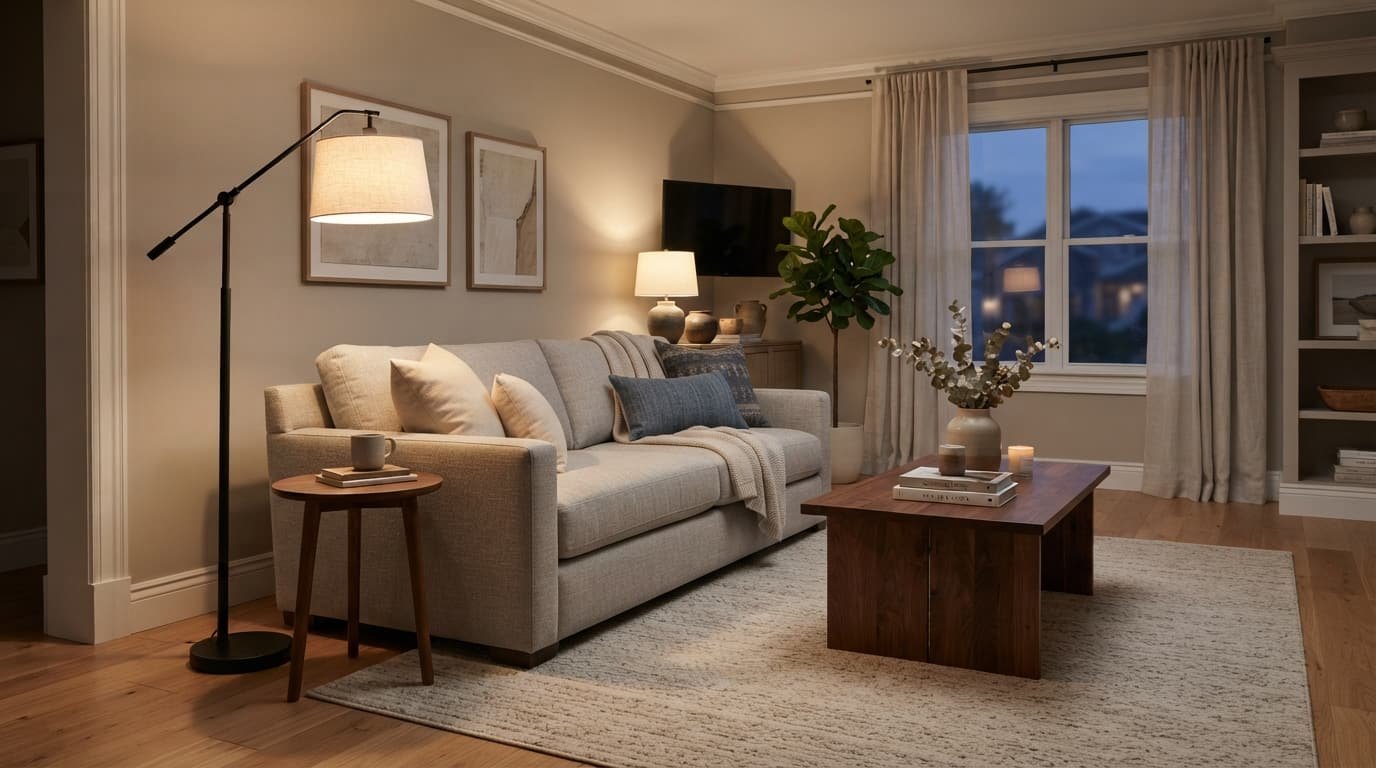
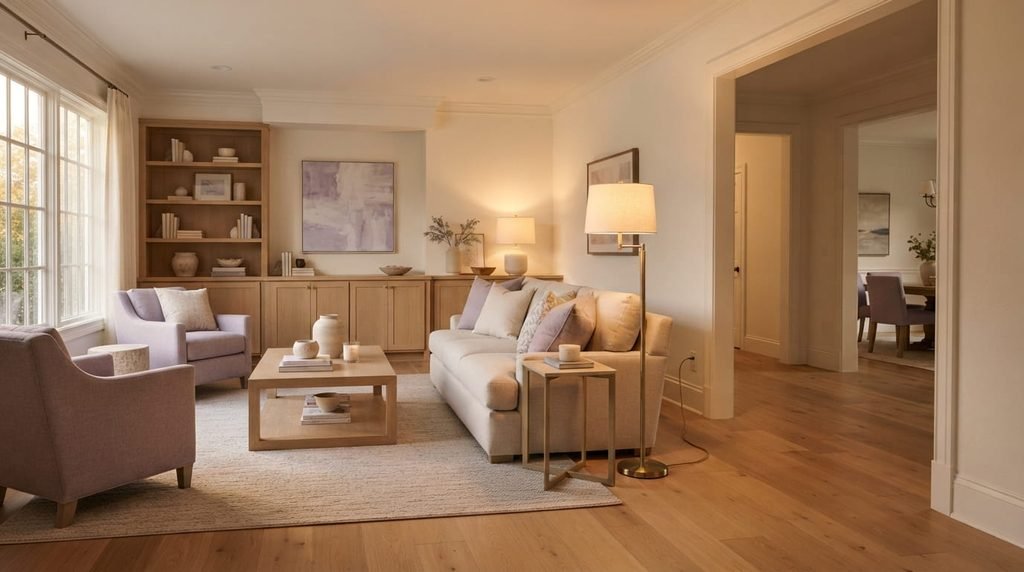
The right floor lamp can do more than fill an empty corner. It can brighten a reading spot, add a softer layer of light beside the sofa, or become a decorative feature that helps pull the room together.
But choosing among floor lamps for living room spaces isn’t only about finding a style you like. The lamp needs to fit your furniture, available floor space, lighting needs, and everyday movement through the room.
These nine ideas show where different floor lamps work best, followed by practical tips for choosing and positioning one without making your living room feel crowded.
1. Try an Arc Floor Lamp Over the Sofa
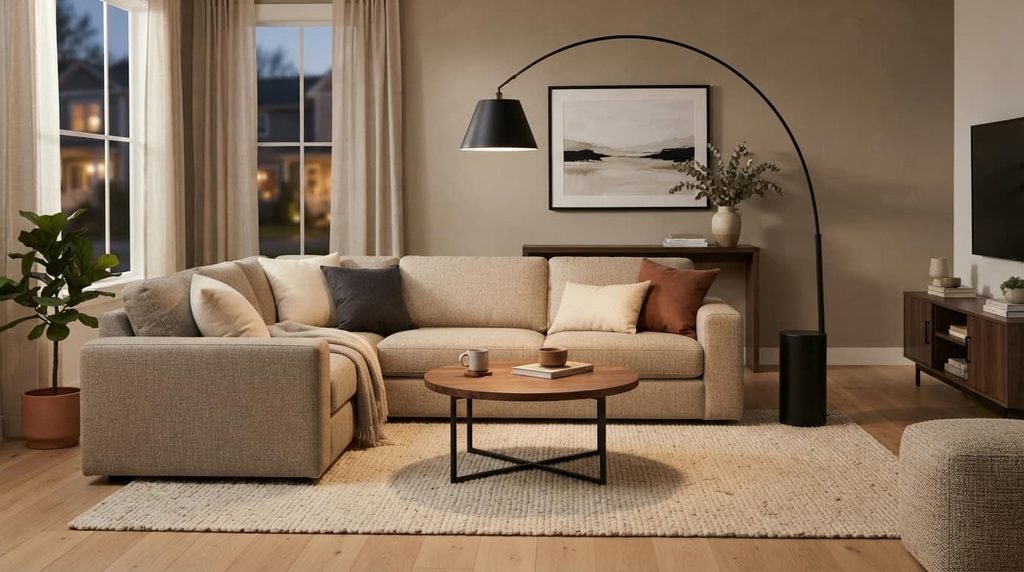
An arc floor lamp is a practical choice when you want light over a sofa without using a table lamp.
The base can sit beside or slightly behind the sofa while the curved arm extends over the seating area. This makes arc floor lamps for living room layouts particularly useful when you want light near the middle of a sofa or over a nearby coffee table.
They work especially well with:
- Sectional sofas
- Large sofas with limited side-table space
- Open seating arrangements
- Reading or conversation areas
Before buying one, check the reach of the arm as well as the footprint of the base. A large arc can overwhelm a compact room, while a smaller design may look undersized beside a substantial sectional.
2. Put a Reading Floor Lamp Beside an Armchair
If you have a favorite reading chair, give it its own light.
A slim floor lamp with an adjustable head or arm can provide focused illumination without requiring a table beside the chair. Position it slightly behind or to the side of the seating so the light falls onto the reading area rather than directly into your eyes.
This setup works particularly well with a small side table and a nearby bookshelf.
When testing the position, sit in the chair and look at the lamp from your normal reading position. A placement that looks perfect from across the room may create uncomfortable glare when you’re actually sitting down.
3. Fill a Dark Living Room Corner
Corners often become noticeably darker after sunset, particularly when the main ceiling fixture doesn’t spread light evenly.
A floor lamp can turn that unused area into a useful part of the room.
For softer ambient light, consider a shade or fixture that spreads light rather than sending a narrow beam directly downward. An uplight can also direct illumination toward the ceiling and surrounding walls.
A corner lamp can work beside:
- A sofa
- A plant
- A bookcase
- An accent chair
- A small console
The goal isn’t simply to put a lamp wherever there is empty floor space. Choose a corner that genuinely needs additional light.
4. Choose a Slim Floor Lamp for a Small Living Room
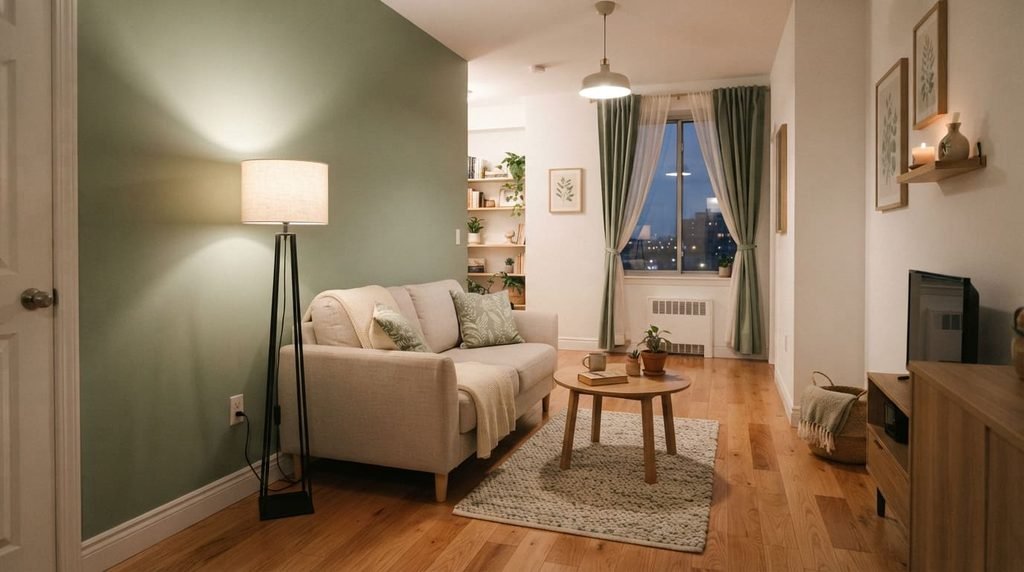
Floor lamps for small living rooms need to provide useful light without becoming another obstacle.
Look for a narrow base and a relatively simple vertical shape that can fit beside existing furniture. A slim lamp can be especially useful when there isn’t enough surface area for a table lamp.
Before buying, check three things:
- Footprint: Will the base fit comfortably beside your furniture?
- Walking space: Will anyone have to walk around it?
- Cord route: Can the cord reach an outlet without crossing a main pathway?
Don’t choose a lamp simply because it is physically small. It should still have enough visual presence to work with the size of your sofa and other furniture.
5. Add Texture With a Tripod Floor Lamp
Tripod lamps can bring more visual interest than a simple straight floor lamp.
Their three-legged base can complement relaxed, contemporary, Scandinavian-inspired, or eclectic living rooms, while fabric or natural-looking shades can add softness to rooms filled with hard surfaces.
A tripod design can sit beside a sofa, reading chair, or media unit.
If your living room already has lots of patterns and decorative objects, a simple tripod lamp may be enough. In a more restrained room, a distinctive base or shade can provide a stronger focal point.
6. Use a Floor Lamp Behind the Sofa
A floor lamp doesn’t always have to sit directly beside the sofa.
If your sofa is positioned away from the wall, the space behind it can provide a useful location for lighting. A lamp tucked behind one end of the sofa can add light without taking up one of the main seating surfaces.
This is also a useful option when the sofa’s side tables are already occupied.
Keep the base close to the furniture rather than placing it where people normally walk. The lamp should feel connected to the seating arrangement, not like a freestanding obstacle.
7. Make a Statement With a Sculptural Lamp
Some living room floor lamps are chosen as much for their shape as for their light.
A sculptural design can become a focal point in a room with relatively simple furniture. Look for an interesting curved form, unusual shade, textured material, or distinctive base.
This approach works best when the lamp has enough space around it to remain visible.
Avoid placing a statement lamp in an already cluttered corner. If the fixture is meant to stand out, let the surrounding area remain relatively simple.
8. Layer Your Floor Lamp With Other Lighting
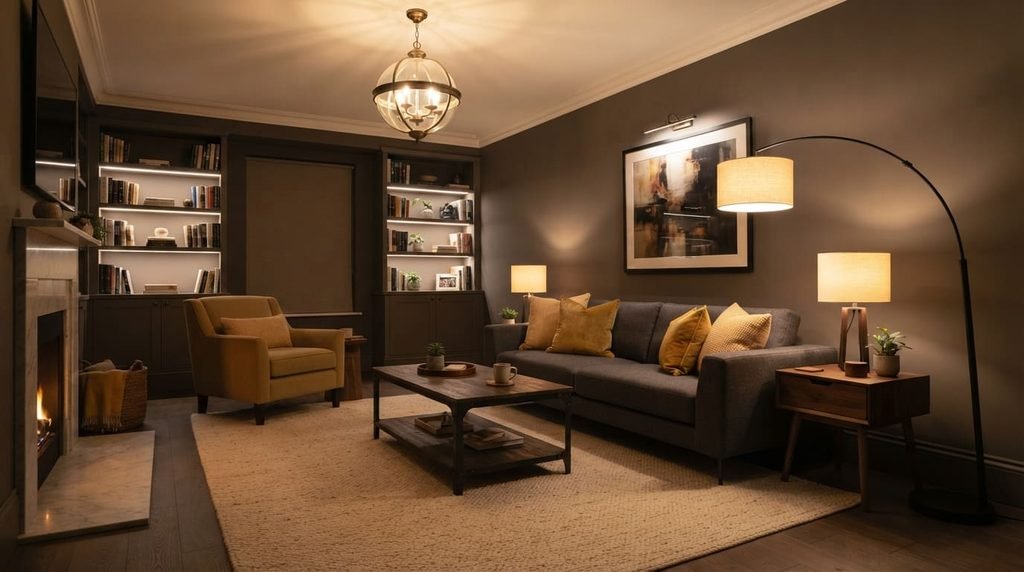
A floor lamp doesn’t have to provide all the light in your living room.
A more flexible setup combines different lighting sources for different purposes. For example:
- Ceiling lighting: General illumination
- Floor lamp: Reading, seating, or ambient light
- Table lamp: Additional light at a lower level
- Accent lighting: Attention on artwork, shelving, or architectural details
This is where a floor lamp becomes particularly useful. You can use different lights according to what you’re doing instead of relying on one bright fixture for the entire room.
HomeFocuse’s broader decorating guidance also recommends thinking about overhead, task, and ambient lighting together rather than treating each fixture as an isolated purchase.
9. Use a Floor Lamp to Balance the Furniture Layout
A floor lamp can also help visually balance a living room.
Imagine a large bookcase on one side of the sofa and an empty area on the other. Adding a tall lamp to the emptier side can introduce another vertical element without requiring another large piece of furniture.
The same idea can work around:
- Fireplaces
- Media units
- Large windows
- Empty wall sections
- Open seating areas
You don’t have to create perfect symmetry. Instead, look at the room from the main seating position and ask whether one side feels noticeably heavier or darker than the other.
How to Choose Floor Lamps for Living Room Spaces
The easiest way to choose a lamp is to decide what you need it to do before deciding what you want it to look like.
Start With the Lighting Job
Ask yourself:
Do I need task lighting, ambient light, or a decorative accent?
For reading, an adjustable or directional lamp may make more sense.
For a dark corner, a lamp that spreads or directs light upward can be more useful.
For decoration, the shape and material may matter more than adjustability.
Starting with the function helps narrow your choices before you begin comparing styles.
Match the Lamp to the Furniture Scale
A substantial sectional can usually accommodate a visually larger lamp than a compact loveseat.
Likewise, a large open living room may need a fixture with enough visual weight to avoid looking lost.
Stand back and consider the lamp together with the sofa, chairs, coffee table, rug, and other large pieces rather than judging the fixture by itself.
Consider the Shade and Light Direction
The shade affects both appearance and how light enters the room.
A diffusing shade can create a softer glow, while a directional fixture can concentrate light where you need it.
For reading, position the light so it reaches the page without shining directly into your eyes. For general atmosphere, a broader spread can be more useful.
Check the Lamp From Sitting Height
This simple step is easy to overlook.
Sit on your sofa or chair and look toward the lamp.
Can you see the bulb directly? Does the shade block enough glare? Does the lamp feel too tall or too short compared with the furniture?
Checking it from the position where you’ll actually use the room gives you a better idea of whether the placement works.
Plan the Outlet and Cord
Don’t leave cord placement until after you buy the lamp.
Trace a possible route from the lamp to the nearest suitable outlet. If the cord would cross a major walking path, the location may not be practical.
This is particularly important in small living rooms where furniture and walkways are already close together.
Floor Lamp Placement in Living Room: Mistakes to Avoid
Blocking a Main Walkway
A stylish lamp isn’t helpful if people have to step around it every time they cross the room.
Keep the base outside normal traffic routes.
Ignoring Glare
A lamp can provide plenty of light and still be uncomfortable.
Check the fixture from the sofa, chair, and other common viewpoints before settling on the final position.
Choosing a Lamp That Is Too Large
A large arc or wide tripod base can make a small room feel crowded.
Measure the available area before purchasing instead of relying only on the product photograph.
Putting Every Lamp in a Corner
Corners are convenient, but they aren’t the only useful locations.
Depending on the room, a floor lamp may work better beside a sofa, behind a chair, or behind one end of a sectional.
Forgetting the Existing Lights
Turn on your current lights before deciding where another lamp is needed.
You may discover that the room isn’t generally too dark—the problem may simply be one poorly lit reading area or corner.
Matching Every Finish
Your lamp doesn’t have to be an exact match for your furniture.
A related material, repeated finish, or complementary shape is often enough to make the fixture feel connected to the rest of the room.
Quick Guide: Which Floor Lamp Fits Your Living Room?
| Living room need | Floor lamp style to consider | Useful placement |
|---|---|---|
| Light over a sofa | Arc lamp | Beside or behind sofa |
| Reading | Adjustable task lamp | Beside armchair |
| Dark corner | Uplight or diffused lamp | Corner |
| Small room | Slim floor lamp | Beside furniture or in corner |
| Decorative feature | Sculptural lamp | Open, visible area |
| Extra texture | Tripod lamp | Beside sofa or chair |
| Layered lighting | Floor lamp + other fixtures | Near seating zone |
The right choice depends on the room’s layout and how you use it, rather than on one universally “best” lamp style.
Frequently Asked Questions
Where should a floor lamp go in a living room?
Common locations include beside a sofa, behind one end of a sectional, next to a reading chair, or in a darker corner. Choose the position according to what you want the lamp to illuminate while keeping the base outside normal walking paths.
Are floor lamps good for small living rooms?
Yes. A slim floor lamp can provide useful light without requiring the surface space of a table lamp. The important factors are the lamp’s footprint, furniture arrangement, and cord path.
Are arc floor lamps good for living rooms?
They can be particularly useful over sofas and seating areas because the base can remain beside or behind the furniture while the curved arm extends the light toward the seating zone.
Can you put a floor lamp behind a sofa?
Yes, provided the placement doesn’t interfere with a walkway or furniture movement. Behind a sofa can be a useful location when the lamp is intended to provide light to the seating area without taking up side-table space.
Should a floor lamp match the living room furniture?
It doesn’t have to match exactly. Consider whether its finish, material, shape, or color relates naturally to existing elements in the room.
Are floor lamps enough to light a living room?
A floor lamp can provide useful ambient or task lighting, but one fixture may not illuminate every part of the room equally. Combining different light sources gives you more flexibility for activities such as reading, relaxing, entertaining, and watching TV.
Conclusion
The best floor lamps for living room spaces are the ones that solve a real lighting or layout problem while fitting naturally into the room.
Start with the purpose: reading, brightening a dark corner, lighting a sofa, adding ambient light, or creating a decorative focal point. Then consider the lamp’s size, light direction, placement, and cord route.
If you’re working with a small room, prioritize a compact footprint. If you have a large sofa or sectional, an arc lamp may give you useful reach without taking up table space. For a reading corner, an adjustable floor lamp can provide more control.
Before buying, mark out the lamp’s footprint and check the view from where you’ll actually sit. That small step can help you choose a fixture that looks good and works well every day.
Related resource: Home Focus Curtains: 9 Smart Tips for Choosing the Right Style
One thought on “Floor Lamps for Living Room: 9 Chic Decor Concepts”