

Drafty windows can make a comfortable room feel cold, increase the workload on your heating system, and leave you wondering whether you need completely new windows.
The good news is that how to seal drafty windows often starts with a much smaller repair. The right solution depends on where the air is entering. Worn weatherstripping, gaps around a stationary frame, loose trim, and poorly sealed window openings each call for a different approach.
The U.S. Department of Energy recommends caulking for cracks around stationary components and weatherstripping for moving parts such as operable windows.
Before buying materials, find the leak. Then choose the simplest suitable fix.
Key Takeaways
- Check exactly where air is entering before applying a sealant.
- Use weatherstripping around moving window parts.
- Use caulk around stationary gaps and joints.
- Window film, insulated curtains, and draft stoppers can provide additional seasonal protection.
- Larger gaps behind trim may require a different air-sealing approach.
- Damaged frames, loose glass, or serious deterioration may require professional repair or replacement.
How to Seal Drafty Windows: Find the Leak First
The most important step is identifying the source of the draft.
Don’t assume that cold glass automatically means outside air is leaking through the window. A cold pane can make nearby room air cool and move downward even when there isn’t an actual air leak.
Instead, inspect the areas where separate window components meet.
Check the Sash and Moving Parts
Run your hand slowly around the edges of a closed window.
Pay particular attention to:
- The meeting point between sashes
- The sides of the sash
- The bottom of the window
- The area around the lock
- Old or damaged weatherstripping
If air enters around a part that moves when the window opens, weatherstripping is usually more appropriate than simply applying caulk.
Weatherstripping is specifically intended to reduce air leakage around components that open, close, and move.
Inspect the Frame, Trim, and Exterior Joints
Look for:
- Cracked caulk
- Visible gaps
- Loose trim
- Deteriorated sealant
- Open joints between the frame and surrounding wall
These are stationary areas, so caulk or another appropriate sealant may be the better solution.
If you’re unsure where the leak is, check the window on a windy day. A noticeable change in airflow around a joint can help identify the problem.
11 Ways to Seal Drafty Windows
Once you’ve found the source, choose a method that fits the location and condition of the window.
1. Replace Worn Weatherstripping
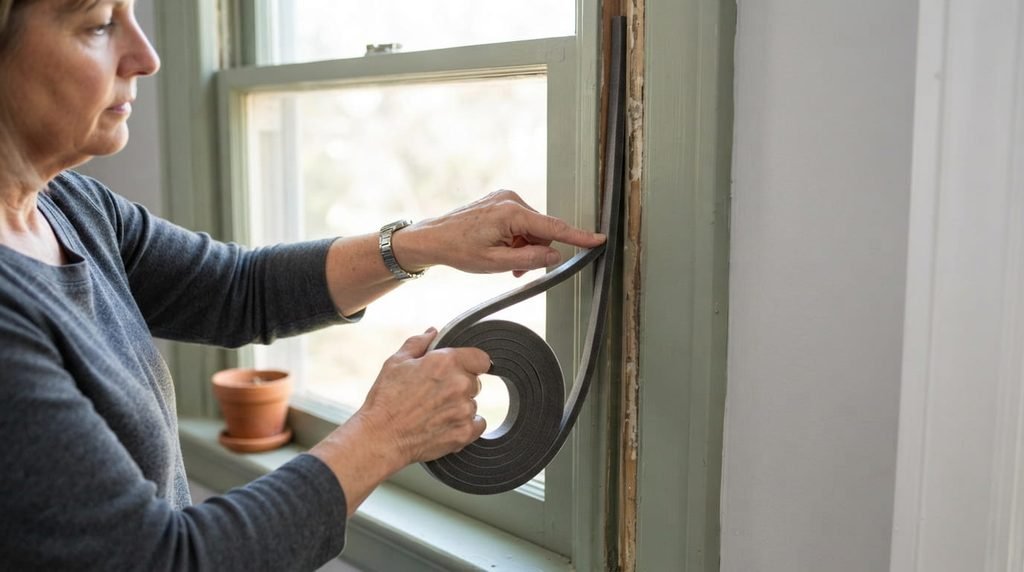
Old weatherstripping can become brittle, cracked, flattened, or detached.
Remove damaged material, clean the surface, measure the area carefully, and install a compatible replacement.
Common types include:
- Foam tape
- V-strip
- Rubber seals
- Tubular seals
- Other window-specific weatherstripping
The exact product should match the window design and the location being sealed.
After installation, confirm that the window can still open and close correctly. If the new weatherstripping is too thick, the sash may not close correctly.
2. Apply Caulk to Fixed Gaps
Caulk is useful for cracks and openings around stationary window components.
The U.S. Department of Energy identifies caulk as an air-sealing method for stationary components, including areas around window frames.
Before caulking:
- Remove loose or failing old sealant.
- Clean dirt and debris from the joint.
- Allow the surface to dry.
- Apply a continuous bead of appropriate caulk.
- Tool the bead neatly if necessary.
- Follow the product’s curing instructions.
Don’t caulk a joint that needs to move.
The goal is to close the air gap without preventing normal window operation.
3. Use Rope Caulk for Seasonal Gaps
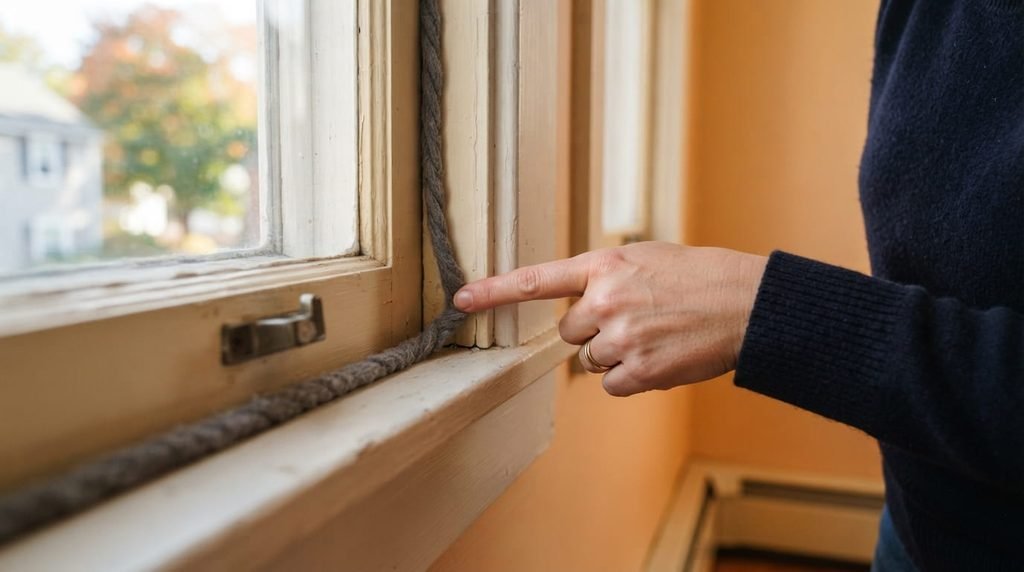
Rope caulk can be useful when you need a removable or seasonal way to close small gaps.
It can be pressed into suitable window gaps and removed later.
This makes it particularly useful for:
- Older windows
- Temporary winter sealing
- Renters
- Windows that need a reversible solution
The U.S. Department of Energy lists rope caulk as one option for leaky windows.
However, don’t use a temporary product as a substitute for repairing a seriously damaged window.
4. Install Window Insulation Film
Window insulation film adds another layer over the interior side of a window.
It’s particularly useful when you want a relatively quick seasonal improvement.
A typical installation involves:
- Clean the window and surrounding surface.
- Apply the supplied tape according to the kit instructions.
- Attach the film.
- Smooth and tighten it according to the manufacturer’s directions.
- Use a hair dryer if the specific product calls for heat shrinking.
Installation requirements vary between products, so follow the instructions included with the kit.
The Department of Energy also recommends clear plastic film as one option for reducing airflow and energy loss around drafty windows.
5. Add Insulated Curtains

Window treatments won’t repair an actual air leak, but they can add another barrier between the room and the cold window surface.
Insulated curtains can be especially useful during colder months.
For better performance, choose curtains that:
- Cover the window adequately
- Fit the surrounding area well
- Close fully when needed
- Don’t interfere with heating equipment
- Are appropriate for the room
Heavy or insulated drapes can also complement other sealing methods rather than replacing them.
If you’re choosing curtains specifically for a living room, HomeFocuse’s existing guide covers fabric, length, width, layering, and light-control considerations.
6. Use a Draft Stopper
If cold air is entering around the bottom of a window, a fabric draft stopper can provide a simple temporary barrier.
Position it directly against the lower area where the air is entering.
This method can be helpful when:
- You need a quick seasonal fix
- You’re renting
- You don’t want permanent modifications
- The window has a small, localized draft
A draft stopper isn’t a replacement for repairing deteriorated seals or damaged frames, but it can be a practical extra layer.
7. Seal Gaps Behind Window Trim
Sometimes the visible window looks reasonably well sealed while air enters through the space between the window framing and the surrounding wall.
This can require access behind the interior trim.
The Department of Energy identifies sealing between window trim and framing as a potential air-sealing project. Depending on the construction and accessibility, appropriate materials can include backer rod, caulk, or low-expansion spray foam.
This is more involved than simply applying caulk around the visible edge.
If removing the trim could damage the wall or you aren’t comfortable working around the window opening, consider getting professional help.
8. Use Low-Expansion Window Foam Where Appropriate
Larger gaps around the window opening may require more than a thin bead of caulk.
Low-expansion foam designed for windows and doors can be used in appropriate gaps between framing and the window assembly.
The important word is low-expansion.
Using an inappropriate expanding foam can create problems if it places excessive pressure on the window frame.
For accessible but substantial gaps, follow the product’s instructions carefully and use only a product intended for the application.
9. Improve the Window Lock and Closure
Sometimes the window itself isn’t sealing tightly because the sash isn’t closing correctly.
Check whether:
- The lock engages properly
- The sash sits squarely
- The window closes completely
- Weatherstripping is preventing proper closure
- Hardware is loose or damaged
A window that doesn’t pull tightly into its closed position may continue leaking air even after you replace some weatherstripping.
Don’t force the lock or hardware. If the window is badly misaligned or difficult to operate, investigate the underlying problem before adding more sealing material.
10. Add Storm Windows
Storm windows can provide another layer of protection over an existing window.
They may be worth considering when you have older windows that are otherwise functional but provide poor thermal performance.
The Department of Energy includes storm windows among measures that can improve the efficiency of existing windows.
Consider this option when:
- The existing window is structurally sound
- You want an additional seasonal layer
- Basic weatherstripping and caulking aren’t enough
- You want to improve the window without immediately replacing it
The right storm-window solution depends on the existing window and the home’s design.
11. Repair or Replace Damaged Window Components
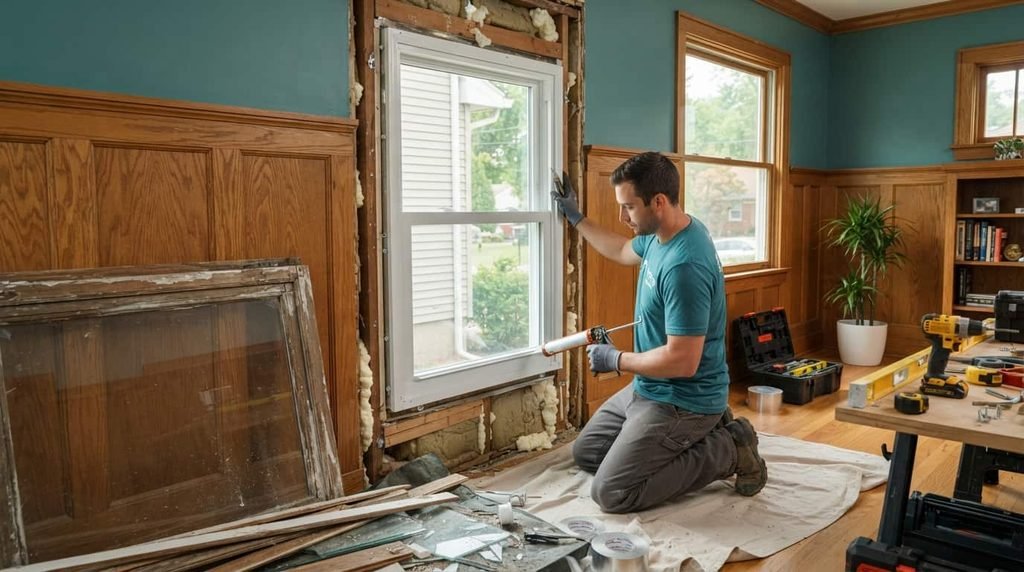
Sealing materials aren’t a cure for every window problem.
You may need professional repair or replacement when you notice:
- Rotten or severely damaged framing
- Broken glass
- Persistent moisture problems
- A window that won’t close correctly
- Major structural deterioration
- Significant damage around the opening
- Failed components that cannot be repaired effectively
In these situations, repeatedly adding caulk or weatherstripping may only hide the underlying issue.
Which Window-Sealing Method Should You Use?
Use the location of the leak as your starting point.
| Problem | Potential solution |
|---|---|
| Gap around a moving sash | Weatherstripping |
| Cracked stationary joint | Appropriate caulk |
| Small seasonal gap | Rope caulk |
| Cold window surface | Insulated curtains or window film |
| Draft at the bottom | Draft stopper + appropriate sealing |
| Gap behind removable trim | Backer rod, caulk, or suitable low-expansion foam |
| Poorly closing sash | Inspect lock, alignment, and hardware |
| Older but functional window | Storm window or additional insulation |
| Rotten or badly damaged frame | Professional repair or replacement |
This approach is more useful than choosing a single “best” product because different leaks require different repairs.
Common Mistakes to Avoid
Caulking a Moving Joint
Caulk isn’t intended to stop a window from moving.
If the draft comes through an operable joint, look at weatherstripping instead.
Sealing Before Finding the Leak
Applying products everywhere can waste time and make future repairs harder.
Find the source first.
Using Too Much Spray Foam
Foam products designed for other applications may expand aggressively.
Use a product specifically appropriate for windows and doors and follow the manufacturer’s directions.
Blocking Window Operation
Don’t seal a window so thoroughly that it can no longer open when it needs to.
This is especially important for rooms where windows are part of normal ventilation or emergency egress.
Ignoring Ventilation
Air sealing can improve comfort, but a home still needs appropriate ventilation.
The Department of Energy warns that ventilation is important when tightening a home because excessive moisture and indoor pollutants can become concerns in poorly ventilated spaces.
Assuming Every Cold Window Is Leaking
A cold pane doesn’t automatically mean outdoor air is entering.
Check for actual airflow around the frame, sash, trim, and other joints before deciding what repair is necessary.
When Should You Replace a Drafty Window?
Not every drafty window needs replacement.
If the window is structurally sound, operates correctly, and the problem is caused by worn seals or small gaps, a targeted repair may be enough.
Replacement becomes more relevant when the window has serious deterioration or repeatedly fails despite reasonable repairs.
Before making a major purchase, consider:
- The condition of the frame
- The condition of the glass
- How well the window operates
- The severity of the air leakage
- Repair costs
- Long-term plans for the property
- Whether other parts of the home also have significant air leaks
The Department of Energy recommends considering the home as a whole when assessing air leakage rather than assuming the windows are always the largest source of energy loss.
Frequently Asked Questions
What is the easiest way to seal drafty windows?
For a moving window joint, replacing worn weatherstripping is often a straightforward approach. For a fixed crack around the frame, appropriate caulk may be more suitable. The easiest solution depends on where the air is entering.
Should I use caulk or weatherstripping on windows?
Use caulk for stationary gaps and weatherstripping for moving window components. This distinction is also reflected in U.S. Department of Energy guidance.
How can I stop cold air from coming through my windows?
First identify the leak. Depending on its location, you may need weatherstripping, caulk, rope caulk, window film, insulated curtains, or another appropriate sealing method.
Can window film help with drafty windows?
Yes. Clear plastic window film can reduce airflow and provide an additional insulating layer during colder periods. Follow the installation instructions for the particular product.
Can I seal drafty windows if I rent?
Yes, temporary options such as removable rope caulk, window film, and draft stoppers can be useful. Always check your lease before making permanent modifications.
Should I caulk around the inside or outside of a window?
The appropriate location depends on where the gap exists and how the window assembly is constructed. Inspect both interior and exterior joints where accessible, and use a sealant suitable for the specific location and exposure.
How do I know if my window needs replacement?
Look for significant frame damage, broken glass, persistent moisture problems, serious misalignment, or problems that remain after reasonable repairs. A qualified window professional can assess more complicated failures.
Can sealing windows lower energy use?
Reducing uncontrolled air leakage can improve comfort and reduce heating and cooling demand. The Department of Energy identifies air sealing as a way to improve comfort and reduce energy costs.
Conclusion
Learning how to seal drafty windows doesn’t have to begin with replacing every window in your home.
Start by finding the actual air leak. Use weatherstripping around moving components, caulk around appropriate stationary gaps, and consider seasonal options such as window film, rope caulk, or insulated curtains when they fit your situation.
For larger gaps or hidden problems behind the trim, a more involved repair may be necessary. And if the window frame is severely damaged or the window no longer functions correctly, sealing products may not solve the underlying problem.
The most useful approach is simple: find the leak, choose the right material, preserve normal window operation, and address serious damage rather than covering it up.
Related resources: How to Remove Window Blinds Without Damaging Them · How to Close Blinds: Every Type, Plus Fixes for Stuck Ones
Related resource: How to Soundproof Interior Door: 5 Proven Best Hacks



One thought on “How to Seal Drafty Windows: 11 Simple Proven Fixes”